
Reviewed · MUSEUMS
Pompeii: Virtual Museum ticket
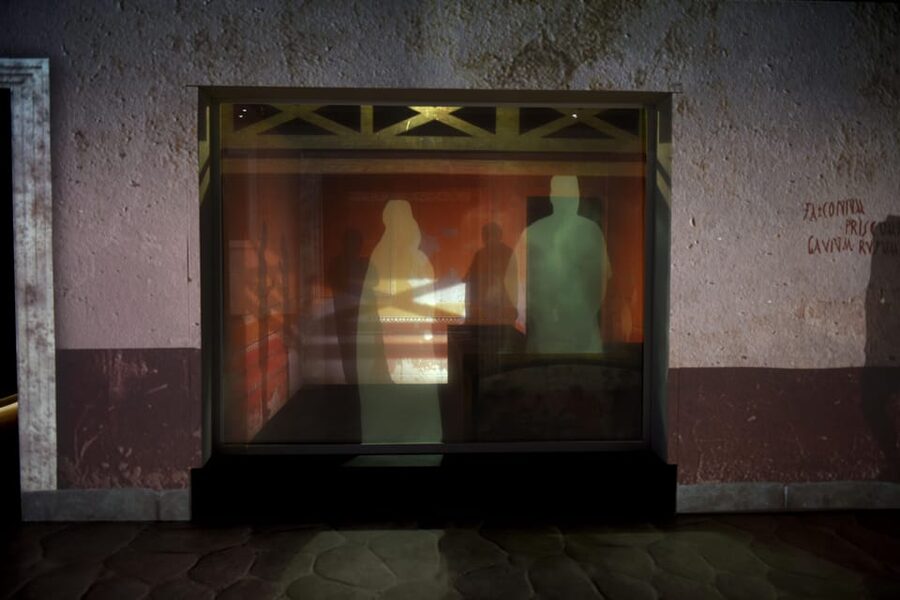
Pompeii’s greatest challenge is easy to understand: the ruins are powerful, but they can be hard to picture as a living city. This 30-minute virtual presentation fills in the missing pieces, showing Pompeii before Vesuvius buried it in 79 AD. You see houses, public buildings, meals, street life, and the final eruption in animated 3D scenes and physical models.
I like the way the museum prepares you for the archaeological site, especially the reconstructions of the Forum, baths, and amphitheater. I also like the human focus, with scenes of banquets, daily routines, and the Lupanar rather than only dates and stonework. The main caution is value: at $14 per person, the museum may feel expensive if you want only the real ruins, particularly if you do not add the archaeological entry ticket.
In This Review
- Key points to know before you go
- Why Pompeii is easier to understand in 3D
- From ordinary life to the disaster of 79 AD
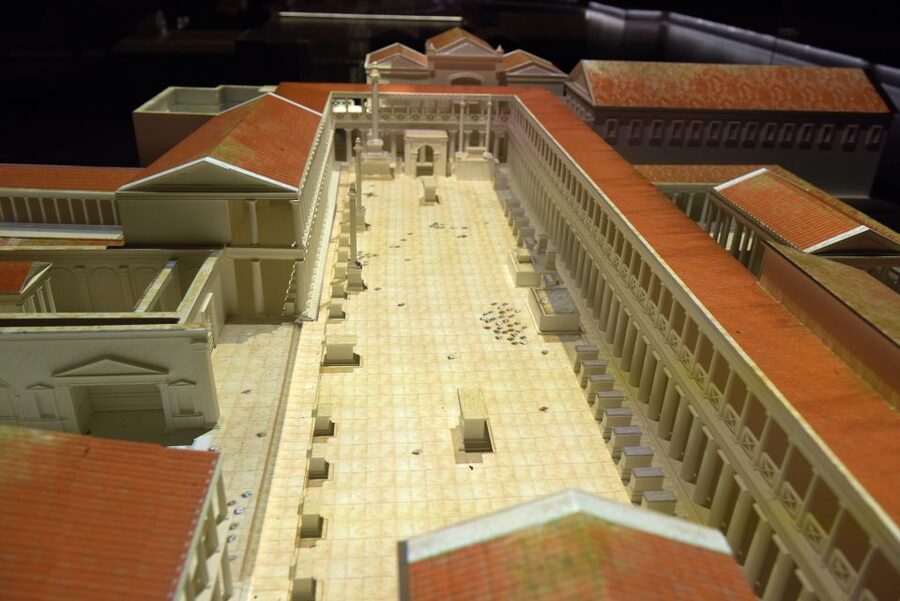
- The Forum, baths, and amphitheater from above
- A useful first stop before the archaeological area
- What the optional Pompeii entry adds
- Meeting point and what to leave behind
- Who will get the most from this experience
- Is $14 a fair price?
- Practical booking advice for a smoother visit
- Should you book the Pompeii Virtual Museum?
- FAQ
- How long does the Pompeii Virtual Museum experience last?
- Is entry to Pompeii’s archaeological area included?
- Does the ticket include Villa dei Misteri?
- Is a guided tour or audio guide included?
- Where do I meet for the experience?
- Can I bring food, drinks, luggage, or pets?
- Can I cancel the booking?
Key points to know before you go
- See Pompeii as a living city: Reconstructed streets, houses, public buildings, meals, and social scenes help you picture the city before the eruption.
- The eruption provides the dramatic finish: The presentation shows how Vesuvius erased Pompeii and preserved its memory.
- A French-speaking welcome may be available: A mediator guided one French-language visit and explained the reconstructed sites before the archaeological walk.
- Add the ruins if you want the full experience: The archaeological-area ticket is optional and included only when selected during booking.
- Plan for a short museum visit or a longer combined outing: The stated duration ranges from 30 minutes to four hours, depending on your selected option and time at the site.
- Expect a simple, focused visit: There is a city map, Touristation assistance, and free Wi-Fi, but no food, drinks, audio guide, or transportation.
Why Pompeii is easier to understand in 3D
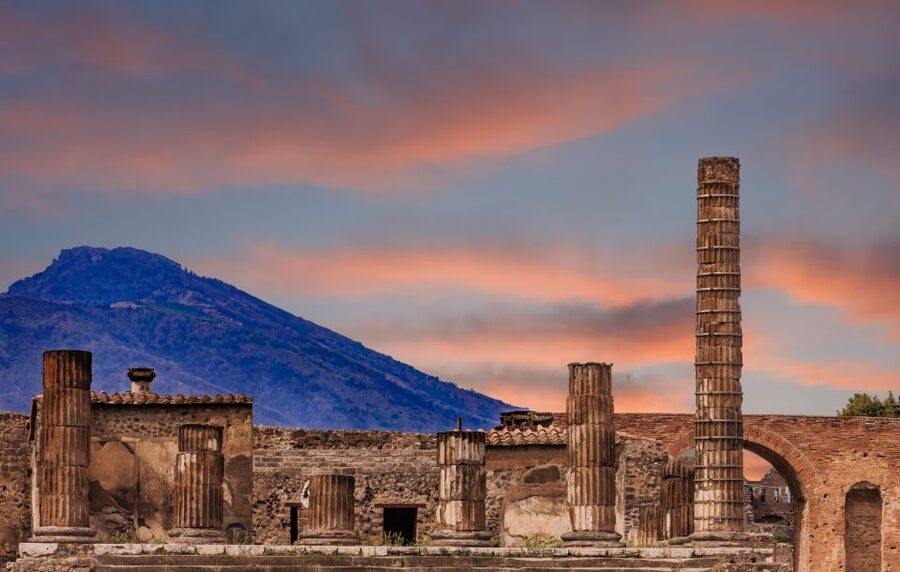
When you first see Pompeii’s ruins, you are looking at fragments of a city that once had color, movement, noise, and people going about ordinary business. Walls remain, but roofs are gone. Rooms are open to the sky. Public buildings can seem like bare outlines unless you already know what they looked like.
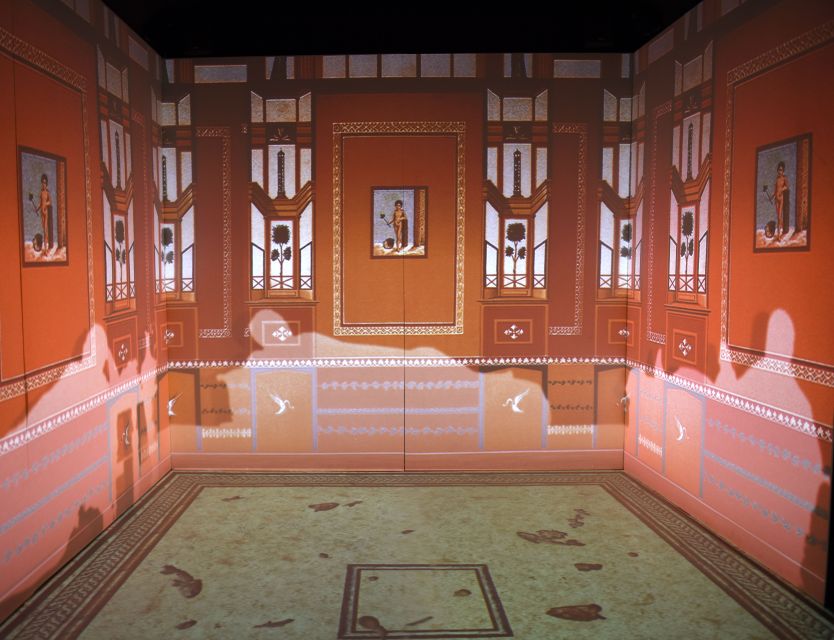
The Virtual Museum tackles that problem directly. Instead of asking you to imagine every missing detail, it reconstructs parts of ancient Pompeii through animation, 3D scenes, and models. You can watch the city take shape before seeing the surviving remains.
I find this especially useful for first-time visitors. The presentation gives you a mental map of the city and its important buildings. When you later enter the archaeological area, a Forum or bath complex is no longer just a pile of old masonry. You have already seen the building in use.
The experience is not a guided walk through the ruins, and it should not replace one if your main goal is archaeology. It is a visual introduction. Think of it as a short historical film with reconstructed spaces, followed by the option to walk through the actual city.
More Pompeii excavation visits:
- Pompeii: Entry Ticket and Guided Tour with an Archaeologist
★ 4.8 · 19,459 reviews - Pompeii: Small Group Tour with an Archaeologist
★ 4.8 · 12,264 reviews - Pompeii: Skip-the-Line Entrance Ticket with Audio Guide
★ 4.0 · 2,509 reviews
From ordinary life to the disaster of 79 AD
The presentation begins with Pompeii before the eruption. That choice matters. The city is shown as a place where people lived, loved, fought, ate, worked, and gathered, not simply as a site waiting to be destroyed.
You can expect scenes of domestic life and public activity, including a Roman banquet and the Lupanar. These details give the experience an earthy, human tone. Pompeii was not only temples and government buildings. It was also food, desire, arguments, celebrations, and routine.
The Lupanar scene may not suit every child or every family. The material is presented as part of Pompeii’s social life, but parents should decide if that subject fits their group. The supplied information does not promise a family-specific presentation, so I would not assume the content is tailored for young children.
The reconstruction then moves toward the eruption. The final section presents Vesuvius’s fire-and-brimstone destruction and the sudden end of the city. This contrast is the museum’s strongest storytelling tool: first you see a functioning Roman city, then you watch its world disappear.
That sequence also helps explain why Pompeii remains so compelling. The eruption ended the city, but it also preserved an extraordinary record of daily life. The museum makes that connection clear without requiring you to begin with a long museum lecture.
The Forum, baths, and amphitheater from above
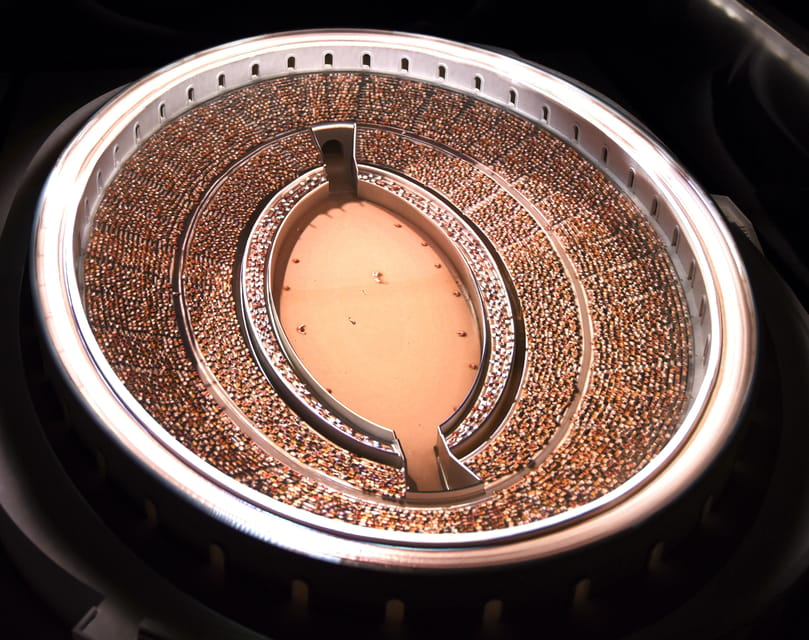
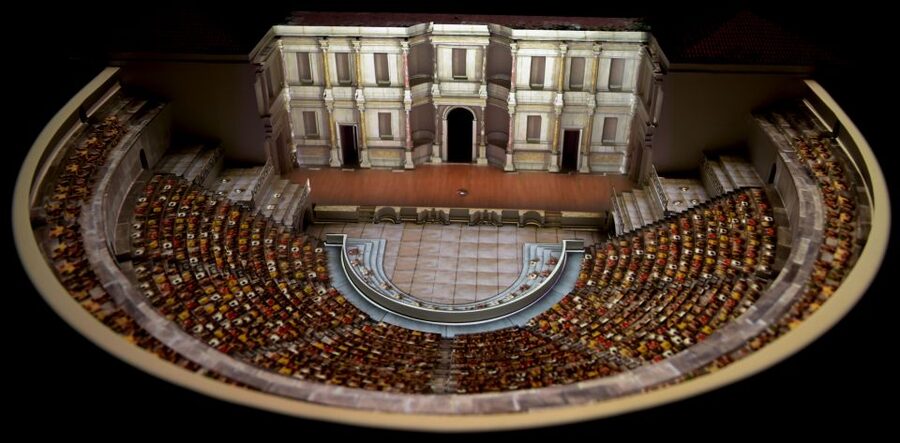
Some of the best scenes focus on Pompeii’s major public buildings. Animated reconstructions show the Forum, baths, and amphitheater as complete structures, including views from above.
An overhead view is useful because the archaeological area can be confusing at ground level. Streets turn, walls stop, and modern signs cannot always explain how separate buildings fitted together. Seeing the city from above helps you understand its layout before you walk it.
The Forum is particularly important because it was one of Pompeii’s central public spaces. The presentation lets you see it as an organized civic area rather than a collection of columns and pavement. You can then compare the virtual reconstruction with what remains outdoors.
The baths benefit from the same treatment. Their purpose and layout are easier to grasp when you see a complete building with rooms connected to one another. The amphitheater also gains scale in 3D. From the ground, you may notice seating and walls. From above, you can better understand the shape and size of the whole structure.
The museum does not promise a detailed audio guide or a formal guided tour. Its strength is visual explanation. If you learn best by seeing buildings reconstructed, you will get more from this than from a bare map or a list of dates.
A useful first stop before the archaeological area
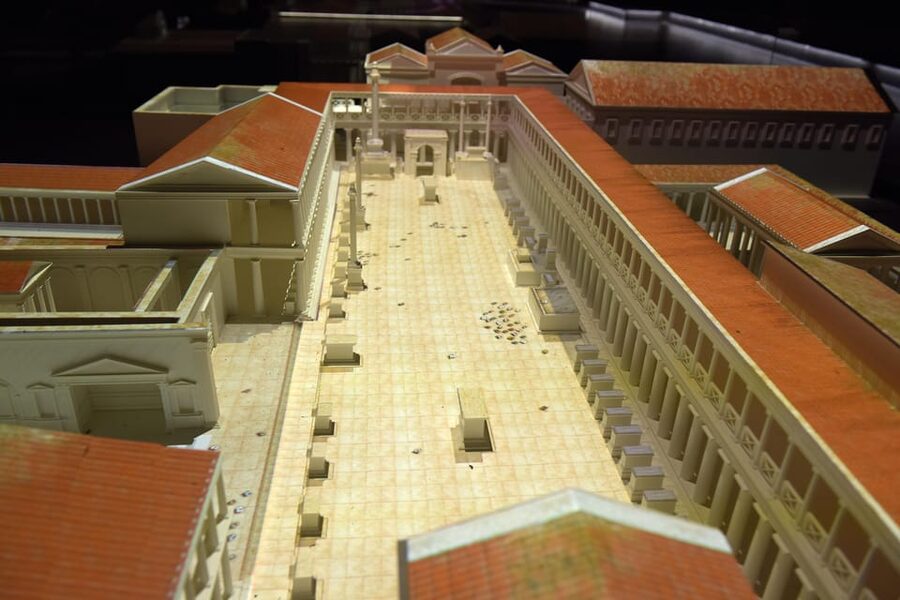
I would place the Virtual Museum before your walk through Pompeii whenever possible. One French-language visit was guided by a mediator who explained each reconstructed location and offered anecdotes about daily life and the city’s destruction. That kind of introduction can make the outdoor visit more rewarding.
No guide’s name is provided, so you should not book this expecting a particular individual. The available language and format may depend on the session. The experience does not include a standard audio guide, and a guided tour is listed separately as not included.
The museum can also help you choose what to pay attention to outside. You may recognize the Forum, baths, amphitheater, houses, and other major spaces from the virtual scenes. Instead of wandering without a plan, you can look for the details that connect the reconstructed city with the damaged one.
There is a practical limit here. A virtual model can show the full appearance of a building, but it cannot reproduce the sensation of walking on ancient streets or seeing surviving walls in person. The museum works best as preparation, not as a substitute.
More museums and galleries in Pompei Campania:
- Pompeii & Virtual Museum Private 2-in-1 Kid’s Tour
★ 4.9 · 9 reviews - Pompeii Pass: Skip-the-Line, Guided Tour & Museum Access
★ 4.8 · 5 reviews - Amalfi: Vertical Lemon Farm Tour, Tastings, and Rural Museum
★ 4.8 · 196 reviews - Private Guided Multimedia Exhibition on the History of Sorrento
★ 4.5 · 90 reviews
What the optional Pompeii entry adds
The archaeological-area ticket is not automatically included. You must select the option that includes it if you want to continue into the ruins. When selected, the ticket is described as a skip-the-line entry for Pompeii’s archaeological area.
That add-on changes the value calculation. At $14, the Virtual Museum alone is a short, specialized attraction. If you are already planning to visit Pompeii, adding the archaeological entry makes the combined outing more useful because the presentation and the ruins support one another.
The stated duration ranges from 30 minutes to four hours. The short end fits the museum by itself. The longer end allows time for the virtual presentation and a visit to the archaeological area, though the precise schedule depends on the option and available starting time.
Do not assume the entry includes Villa dei Misteri. It is specifically listed as not included. You also do not get transportation, food, drinks, or an audio guide, so plan those parts of the day separately.
For a serious Pompeii visit, I would select the archaeological-area option and allow several hours if your schedule permits. For a quick stop or a rainy-day introduction, the museum alone may be enough, but its $14 price deserves careful thought.
Meeting point and what to leave behind
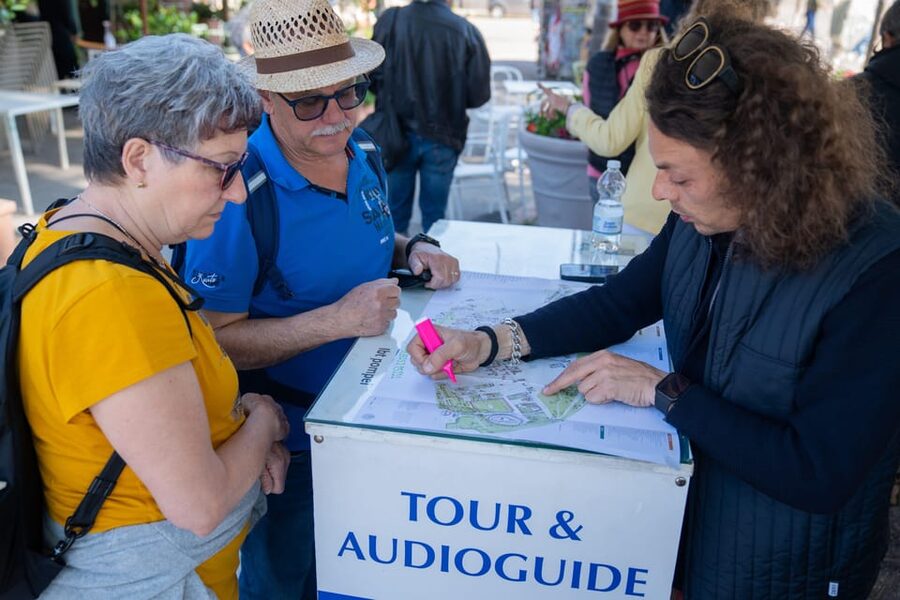
You check in at the IBT Center, also called Touristation, next to Chalet Donna Lucia. Assistance is available at the Touristation office, and a paper city map is included.
The entry rules are strict in familiar archaeological-site fashion. Pets are not allowed inside the virtual museum, and food and drinks are prohibited. Large bags and luggage are also not allowed, so do not arrive with your full suitcase or a bulky day bag.
Photography inside is prohibited. That is worth knowing before you arrive, especially if you are used to recording every stage of a museum visit. You can focus on the presentation itself, then take photographs in permitted areas outside according to the archaeological site’s rules.
Small dogs are permitted in the archaeological area if kept on a leash, and they must be carried inside buildings. That exception applies to the ruins, not the Virtual Museum, where pets are not allowed.
The visit offers free Wi-Fi, but that is a convenience rather than a main reason to book. The paper map and office assistance are more useful for getting oriented before the archaeological walk.
Who will get the most from this experience
I would recommend the Virtual Museum to you if Pompeii feels difficult to picture from ruins alone. It is also a good choice if you are visiting with someone who prefers visual storytelling, or if you want a quick introduction before spending more time outdoors.
Families may appreciate the animated scenes, but I would consider the Lupanar content before bringing young children. The experience includes adult aspects of Roman life, and no age guidance is provided in the information here.
History enthusiasts may find the museum too brief if they want a detailed scholarly presentation. There is no included audio guide and no standard guided tour. The attraction is strongest as a clear visual overview, not as an exhaustive lesson.
Language is another consideration. One visit was conducted in French with a mediator, which shows that French-language assistance can be available. However, no full language schedule is supplied, so check the available session before booking if language support is important to you.
The experience is less suitable if you only want the archaeological site. In that case, paying for a separate virtual presentation may not feel worthwhile. You should also skip it if you dislike reconstructions and prefer to form your own picture from the surviving remains.
Is $14 a fair price?
The answer depends on how you use it. For a 30-minute presentation alone, $14 is not a bargain for everyone. One person found the experience curious but not worth the price, and that is a fair warning for budget-minded visitors.
I see better value when you pair the museum with the archaeological-area entry. The virtual scenes give context, while the ruins provide the physical scale and atmosphere that no animation can match. You are paying for a clearer understanding of Pompeii, not just another ticket.
The price also makes more sense if you can use the museum to organize your outdoor visit. Seeing the Forum, baths, and amphitheater reconstructed beforehand may help you spend your time more wisely in the ruins.
Still, do not buy it automatically. If you have already watched a detailed Pompeii presentation, hired a guide, or feel comfortable interpreting ruins on your own, the museum may add little. If this is your first visit and you want the city to make sense quickly, it has a stronger case.
Practical booking advice for a smoother visit
You can cancel up to 24 hours before the activity for a full refund, and the reserve-now, pay-later option keeps payment off your immediate to-do list. Starting times vary, so check availability rather than assuming the museum runs continuously.
Choose the archaeological-area add-on at the time of booking if you want to enter the ruins. The ticket is included only when that option is selected, and Villa dei Misteri remains outside the package.
Free admission is available for visitors with a certified disability. If accessibility is important to your group, confirm the exact arrangements with the provider before arrival, since the supplied details do not describe routes or facilities.
Should you book the Pompeii Virtual Museum?
Book it if you want to understand Pompeii as a real city before you walk through its remains. The 3D reconstructions, overhead views, banquet scenes, public buildings, and final eruption create a useful bridge between modern visitors and an ancient place that can otherwise feel fragmented.
I would especially choose it before an archaeological visit, ideally with the entry add-on. I would skip it if you have limited time, want only the ruins, or are unlikely to value a short visual reconstruction enough to justify $14.
The best plan is simple: check in at Touristation, see the virtual Pompeii first, then walk into the archaeological area while the images are fresh. That order gives the experience its purpose.
FAQ
How long does the Pompeii Virtual Museum experience last?
The stated duration ranges from 30 minutes to four hours. The museum itself fits the shorter timeframe, while the longer period can include the archaeological area when that option is selected.
Is entry to Pompeii’s archaeological area included?
Only if you select the option that includes it. The basic Virtual Museum ticket does not automatically include entry to the archaeological area.
Does the ticket include Villa dei Misteri?
No. Entrance to Villa dei Misteri is not included.
Is a guided tour or audio guide included?
No. A guided tour and audio guide are not included. Assistance is available at the Touristation office, and a French-speaking mediator guided one French-language visit.
Where do I meet for the experience?
Report to the IBT Center, also called the Touristation office, next to Chalet Donna Lucia.
Can I bring food, drinks, luggage, or pets?
Food, drinks, luggage, and large bags are not allowed inside the Virtual Museum. Pets are not allowed there. Small dogs are permitted in the archaeological area if kept on a leash and carried inside buildings.
Can I cancel the booking?
Yes. You can cancel up to 24 hours in advance for a full refund. A reserve-now, pay-later option is also available.
Newest reviews from Pompei Campania
- From Sorrento: Pompeii & Vesuvius tour small group★ 4.8 · 4 reviews
- Pompeii Private Tour for Kids and Their Families★ 4.8 · 4 reviews
- From Naples_ Pompeii Tour_Skip the line ticket + audioguide★ 4.3 · 4 reviews
- Pompeii, skip-the-line ticket with smartphone audio guide on App★ 3.0 · 4 reviews
- Pompeii Guided Experience – Tour Service Only★ 4.6 · 4 reviews
- From Naples Port:Pompeii+Vesuvius tour★ 4.3 · 4 reviews
- 2-Hour Pompeii Child-Friendly Tour★ 5.0 · 4 reviews
- Naples: Amalfi Coast, Sorrento and Pompeii Day Trip★ 4.4 · 5 reviews
Museums, compared.

Vertical Lemon Farm Tour, Tastings, and Rural Museum
Read our review →
Private Tour of Greek Temples and Archaeological Museum
Read our review →
Tour at the Temples and the National Museum of Paestum
Read our review →
Paestum Private: Temples & Archaeological Museum with Your Local Archaeologist
Read our review →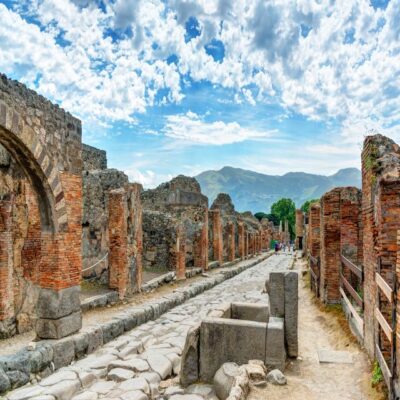
Browse the lists this tour appears in