
Reviewed · SKIP THE LINE
Pompeii tour with LOCAL GUIDE and SKIP THE LINE entrance
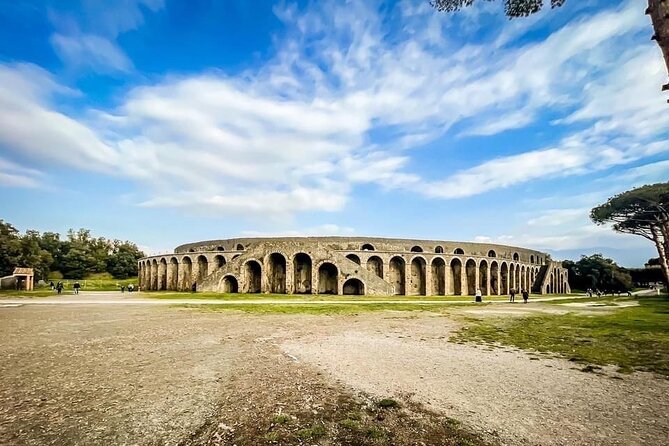
Pompeii is not just a collection of broken columns. It is a Roman city caught in mid-sentence, with homes, shops, bathhouses, streets, and public squares preserved beneath volcanic ash. This 2.5-hour guided walk gives you a clear introduction without making you handle the site alone.
I like the priority entry and the small group, capped at 14 people. I also like the chance to remain inside the excavations after the guided portion, which lets you revisit a favorite spot at your own pace. The main drawback is simple: Pompeii is enormous, and two hours of guiding can feel short for a place this large.
In This Review
- Key points to know before booking
- Why Pompeii needs a guide
- Meeting near Via Villa dei Misteri
- The archaeological park and the first view of Pompeii
- Casa del Menandro and Roman private life
- The Lupanar and Pompeii’s frank public life
- The Forum, Pompeii’s civic center
- The Stabian Baths and the daily Roman routine
- What the $66.38 price includes
- Who should book this Pompeii tour
- Should you book it?
- FAQ
- Where does the Pompeii tour begin?
- Where does the tour end?
- How long does the experience last?
- What is included in the price?
- Is the tour offered in English?
- How large is the group?
- Which Pompeii sights are included?
- Is the tour accessible with a service animal?
- What happens if bad weather cancels the tour?
Key points to know before booking
- A local guide brings the ruins to life: Guides including Gennaro, Antonio, Anna, and Sasa explain both major monuments and daily Roman life.
- Priority entry saves valuable time: The meeting point is close to the ruins, Pompeii station, and nearby car parks.
- The group is limited to 14 people: This is more personal than a large coach tour, though headsets are not listed as included.
- The route covers Pompeii’s essential sights: Expect the Forum, Casa del Menandro, Lupanar, and Stabian Baths.
- You can stay after the tour: The guided walk ends at the meeting point, but you may remain inside the archaeological park.
- The price is $66.38 per person: That includes entry, an authorized guide, and priority service, but not a tip.
Why Pompeii needs a guide
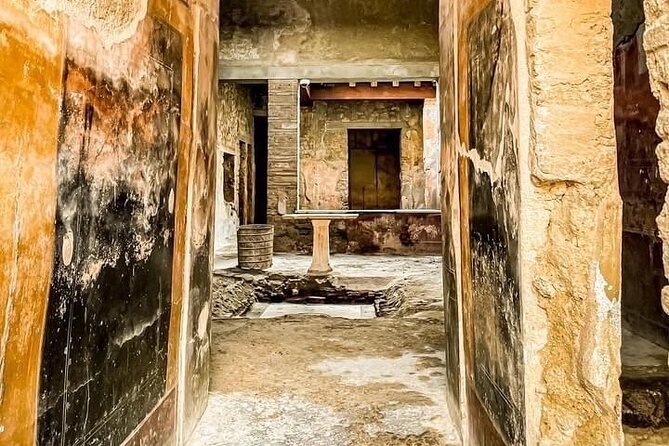
Pompeii rewards curiosity, but it can also overwhelm you. The archaeological park is spread across a full Roman town, and the remains often look confusing until someone explains what you are seeing. A guide can point out the difference between a private house, a public building, a shop, and a religious site in a way that a quick walk with a map may not.
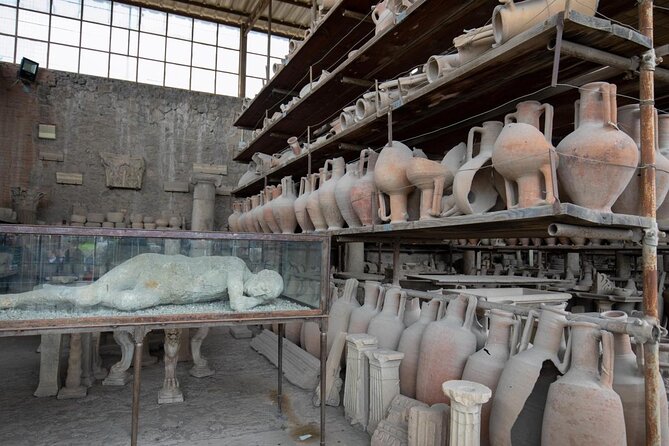
The eruption of Mount Vesuvius in AD 79 buried Pompeii beneath ash and volcanic material. That disaster destroyed the city, but it also preserved an unusually clear picture of Roman urban life. Excavations began in the 18th century, and about 75 percent of the city has now been brought to light.
That number matters. You are not walking through a single monument. You are walking through streets where people lived, worked, worshipped, bathed, ate, and sought entertainment. The guide’s job is to connect scattered walls and faded paintings with ordinary life.
The most successful guides on this experience are warm as well as informed. Gennaro is described as friendly, funny, and very strong on the history. Antonio has a gift for keeping younger children interested. Anna is praised for patience and for taking time to connect the ruins with the people who once lived there. Sasa is described as informative and attentive, though the short tour time limited how much could be covered.
The guide quality can make or break Pompeii. A good explanation turns a roofless house into a family home and a paved square into the political heart of a city. Still, the guide cannot change the clock. If you want a slow, very detailed study of Pompeii, you should consider a longer or private experience.
More Pompeii excavation visits:
- Pompeii: Entry Ticket and Guided Tour with an Archaeologist
★ 4.8 · 19,459 reviews - Pompeii: Entry Ticket with Optional Audio Guide
★ 4.2 · 12,360 reviews - Pompeii: Small Group Tour with an Archaeologist
★ 4.8 · 12,264 reviews
Meeting near Via Villa dei Misteri
The tour begins at Via Villa dei Misteri, 3, near the entrance to the archaeological park. The meeting point is only a few meters from the station and car parks, which is useful if you are arriving by train or car.
Your confirmation arrives at booking, and the activity is offered in English. Communication about the exact meeting place deserves careful attention. One booking nearly ran late because the instructions were confusing, so read the meeting details closely and keep your phone available before the start.
The small group limit of 14 is a real advantage. Pompeii’s streets can be uneven and narrow, and a large group tends to stop traffic as much as it studies the ruins. A smaller party makes it easier to hear the guide and ask questions.
Headphones are not listed among the inclusions. In a group of 14, you may still hear well if everyone stays close, but people who want every word should ask about the setup before booking. This matters most in windy weather or when the guide is explaining something from a distance.
The entry ticket is included, as is priority service for entering the ruins. The exact benefit depends on the crowd at the gate, but skipping a long queue can protect your limited time in Pompeii. At $66.38 per person, the cost is higher than simply buying entry and walking in alone. You are paying for the guide, the organization, and the time saved at the entrance.
The archaeological park and the first view of Pompeii
The main stop is the Archaeological Park of Pompeii, and most of the tour is spent here. The guide leads you along ancient streets and explains how the city worked before the eruption.
The first impression can be strange. Pompeii feels both distant and close. The walls are ancient, but the layout of homes and public spaces is easy to recognize. The ash preserved buildings and objects with enough detail to help historians study daily life in the Roman Empire roughly 2,000 years ago.
You will see streets that still suggest their original purpose, though the supplied details do not promise every major area of the park. That is important. A 2.5-hour tour cannot cover all of Pompeii, and the exact order of stops may change.
The guided portion is listed as about two hours, while the full experience is approximately two hours and 30 minutes. The extra time may allow for meeting, entry, and movement through the site. You should treat the tour as an introduction, not a complete survey.
At the end, you can remain inside the excavations. This is one of the most useful features. If the guide moves quickly past a house or public building that interests you, you may have a chance to look again after the formal tour. The information provided does not specify how long you may remain, so confirm any site closing time on the day.
Casa del Menandro and Roman private life
Casa del Menandro is one of the strongest stops for understanding how a wealthy Roman family lived. It was changed several times, and its plan reflects the size and complexity of a high-ranking home.
The atrium contains frescoes with scenes from the Iliad and the Odyssey. These images point to the education and cultural tastes expected in an affluent household. The house takes its name from a portrait of Menander, an Athenian playwright, placed in the porch.
The property also includes a peristyle of the rhodium type, with its northern side higher than the others. That architectural detail may sound technical, but it helps you see that Roman homes were not simple rooms arranged around one courtyard. They could include carefully planned spaces for display, leisure, work, and service.
A small thermal area lies below the house, along with an underground room that may have been a cellar. Archaeologists found a chest containing 118 pieces of silverware there. The collection is now displayed at the National Archaeological Museum of Naples, so you will not see the treasure at Pompeii itself.
The silverware gives the house a personal touch. These were not abstract museum objects. They formed a family service, including vessels for pouring wine and plates and cups used at banquets.
On the southern side, the rustic quarter includes a reconstructed wagon. This helps balance the elegant frescoes and formal courtyard. Wealthy Roman homes depended on practical work areas, storage, transport, and household labor. Casa del Menandro shows both sides of that life.
The planned 15 minutes here is enough for a focused explanation. It is not enough for every painting, room, and architectural detail. Listen for the guide’s main points, then use your time after the tour if you want to study the house more carefully.
More Pompeii Ruins tours worth comparing
- Pompeii: Skip-the-Line Entrance Ticket with Audio Guide
★ 4.0 · 2,509 reviews - Sorrento: Skip-the-Line Pompeii Express Tour by Train
★ 4.8 · 2,038 reviews - Pompeii: Skip-the-line-Ticket and Guided Tour
★ 4.6 · 1,152 reviews - Pompeii: Guided Tour with Skip-the-Line Entry
★ 4.9 · 812 reviews
The Lupanar and Pompeii’s frank public life
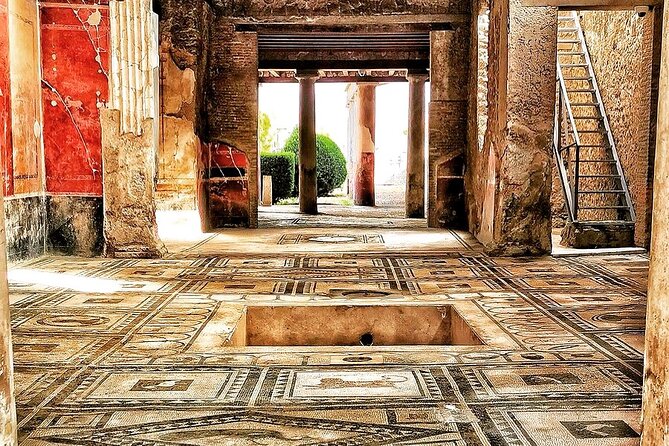
The Lupanar is one of Pompeii’s most talked-about buildings, but it deserves more than a quick photo stop. The name comes from lupa, a Latin term used for a prostitute. The building was a brothel, and its design shows how openly the business operated in Roman society.
The lower floor contains five small rooms arranged along a corridor between two ground-level entrances. Each room had a built-in bed and was closed by a curtain. A latrine sits beneath the stairs at the end of the corridor. The upper floor held the homes of the owners and enslaved workers.
Small erotic pictures on the walls helped customers understand the services offered. The women who worked there were mostly Greek and Eastern slaves, a detail that points to the unequal and harsh social order behind the building’s commercial purpose.
The stated prices offer a glimpse of the scale of everyday spending. Sex cost between two and eight asses, while a cup of wine cost one. Your guide can put these numbers into context and explain what the rooms and paintings reveal about Roman customs.
The visit is scheduled for about 10 minutes. That is enough to see the layout and hear the central explanation, but not enough for a long discussion. The itinerary lists the Lupanar twice, each for 10 minutes. This appears to represent two portions or repeated timing in the route, not two separate brothels. The supplied details do not explain the distinction, so do not assume you will receive 20 minutes of separate commentary.
Because the Lupanar is small, crowded conditions could make this the least comfortable stop. Stay close to the guide and expect a brief visit.
The Forum, Pompeii’s civic center

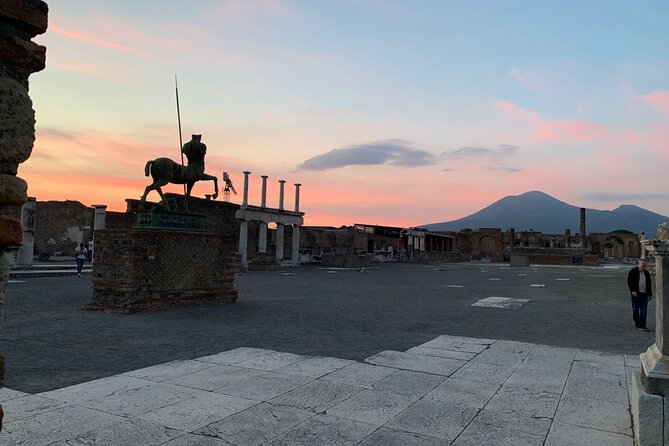
The Foro de Pompeya, or Civil Forum, is the city’s central public square. Its surrounding buildings handled administration, justice, business, worship, and commerce. This is where the guide can help you picture Pompeii as a working city rather than a silent ruin.
The Forum began as a fairly plain open area with a rammed-earth surface. On the western side stood the Sanctuary of Apollo, while shops lined the eastern side. Between the third and second centuries BC, the square was reshaped with arcades and a paved surface made of tuff slabs.
The Temple of Jupiter became a major visual focus, aligned with Vesuvius. That arrangement tied civic power, religion, and the volcano together in a way that feels especially striking once you understand the city’s setting.
Later, during the early imperial period, the Forum was paved again with travertine slabs. Some slabs still have recesses for bronze letters from a large inscription, though they are no longer in their original positions.
The Forum receives about 20 minutes, the longest single stop listed in the route. That makes sense. It is an open space with several buildings to explain, and it provides the best setting for understanding Pompeii’s public life.
The drawback is that a short stop here can leave you wanting more. The Forum is one of the places where a longer tour would pay off, especially if you enjoy ancient politics, architecture, or urban planning.
The Stabian Baths and the daily Roman routine
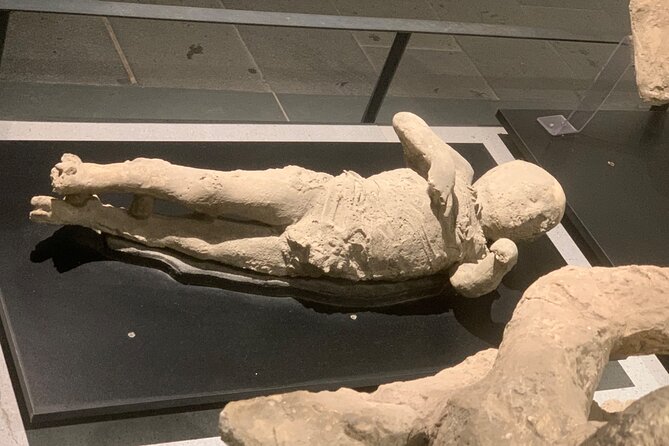
The Stabian Baths are the oldest bathing complex in Pompeii of their kind. They were buried by the eruption and later uncovered through archaeological work.
A bathhouse tells you about routine, not just ceremony. Romans used baths for washing, exercise, social contact, and business. The surviving complex gives the guide a chance to explain how public amenities shaped the rhythm of city life.
The stop lasts about 10 minutes. That is brief, but the baths work well as a final example of ordinary Roman habits after the grand public setting of the Forum and the private world of Casa del Menandro.
You may find the baths particularly useful if you are trying to understand how Pompeii functioned as a community. Homes, shops, civic buildings, brothels, and baths were not isolated attractions. They formed a connected town.
What the $66.38 price includes
The price is $66.38 per person. It includes the entrance ticket, an authorized local guide, priority entry, and a feature called Time Machine. No further explanation is provided for Time Machine, so ask the provider what it involves before you rely on it as part of the experience.
The strongest value comes from combining entry with a live explanation. Buying admission alone gives you access to the ruins, but it does not guarantee that you will understand what you are seeing. Pompeii can be a poor place for a rushed self-guided visit because the site is so large and its remains are often incomplete.
The small group also supports the price. A cap of 14 is not a private tour, but it is much more manageable than a large group. You are likely to have better access to the guide and a greater chance to ask a question.
The weak point is duration. One hour of extra guiding would make a substantial difference at a site this large. The experience is a reasonable choice if you want the main story, priority entry, and freedom to stay inside afterward. It is less suitable if your goal is to inspect many houses or study Pompeii in depth.
Tips are not included. The cancellation terms are strict: the experience is non-refundable and cannot normally be changed. If poor weather makes the tour unsafe, or if the minimum number is not met, you are offered another date or a full refund. Keep an eye on messages, especially during storms, since the tour may be canceled for safety even if the archaeological park itself remains open.
Who should book this Pompeii tour
I would choose this tour for a first visit when you want structure, a local English-speaking guide, and a small group. It suits couples, families, and anyone arriving by train who wants to meet close to the entrance rather than spend time finding the site alone.
It also works well for people who want a guided introduction and then prefer to continue independently. The option to stay inside afterward gives you some freedom that a tightly managed excursion may not.
Families may benefit from a guide who can turn the ruins into stories about homes, meals, work, entertainment, and school rather than offering only dates and architectural terms. Antonio, in particular, has been praised for engaging children.
I would not choose it for a serious Pompeii enthusiast who wants extensive coverage. A longer tour, ideally private if available within your budget, would give you more time for detail and questions. If you are sensitive to missing information in a group, ask about headphones, since they are not listed as part of this experience.
Should you book it?
Book this Pompeii tour if you value priority entry, a local guide, and a compact introduction at a famous but demanding archaeological site. Guides such as Gennaro, Antonio, Anna, and Sasa have each been associated with the kind of personal, clear presentation that makes Pompeii easier to understand.
The 4.9 rating from 55 reviews and 96 percent recommendation rate point to a strong overall experience, but the shorter format deserves honest attention. You will see important parts of Pompeii, not the entire city.
For a first look, the $66.38 fee is defensible because entry and guiding are included. For a once-in-a-lifetime Pompeii visit, I would compare it with a longer option before paying. If you choose this one, arrive ready to listen closely, keep your questions focused, and use the time afterward to revisit the places that caught your attention.
FAQ
Where does the Pompeii tour begin?
The meeting point is Via Villa dei Misteri, 3, 80045 Pompei, Italy. It is near the entrance to the archaeological ruins, the station, and car parks.
Where does the tour end?
The activity ends back at the meeting point. You may also have the possibility of remaining inside the excavations after the guided tour.
How long does the experience last?
The approximate duration is two hours and 30 minutes. The main guided visit is described as about two hours, with the remaining time covering the wider activity.
What is included in the price?
The price includes entry tickets, priority service for entering the ruins, an authorized local guide, and Time Machine.
Is the tour offered in English?
Yes. The activity is offered in English.
How large is the group?
The experience has a maximum of 14 travelers.
Which Pompeii sights are included?
The route includes the Archaeological Park of Pompeii, Casa del Menandro, the Lupanar, the Civil Forum, and the Stabian Baths. The Lupanar is listed twice in the timing information.
Is the tour accessible with a service animal?
Yes. Service animals are allowed.
What happens if bad weather cancels the tour?
The tour requires good weather. If poor weather causes a cancellation, you are offered a different date or a full refund. A refund or alternative is also offered if the minimum number of participants is not met.
Newest reviews from Pompeii Ruins
- Private Tour Pompeii and Winery★ 5.0 · 4 reviews
- Visit the Pompeii ruins from Salerno with Pizza Lunch★ 5.0 · 4 reviews
- Pompeii Private Tour for Kids and Their Families★ 4.8 · 4 reviews
- From Sorrento: Pompeii & Vesuvius tour small group★ 4.8 · 4 reviews
- Pompeii Sorrento and Positano Tour★ 5.0 · 4 reviews
- From Naples_ Pompeii Tour_Skip the line ticket + audioguide★ 4.3 · 4 reviews
- Pompeii Private Half-Day Tour from: Naples,Sorrento, Amalfi Coast★ 5.0 · 4 reviews
- Pompeii, skip-the-line ticket with smartphone audio guide on App★ 3.0 · 4 reviews
Skip the Line, compared.

Skip-the-Line Entrance Ticket with Audio Guide
Read our review →



Skip-the-Line Entry Ticket with Digital Guide App
Read our review →
Pompeii Ruins Private Tour with Optional Skip-the-Line Entry
Read our review →
Skip-the-Line Pompeii Guided Tour from Sorrento
Read our review →
Skip the Line Guided Tour of Pompeii led by an Archaeologist
Read our review →Browse the lists this tour appears in