Reviewed · GUIDED
Pompeii private tour with expert guide in archaeology
Pompeii becomes far more understandable when someone points out how its streets, shops, baths, theaters, and homes fit together. This private tour focuses on ordinary Roman life, not just the famous eruption, and brings you to places such as the gladiator training area, ancient taverns, the red light district, and the Forum.
I like the private format, since your group can ask questions and adjust the visit around its interests. I also like the archaeology focus: a good guide can explain why a bakery, bath, household mosaic, or plaster cast matters instead of leaving you to guess at the ruins.
The main drawback is time. Two hours passes quickly in Pompeii, and admission is not included in the $302.34 group price. You will need to pay the park entrance fee separately and may want more time afterward to continue on your own.
In This Review
- Key points to know before booking
- Why Pompeii is better with an archaeologist
- Starting at Coffee Shop Vittoria
- Gladiators, theaters, and public entertainment
- Main streets, taverns, and shops
- Baths and the Roman idea of leisure
- Erotic frescoes in the red light district
- A patrician house with frescoes and mosaics
- Plaster casts and the human cost of the eruption
- Temples, worship, and the Forum
- What the private format is worth
- Who should book this Pompeii tour
- Booking, cancellation, and final advice
- FAQ
- How long does the Pompeii private tour last?
- Where does the tour begin?
- Where does the activity end?
- Is the entrance ticket included?
- Is transportation included?
- How many people can join the private tour?
- Is the tour offered in English?
- Are service animals allowed?
- What happens if I cancel?
Key points to know before booking

- Two hours with an archaeology guide: The visit gives you a focused introduction rather than a full-day exploration of Pompeii.
- Private group of up to eight: You share the guide only with your own party, which makes questions and pacing easier.
- A broad route through daily life: Expect gladiator spaces, a theater, shops, taverns, baths, an ancient brothel, private homes, temples, the market, and the Forum.
- The guide ends at the Forum: You can keep exploring alone from there or walk back to the exits with the guide.
- Entrance and transport cost extra: The archaeological park admission is listed as €19 per booking, and minivan pickup and drop-off are available separately through Pompeigrandtour.
- A well-regarded experience: It has a 5 rating from 96 reviews, with 100 percent of respondents recommending it.
Why Pompeii is better with an archaeologist
Pompeii is not a compact ruin with one obvious path. It is a large ancient city, and its walls, paving stones, temples, shops, and homes can look alike if you do not know what to watch for. A guide trained in archaeology gives each stop a purpose.
That matters most in the less famous corners. A row of rooms might have been a shop, a bar, a kitchen, or part of a private house. A narrow doorway may lead to a bath complex or a home with painted rooms. The guide helps you read these spaces as parts of a working city.
The strongest praise for this experience centers on that added explanation. The ruins are impressive on their own, but the story of Pompeii becomes much clearer when someone connects the physical remains to Roman habits, business, worship, leisure, and social life.
This tour is offered in English. No guide name is supplied in the booking details, so you should not expect to select a particular archaeologist unless the operator confirms one before your visit.
More Pompeii excavation visits:
- Pompeii: Entry Ticket and Guided Tour with an Archaeologist
★ 4.8 · 19,459 reviews - Pompeii: Entry Ticket with Optional Audio Guide
★ 4.2 · 12,360 reviews - Pompeii: Small Group Tour with an Archaeologist
★ 4.8 · 12,264 reviews
Starting at Coffee Shop Vittoria
The meeting point is Coffee Shop Vittoria on Via Mare in Pompei. You meet there before entering the archaeological park, so allow enough time to find the café and gather your group.
The tour does not include a minivan transfer. If you need pickup or drop-off, Pompeigrandtour offers that as an additional service. This is important if you are arriving with luggage, traveling from another town, or trying to coordinate a tight day around Pompeii.
The activity lasts about two hours. That length works well for a first look or for a hot day when you want expert guidance without committing to several hours on foot. It also means you should arrive ready to walk and pay attention from the start. Pompeii is an outdoor archaeological site, and a moderate level of fitness is recommended.
Gladiators, theaters, and public entertainment
The route includes the school and training place of gladiators. This stop offers a useful correction to the usual movie version of Roman life. Gladiators were performers and fighters, but they also trained within organized settings that were part of the city’s public culture.
You then visit the theater. Public entertainment was a major part of Roman social life, and a theater helps show how residents gathered, watched performances, and spent free time. The structure also gives you a sense of how carefully public buildings were planned within the city.
These stops are especially useful for families and first-time visitors because they create an immediate story. You are not only looking at broken walls. You are seeing places built for training, performance, and shared public experiences.
The limitation is that two hours does not allow unlimited time at every building. Your guide will need to keep the group moving, especially if the site is busy or if your party has many questions.
Main streets, taverns, and shops

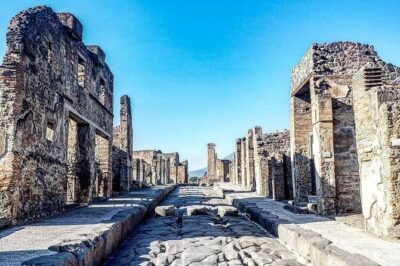
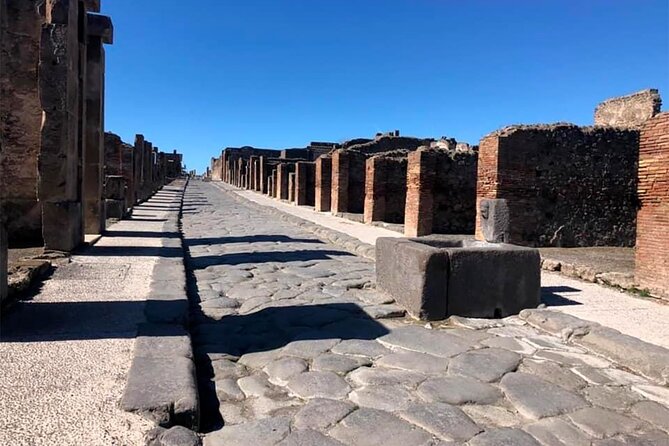
The main streets reveal the practical side of Pompeii. You will see the routes people used to move around the city, along with ancient taverns and shops that served everyday needs.
This is one of the most valuable parts of the tour because it shifts attention from grand temples and wealthy houses to ordinary commerce. A tavern or shop can tell you about food, trade, work, and the rhythm of daily errands. With the guide’s help, you can look at entrances, counters, rooms, and street layout as evidence of how the city operated.
The streets also help you understand Pompeii as a real settlement rather than a collection of isolated monuments. Public buildings, businesses, homes, and religious sites were connected by the same roads. The guide can show how these different parts related to one another.
Wear practical shoes. The information provided does not give a detailed surface or route description, but Pompeii is an extensive archaeological park, and the fitness advice makes clear that you should be prepared for walking.
More Pompeii Ruins tours worth comparing
- Pompeii Ruins Private Tour with Optional Skip-the-Line Entry
★ 4.9 · 732 reviews - Pompeii private tour with an Official Guide
★ 5.0 · 631 reviews - Pompeii Private Tour with an Archaeologist and Skip The Line – 3 hours
★ 5.0 · 564 reviews - Visit in Pompeii – Pompeii Private Tour with Ada
★ 5.0 · 436 reviews
Baths and the Roman idea of leisure

The tour visits the baths, described as a 2,000-year-old spa. Roman baths were not simply places to wash. They were social spaces where people could spend time, meet others, and follow a sequence of bathing activities.
This stop gives you a useful view of Roman leisure and public infrastructure. A bath complex required planning, construction, heating, and maintenance. It also shows that city life depended on more than houses and streets. Public services shaped the daily routine.
For you, the baths can be a good point to ask how the building worked and who used it. Since this is a private tour, you have a better chance to pause for questions than you would on a large group walk.
Still, the guide may have to keep the explanation concise. Two hours is enough to understand the role of the baths, but not necessarily enough for a long architectural study of every room.
Erotic frescoes in the red light district

The route includes Pompeii’s red light district, with its famous erotic frescoes. This is one of the city’s most recognizable and talked-about areas, but it is best viewed as part of a wider picture of Roman society.
The frescoes offer clues about how sexual services were advertised and how images functioned in commercial settings. Your guide can place the paintings within the setting rather than treating them as isolated curiosities.
This stop may not suit every group, especially families with young children or anyone who prefers to skip sexual material. The tour description identifies the content clearly, so you can decide in advance. Since the activity is private, you can also discuss your preferences with the guide.
A patrician house with frescoes and mosaics
The visit includes a wealthy Roman home, or domus, with frescoes and mosaics. This is where you see the difference between public city life and private status.
A house of a prosperous family can reveal how rooms were arranged for guests, household work, display, and family life. Painted walls and patterned floors were not just decoration. They helped express taste, wealth, and social position.
This stop balances the taverns and shops nicely. You see both the working city and the homes of people with more money and influence. The contrast makes the social structure of Pompeii easier to grasp.
The exact house is not named in the supplied details. If a particular domus matters to you, ask the operator which one is included when you book. Conditions at archaeological sites can affect which buildings are open, and the information provided does not promise access to every interior.
Plaster casts and the human cost of the eruption
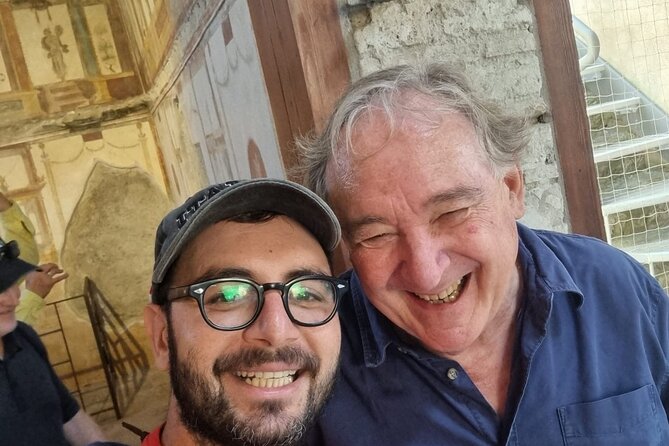
The route includes plaster casts of victims preserved at the time of the Vesuvius eruption. This is often the most emotionally difficult part of a Pompeii visit.
The casts make the disaster personal. Instead of seeing only buildings interrupted by ash, you confront evidence of people caught in the event. A guide can explain what the casts represent and place them within the wider story of the eruption.
Give yourself a moment here. The subject is serious, and the casts can affect people differently. Their presence is not a dramatic prop. It is part of the archaeological record and a reminder that Pompeii was a living city before it became a ruin.
Temples, worship, and the Forum
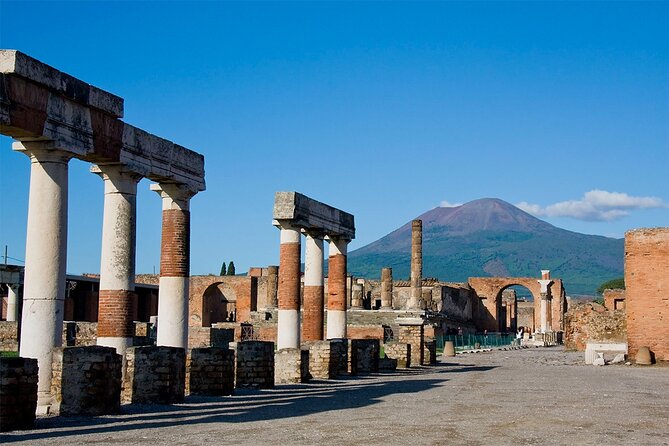
The guided visit ends at the Forum, the center of Pompeii’s social life. Along the way, you see temples and other places of worship, then reach the central civic area where public, political, commercial, and religious activity came together.
Ending at the Forum makes practical sense. It gives the tour a clear final chapter and leaves you in one of the most important parts of the city. The Forum can help tie together what you have already seen: shops, homes, public buildings, worship, markets, and social gatherings.
The route also includes the city’s main market. This adds another view of how residents bought and sold goods. Along with the taverns and shops, it keeps the focus on use and routine rather than only on monumental architecture.
Once the guided portion ends, you can continue exploring alone. You can also return to the exits with the guide. This choice is a real benefit because you are not forced to leave just as you begin to understand the site.
What the private format is worth
The listed price is $302.34 per group of up to eight people. That is not a cheap solo tour, but the calculation changes if you fill the group. Eight people would bring the guide cost to roughly $38 per person, before admission. A smaller party pays more per person.
The price covers the expert archaeologist guide, not the park ticket. Admission is listed as €19 per booking, so confirm the current amount and how it applies to your group before arrival. Minivan pickup and drop-off are also separate.
I see the value mainly in the private attention. Pompeii is easy to visit without a guide, but it is also easy to miss what makes the site meaningful. If you are traveling with relatives or friends and want one shared explanation, the group price can be sensible.
For one or two people, the cost is harder to justify unless you place a high value on specialist interpretation or have limited time. A basic visit on your own will cost less, but you will need to supply the context yourself.
Who should book this Pompeii tour
I would recommend this experience to a first-time Pompeii visitor who wants a clear route and an expert explanation. It also suits families, couples, and friend groups who prefer a private conversation over a large scheduled group.
It is a good match if you want to understand daily life, not just photograph famous walls. The mix of homes, shops, baths, public entertainment, worship, markets, and the Forum gives you a broad introduction in a short period.
You should think twice if you want a slow archaeological study of every major building. Two hours is an introduction. You may need to continue alone afterward, and the guide does not promise an exhaustive visit to the entire park.
The tour also requires moderate physical fitness. Service animals are allowed, and the meeting point is near public transportation. Those details make the outing easier for some visitors, but they do not remove the need for walking around a large outdoor site.
Booking, cancellation, and final advice
Confirmation is provided at booking. Free cancellation is available if you cancel at least 24 hours before the local start time. Cancellations or changes made inside that window are not accepted for a refund.
The strongest reason to book is the guide. One direct assessment of the experience says that Pompeii needs a guide because explanation greatly improves the visit. That is exactly the point of this tour. The ruins are extensive, and the archaeology turns scattered remains into a readable city.
Book it if your group values context, private pacing, and a focused two-hour introduction. Skip it if your main goal is the lowest possible cost or a full-day exploration at an unhurried pace. If you do book, arrive ready to walk, budget separately for admission, and keep extra time after the Forum if Pompeii has caught your attention.
FAQ
How long does the Pompeii private tour last?
The guided experience lasts approximately two hours.
Where does the tour begin?
It begins at Coffee Shop Vittoria, Via Mare, 80045 Pompei, in the Naples area of Italy.
Where does the activity end?
The activity ends back at the meeting point. The guided portion itself ends at the Forum, where you can either continue exploring alone or return to the exits with the guide.
Is the entrance ticket included?
No. Admission to the Archaeological Park of Pompeii is not included. The listed admission cost is €19 per booking.
Is transportation included?
No. Minivan pickup and drop-off are not included. They can be booked separately through Pompeigrandtour.
How many people can join the private tour?
The private tour is for your group only, with up to eight people.
Is the tour offered in English?
Yes. The tour is offered in English.
Are service animals allowed?
Yes. Service animals are allowed.
What happens if I cancel?
You can cancel for a full refund up to 24 hours before the experience start time. Cancellations or changes made less than 24 hours before the local start time are not accepted for a refund.
Newest reviews from Pompeii Ruins
- Wine Tour + Pompeii★ 5.0 · 4 reviews
- Full-Day Sorrento Positano Pompeii Tour★ 5.0 · 4 reviews
- Pompeii: Skip The Line Entrance Tickets + Audioguides★ 3.2 · 4 reviews
- Pompeii: Entry Ticket & Guided Tour with an Expert Historian★ 5.0 · 4 reviews
- Pompeii ruins★ 5.0 · 4 reviews
- Private Tour Pompeii and Winery★ 5.0 · 4 reviews
- Visit the Pompeii ruins from Salerno with Pizza Lunch★ 5.0 · 4 reviews
- Pompeii Private Tour for Kids and Their Families★ 4.8 · 4 reviews
Guided, compared.

Entry Ticket and Guided Tour with an Archaeologist
Read our review →

Skip-the-Line Entrance Ticket with Audio Guide
Read our review →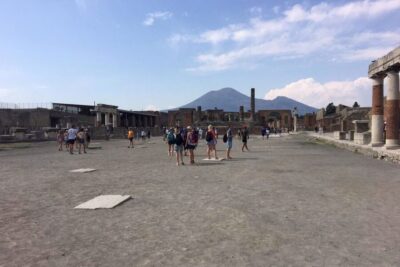



Skip-the-Line Entry Ticket with Digital Guide App
Read our review →