Reviewed · GUIDED
Pompeii 360° – 4-hour tour with an expert Guide in archaeology
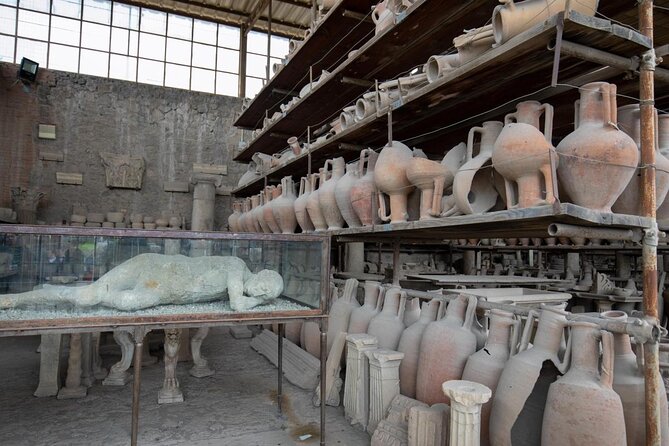
Pompeii is best understood as a city, not a single ruin. This private four-hour tour takes you from the old amphitheater to the Forum, grand villas, theaters, baths, shops, and houses still marked by vivid mosaics and frescoes. The Garden of the Fugitives, with its plaster casts of eruption victims, gives the visit its most sobering moment.
I like the private format, since your guide can adjust the route for children, special interests, or a preferred entrance. I also like the focus on archaeology. Guides such as Luciano, Martina, Annalise, and Ernesto have been praised for making the ruins clear, personal, and easy to follow.
The main drawback is the pace. Four hours is useful, but Pompeii covers a huge area, and this route includes many stops. The €203.70 price is per person, and the €20 Archaeological Park ticket is extra, so the value is strongest for a small group that wants a private guide rather than a quick overview.
In This Review
- Key points to know before you book
- Why a private four-hour visit works well at Pompeii
- Starting at Pompeii’s oldest amphitheater
- Seeing the Forum with Mount Vesuvius behind it
- Entering Pompeii’s largest houses
- Walking Via dell’Abbondanza
- Small theater, baths, and the public side of Roman life
- Temples, gardens, and the final Pompeii views
- What the guides add to the experience
- Is $203.70 per person a fair price?
- Practical details that can make the day easier
- Who should book this Pompeii tour?
- FAQ
- How long is the Pompeii 360° tour?
- Is the Pompeii entrance ticket included?
- Do children pay the Pompeii entrance fee?
- Where does the tour start and end?
- Is this a private tour?
- What should I wear and bring?
- What is the cancellation policy?
- Should you book it?
Key points to know before you book
- A private route through a very large site: Only your group takes part, with room to adjust the visit.
- The archaeology guide is the main value: Luciano, Martina, Annalise, and other guides have received praise for clear explanations and family-friendly teaching.
- The highlights cover every side of Pompeii: Expect villas, temples, public buildings, theaters, baths, shops, gardens, and plaster casts.
- The €20 entrance ticket is not included: Under-18s enter free, while EU visitors aged 18 to 25 pay €2 with valid identification.
- Plan for sun and uneven walking: Wear comfortable shoes, bring a hat and sunglasses, and keep backpacks within 30 by 30 by 15 centimeters.
- The tour may feel brisk: You may see the major sights, but a four-hour visit cannot cover every open street and building in Pompeii.
Why a private four-hour visit works well at Pompeii
Pompeii can be confusing without a plan. Streets run past houses, shrines, shops, public buildings, and open courtyards, and the meaning of each space is not always clear at first glance. A guide with archaeological training helps you connect the pieces: how people lived, where public business took place, and how religion, entertainment, trade, and domestic life fit together.
This tour is private, so you are not tied to the interests or walking speed of a large group. If your children lose patience in a house filled with frescoes, your guide can shift the balance toward theaters, streets, or the amphitheater. If you care most about Roman architecture, mosaics, or the eruption, you can ask for more time in those areas.
The route begins and ends at Piazza Esedra, a practical meeting point near the Pompeii archaeological entrance. The tour is offered in English, and individual guides have also led visits in French and German. Confirmation is sent within 48 hours of booking, subject to availability.
More Pompeii excavation visits:
- Pompeii: Entry Ticket and Guided Tour with an Archaeologist
★ 4.8 · 19,459 reviews - Pompeii: Entry Ticket with Optional Audio Guide
★ 4.2 · 12,360 reviews - Pompeii: Small Group Tour with an Archaeologist
★ 4.8 · 12,264 reviews
Starting at Pompeii’s oldest amphitheater
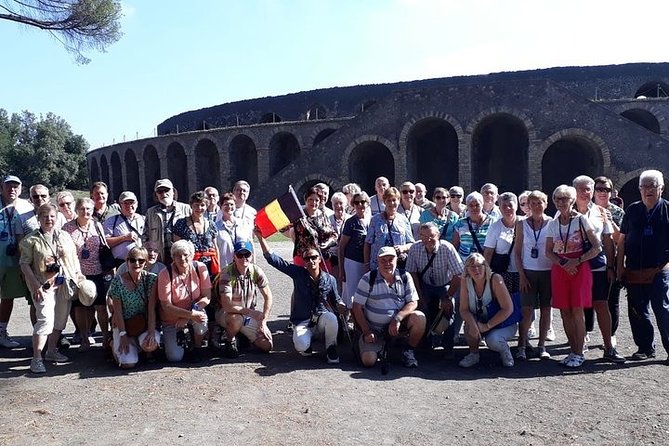
The first stop is the Roman amphitheater, one of the oldest surviving examples in the Roman world. It is a good opening because it immediately shows Pompeii as a functioning city with public entertainment, organized crowds, and large civic construction.
You have about 15 minutes here. That is enough for an explanation and a close look, but not for a long architectural study. The amphitheater is also a reminder that Pompeii was not simply a wealthy resort town. Its public life included mass entertainment, popular gatherings, and the same social tensions found across the Roman world.
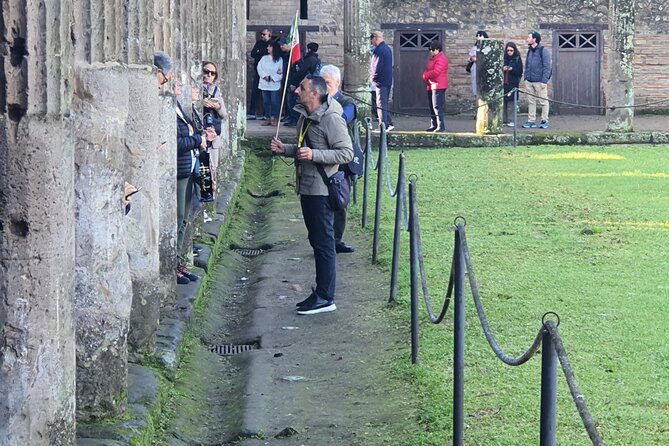
From here, the route moves to the Garden of the Fugitives. The name refers to people who sought refuge during the eruption. The plaster casts are among Pompeii’s most powerful sights because they show the human cost of the disaster. The stop lasts about 15 minutes, and your guide can provide the historical setting without reducing the moment to a grim photo opportunity.
Seeing the Forum with Mount Vesuvius behind it
The route then shifts toward Pompeii’s civic and religious center. The Temple of Jupiter, Juno, and Minerva occupies a strong position with views toward Mount Vesuvius. You have only about five minutes here, so treat it as a quick orientation and photo stop rather than a full lesson.
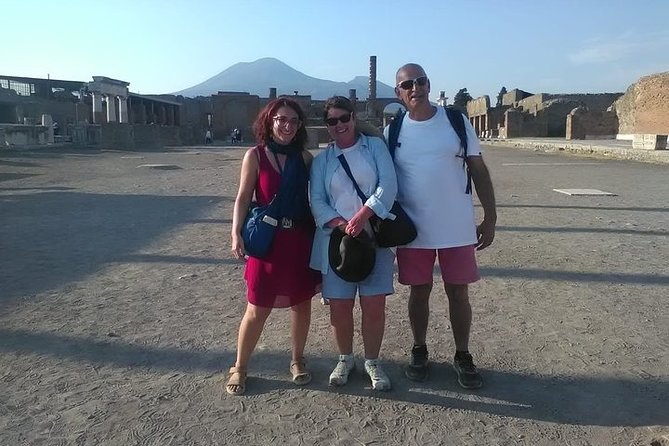
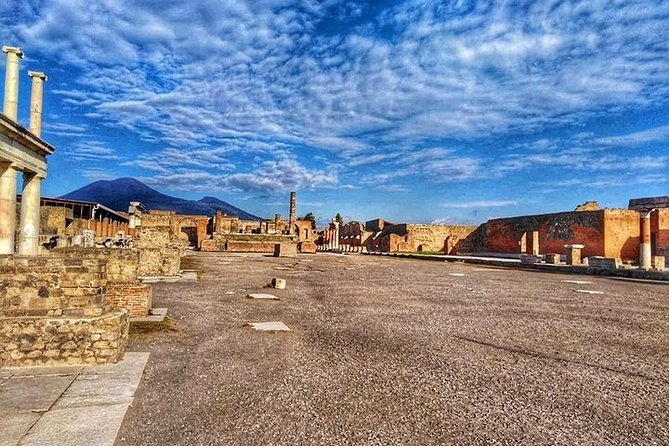
The nearby Forum deserves more attention. This was the center of political, religious, civic, and economic life. Temples and public buildings line the space, and the open area helps you picture how ancient Pompeii organized its public world.
The Forum stop is listed at about 10 minutes, including a photo opportunity with Vesuvius behind you. That timing is short for a site this important, but the guide’s explanation gives the ruins a structure that you may miss when walking through alone. I would ask questions here if you want more context about government, worship, or commerce.
The Temple of Apollo is another short stop, about 10 minutes. It is among Pompeii’s oldest temples and has been restored. Its position offers another view toward Vesuvius, while the dedication to Apollo and Diana opens a window onto Roman religious practice and the connection between the sun, moon, and civic ritual.
Entering Pompeii’s largest houses
Pompeii’s private homes are some of the most rewarding parts of the visit because they turn abstract Roman history into rooms, gardens, floors, and wall paintings. The House of the Faun is the grandest example on this route. Covering roughly 3,000 square meters, it includes gardens, colorful mosaics, the statue of a faun, and the famous Alexander Mosaic.
The Alexander Mosaic depicts Alexander the Great and is one of the great works associated with ancient Pompeii. Even if you are not a specialist in Roman art, the scale and detail help explain the wealth of the household. You will want time here, yet the itinerary includes the House of the Faun twice, with 15 minutes assigned each time. In practice, ask your guide how the route is being handled so you do not expect two entirely separate visits.
The House of the Wild Boar is smaller but useful for comparison. Located near the Forum, it is known for a fine mosaic floor. A short 10-minute stop lets you see how decorative design appeared in a less monumental domestic setting.
The House of the Vettii receives about 30 minutes, making it one of the deeper stops. It is one of Pompeii’s best-preserved Roman homes, with mythological frescoes and mosaics. This is where an archaeology guide adds real value. A house can look like a series of rooms until someone explains how its spaces, paintings, gardens, and decoration reflected family status and Roman domestic life.
More Pompeii Ruins tours worth comparing
- Pompeii: Skip-the-Line Entrance Ticket with Audio Guide
★ 4.0 · 2,509 reviews - Pompeii: Guided Walking Tour with Entrance Ticket
★ 4.3 · 1,423 reviews - Pompeii: Skip-the-line-Ticket and Guided Tour
★ 4.6 · 1,152 reviews - Pompeii: Guided Tour with Skip-the-Line Entry
★ 4.9 · 812 reviews
Walking Via dell’Abbondanza
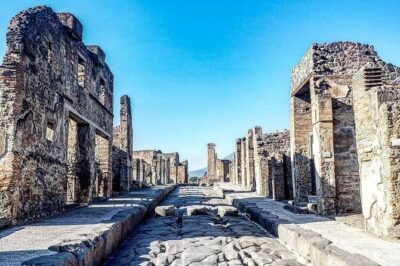
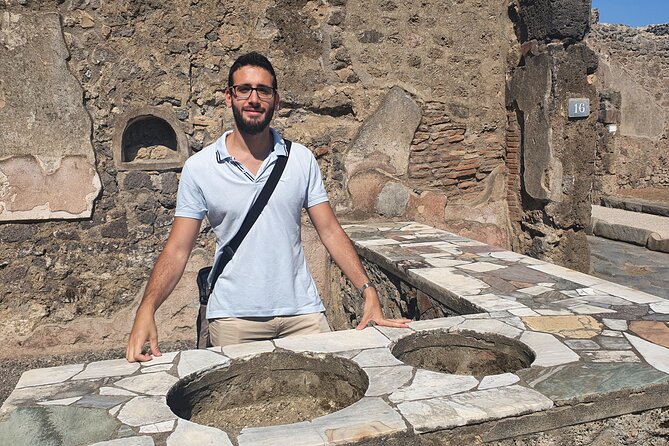
Via dell’Abbondanza was Pompeii’s main commercial street. Walking here gives you a break from grand villas and temples. You will see shops, houses, and public fountains along the road, with the street itself serving as evidence of daily routines.
The stop lasts about 15 minutes. Look down as well as around you. The paving, building fronts, and water points help you picture how people moved through the city and obtained basic services. Pompeii becomes more human on this street. It is less about famous objects and more about the practical shape of ancient urban life.
The itinerary’s many short stops can feel busy here. If you want to study storefronts or ask about street design, tell your guide early. The private format gives you a better chance of adjusting the emphasis, though the total four-hour limit still matters.
Small theater, baths, and the public side of Roman life
The Odeon, or Small Theater, was used for music and poetry. Its precious marble floor is one of the details worth noticing. The visit lasts about 10 minutes, enough to see the form of the building and understand how performance fit into public life.
The Stabian Baths offer a different kind of Roman experience. This public bathing complex included a gym, swimming pool, and rooms for sauna and massage. You have about 15 minutes here. The stop helps explain that Roman baths were not only places to wash. They were social and recreational spaces where exercise, conversation, relaxation, and personal care came together.
The Basilica is another useful correction to a common misunderstanding. Despite its name, this was not a Christian church. It was a Roman courthouse and civic building. A 10-minute visit lets you look at its architectural details and understand how legal and commercial business operated in the Forum area.
Temples, gardens, and the final Pompeii views
The Temple of Venus sits in a panoramic position and is dedicated to Pompeii’s principal goddess. The 10-minute stop connects religion with the city’s setting, especially the views toward Vesuvius and the surrounding area.
The House of Venus in the Shell provides a more intimate finish. It is near the amphitheater and is known for its garden and a fresco showing the birth of Venus. The 10-minute visit gives you another example of how painted walls and planted spaces shaped a Roman home.
The Lupanar, or brothel, is optional at your discretion. It has erotic frescoes and is one of Pompeii’s most talked-about buildings. You have about 15 minutes if you choose to include it. This is a good place to ask your guide about how much is known, what is inferred, and how modern labels can simplify ancient spaces.
Because the Lupanar can be of interest to adults but less suitable for every family group, the option to skip it is useful. The same flexibility applies to the route as a whole. Families have found guides such as Martina patient with children, explaining the ruins in ways that make the historical importance easier to grasp.
What the guides add to the experience
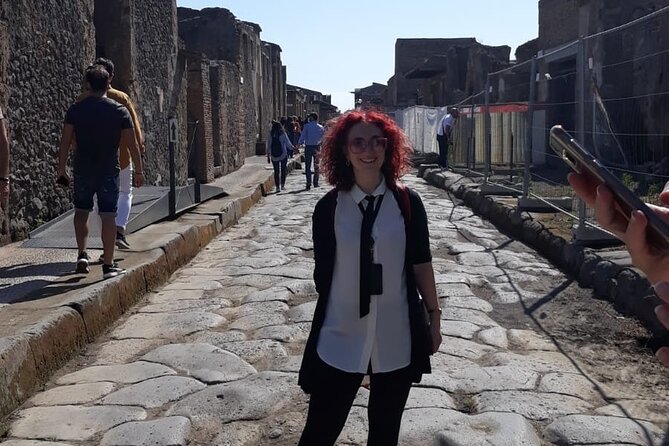
The guide is the reason to choose this tour instead of walking into Pompeii with a map. Luciano has been praised for being professional, personal, and interactive. Martina has been singled out for working well with children and for adjusting the route to specific interests and meeting arrangements.
Annalise has led a shorter private visit that focused on the major highlights, while Ernesto has guided visitors in clear French. A German-language visit with Martina was also described as patient and considerate. The advertised language for this experience is English, so confirm your language needs when booking if English is not your first choice.
The strongest pattern is not a single scripted style. It is the ability to explain the site at the right level, answer questions, and make adjustments. One person was able to meet the guide earlier than planned, while another changed the meeting entrance and requested particular sites. These examples do not guarantee the same arrangement for every booking, but they show why it is worth asking for what you need.
Is $203.70 per person a fair price?
At $203.70 per person, this is not a budget way to enter Pompeii. The archaeological park ticket is separate at €20 per person, bringing the basic cost higher for most adults. Visitors under 18 receive a free park ticket, and EU citizens aged 18 to 25 pay €2 with valid identification.
The price makes more sense for a small private group that values a dedicated guide. Split among several people, it buys four hours of focused attention, route planning, and the ability to shape the visit. For one or two people who are comfortable reading signs and exploring on their own, the cost may feel high.
The tour is also a better buy if Pompeii is a major reason for your trip. A rushed two-hour visit can leave you wanting more, especially when the city’s size and the number of important buildings are considered. Four hours gives you a useful framework, though you should not expect to see every open corner.
Practical details that can make the day easier
Start with comfortable shoes. Pompeii requires walking, and the site includes ancient streets and uneven surfaces. Sunglasses, a hat, and comfortable clothing are specifically recommended.
Backpacks cannot be larger than 30 by 30 by 15 centimeters. Pack lightly so you are not turned away or slowed down at the entrance. Service animals are allowed, and the experience is near public transportation. Most people can take part.
The tour starts at Piazza Esedra in Pompeii and normally ends there. If you prefer, it can end at the Piazza Esedra exit. The park admission is not included, so budget for that separately and check the age-based ticket rules before you arrive.
Free cancellation is available if you cancel at least 24 hours before the local start time. Cancellations or changes made less than 24 hours before the start are not refunded or accepted.
Who should book this Pompeii tour?
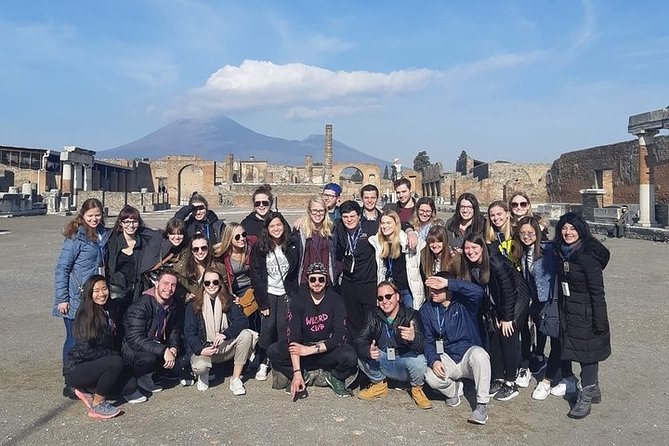
I would choose this tour for a family, a couple, or a small group that wants context without being tied to strangers. It is especially suitable if you want help understanding mosaics, frescoes, temples, and Roman homes rather than simply photographing them.
It also suits repeat visitors who want to request certain buildings or focus on archaeology. The private setup gives you a better chance to shape the visit, although availability and the four-hour limit still apply.
I would skip it if you prefer a slow, unstructured day or if the price is difficult to justify. Pompeii can be explored independently, and the extra €20 admission fee needs to be included in your budget.
FAQ
How long is the Pompeii 360° tour?
The tour lasts approximately four hours.
Is the Pompeii entrance ticket included?
No. Admission to the Archaeological Park of Pompeii costs €20 per person and is not included in the tour price.
Do children pay the Pompeii entrance fee?
Visitors under 18 receive a free ticket to the archaeological park. EU visitors aged 18 to 25 pay €2 per person with valid identification.
Where does the tour start and end?
The meeting point is Piazza Esedra, 80045 Pompei, Italy. The tour normally ends at the same location, though it can end at the Piazza Esedra exit at the customer’s discretion.
Is this a private tour?
Yes. Only your group participates in the activity.
What should I wear and bring?
Wear comfortable clothing and shoes, and bring sunglasses and a hat. Backpacks must be no larger than 30 by 30 by 15 centimeters.
What is the cancellation policy?
You can cancel for a full refund up to 24 hours before the experience starts. Changes or cancellations made less than 24 hours before the local start time are not accepted or refunded.
Should you book it?
Book this Pompeii tour if you want a private archaeology-led visit and plan to give Pompeii a serious half-day. The route covers an unusually broad mix of sites, from the amphitheater and Forum to the House of the Faun, Stabian Baths, theaters, shops, temples, and plaster casts.
The best reason to book is the guide’s ability to make choices for you. Ask for a family-friendly pace, request specific houses, or focus on art, religion, public life, or the eruption. Just remember that the €203.70 price is per person, the €20 park ticket is extra, and four hours will feel full rather than leisurely.
Newest reviews from Pompeii Ruins
- Wine Tour + Pompeii★ 5.0 · 4 reviews
- Full-Day Sorrento Positano Pompeii Tour★ 5.0 · 4 reviews
- Pompeii: Skip The Line Entrance Tickets + Audioguides★ 3.2 · 4 reviews
- Pompeii: Entry Ticket & Guided Tour with an Expert Historian★ 5.0 · 4 reviews
- Pompeii ruins★ 5.0 · 4 reviews
- Private Tour Pompeii and Winery★ 5.0 · 4 reviews
- Visit the Pompeii ruins from Salerno with Pizza Lunch★ 5.0 · 4 reviews
- Pompeii Private Tour for Kids and Their Families★ 4.8 · 4 reviews
Guided, compared.

Entry Ticket and Guided Tour with an Archaeologist
Read our review →

Skip-the-Line Entrance Ticket with Audio Guide
Read our review →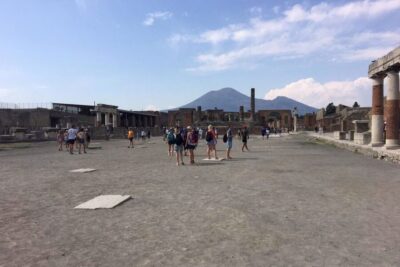



Skip-the-Line Entry Ticket with Digital Guide App
Read our review →