Reviewed · GUIDED
Fast Access Exclusive Private Ancient Pompeii Half Day Tour with Local Guide
Pompeii is easiest to understand when someone helps you read its streets, walls, theaters, and shops. This private tour with priority entry takes you straight into the ancient city, where a local guide explains both the eruption of Vesuvius and the ordinary Roman life preserved beneath the ash. Early morning starts can help you reach key areas before crowds build.
I like the one-group format, which lets you ask questions and adjust the focus toward mosaics, plaster casts, theaters, or daily life. I also like the practical pacing: in about two hours, you cover the major sights without spending half your visit deciding where to go. The main drawback is the price, $203.95 per person, which may feel high for a short tour, especially for a solo visitor or small party.
In This Review
- Key points to know
- Why a private two-hour visit can work well at Pompeii
- Meeting at Piazza Esedra
- Teatro Grande and the sound of Roman entertainment
- Odeon, Pompeii’s smaller theater
- Walking Via dell’Abbondanza
- Terme del Foro and Roman bathing culture
- The Lupanar and Pompeii’s frankest paintings
- What the guide adds to the ruins
- Price, timing, and group value
- Who should book this Pompeii tour
- Cancellation and planning details
- Should you book it?
- FAQ
- How long does the Pompeii tour last?
- Where does the tour begin?
- Where does the tour end?
- Is hotel pickup included?
- Is the tour private?
- Is entrance to Pompeii included?
- What language is the tour offered in?
- Can I choose a morning or afternoon start?
- What sights are included?
- Can children join the tour?
- What happens if the weather is bad?
- Do I need identification?
- Can I cancel for a full refund?
Key points to know
- Priority access: Your guide helps you avoid the long entrance lines and get into the archaeological site with less waiting.
- Private attention: Only your group takes part, so you can ask questions and request extra attention to subjects that interest you.
- Major Pompeii sights: The route includes the Teatro Grande, Odeon, Via dell’Abbondanza, Forum Baths, and Lupanar.
- Morning or afternoon choice: You can select a time that fits your wider Pompeii or Naples plans.
- Guides with different strengths: Anna, Livio, and Lello are among the guides named in guest feedback, with Lello especially praised for an interesting, well-paced visit.
- A fast but physical visit: Expect steady walking over an ancient site, with a moderate fitness level recommended.
Why a private two-hour visit can work well at Pompeii
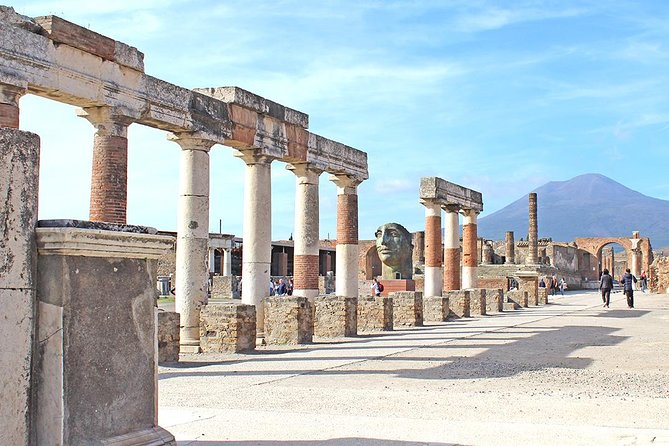
Pompeii is not a compact museum. It is a large archaeological site with streets, public buildings, homes, shops, and open spaces spread across an ancient city. Without a plan, you can spend much of your time checking a map and still miss the places that give the site its character.
A private guide solves that problem quickly. Your guide can lead you toward the best-known buildings and explain what you are seeing as you go, rather than leaving you to piece together a story from scattered signs. The visit is short, but the route includes several different sides of Pompeii: entertainment, shopping, bathing, religion, and private life.
The private format matters most if you are visiting with family or a small group. You are not tied to the questions or pace of strangers. If mosaics catch your eye, you can ask for more detail. If you are especially interested in the plaster casts or Roman shops, you can tell the guide at the start.
The published duration is about two hours. One family’s visit with Lello lasted about two and a half hours, so the exact timing may vary. Plan for a focused overview rather than an exhaustive day inside Pompeii.
More Pompeii excavation visits:
- Pompeii: Entry Ticket and Guided Tour with an Archaeologist
★ 4.8 · 19,459 reviews - Pompeii: Entry Ticket with Optional Audio Guide
★ 4.2 · 12,360 reviews - Pompeii: Small Group Tour with an Archaeologist
★ 4.8 · 12,264 reviews
Meeting at Piazza Esedra
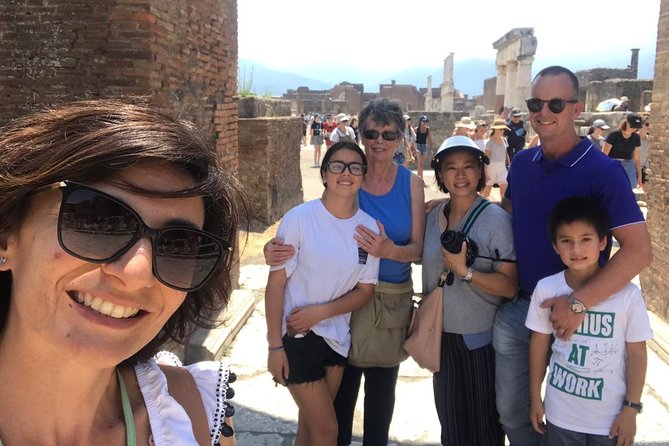
The tour begins at Piazza Esedra in Pompei, at 80045 Pompei NA, Italy. It ends back at the same meeting point, and hotel pickup and drop-off are not included.
That makes the starting point important. You need to arrange your own way to Piazza Esedra and leave enough time to find the guide before the scheduled start. The area is near public transportation, which helps if you are coming from another part of Pompeii or nearby towns.
The guide’s name may vary. Anna, Livio, and Lello are among the guides associated with especially positive visits. One useful detail from an early tour with the host was the use of a less crowded entrance, allowing the group to reach important areas before the site filled up. I would choose the earliest available start if avoiding crowds is a top concern.
You should also bring a current valid passport. This requirement is specifically stated for the day of the tour. Children must be accompanied by an adult.
Teatro Grande and the sound of Roman entertainment
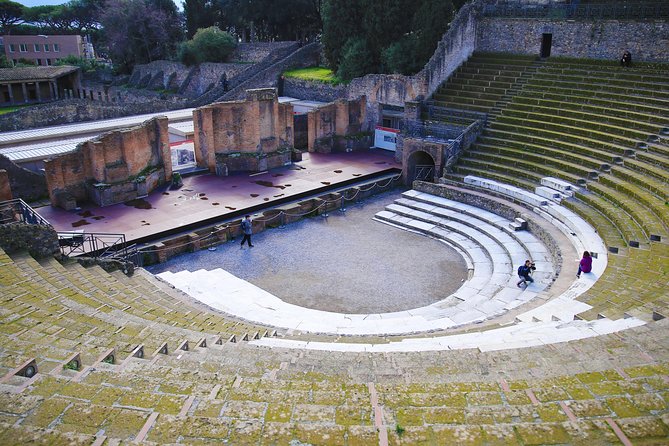
The Teatro Grande is a good opening sight because it immediately shows that Pompeii was a working city with public entertainment, not simply a collection of ruined houses. This open-air theater held about 5,000 people.
Your guide can help you picture how the space functioned, from the seating area to the stage and the flow of people arriving for a performance. The size is striking, but the real value comes from connecting the building to everyday Roman habits. Pompeii’s residents spent time here for the same broad reason people attend public performances today: entertainment was a shared part of city life.
The theater is also a useful place to ask questions about social divisions in Roman public spaces. Seating and access were not necessarily equal, and a guide can provide the context that a quick photograph cannot.
The stop is planned for about 20 minutes. That is enough for an explanation and a look around, but not enough for a long architectural study. If theater design is your main interest, mention it early so your guide can give the subject more attention.
Odeon, Pompeii’s smaller theater
The Odeon, or Teatro Piccolo, held about 800 people. Its smaller size gives it a different feel from the Teatro Grande, and seeing both theaters in the same visit makes the contrast clear.
A smaller venue suggests a more intimate setting for performances. The important point is not only the number of seats, but what the pair of theaters tells you about Pompeii’s public life. The city had more than one kind of performance space, serving different audiences and occasions.
The planned stop lasts about 20 minutes. This is another place where a guide adds value by explaining how the building fits into Pompeii as a whole. You can also compare the two theaters while the details are still fresh.
If you are taking photographs, the Odeon gives you a chance to look at the shape and scale of the theater without treating it as just another stone ruin. The guide’s explanation helps turn a short stop into a useful piece of the city’s story.
More Pompeii Ruins tours worth comparing
- Pompeii Ruins Private Tour with Optional Skip-the-Line Entry
★ 4.9 · 732 reviews - Pompeii private tour with an Official Guide
★ 5.0 · 631 reviews - Pompeii Private Tour with an Archaeologist and Skip The Line – 3 hours
★ 5.0 · 564 reviews - Visit in Pompeii – Pompeii Private Tour with Ada
★ 5.0 · 436 reviews
Walking Via dell’Abbondanza
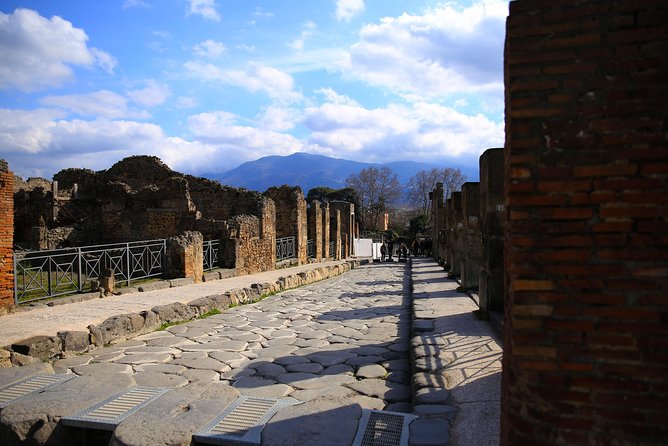
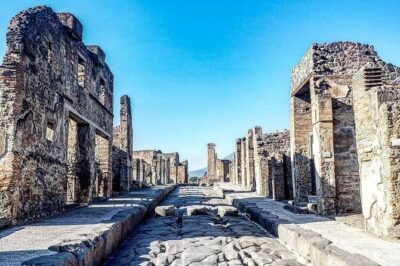
Via dell’Abbondanza was one of Pompeii’s main streets. Walking here brings you close to the part of the ancient city that feels most immediate: shops, homes, and the daily movement of people.
The route includes major villas and ancient Roman shops. This is where I would pay close attention to the ordinary details. Public buildings can impress you, but a street lined with businesses and residences helps you imagine how the city worked from morning to evening.
Your guide may point out features that are easy to pass without noticing. The appeal of a private visit is that you can stop and ask what a space was used for, who might have entered it, and how it related to the homes and public buildings nearby.
The stop is listed as about 20 minutes, so this is a guided walk rather than a long, leisurely stroll down every side street. Wear comfortable shoes. Pompeii requires steady walking, and a moderate level of physical fitness is recommended.
The ancient paving and uneven surfaces can also make the visit tiring for some people. The tour operates in all weather, so dress for the conditions. A light, practical outfit is wiser than anything that makes walking difficult.
Terme del Foro and Roman bathing culture
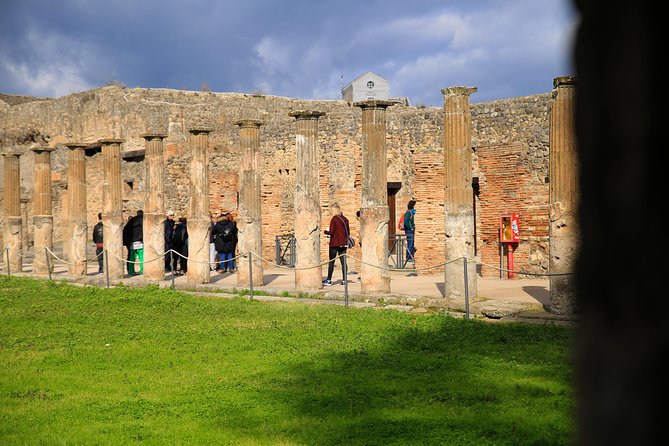
The Terme del Foro is a Roman bath complex buried by the eruption of Vesuvius in 79 AD. Bathhouses were important social spaces, and this stop gives you a look at a part of Roman life that was neither purely private nor purely political.
The baths help balance the tour. After the scale of the theaters and the activity of the main street, you get a more focused look at public facilities used for washing and social contact. Your guide can explain how the complex functioned and why baths mattered in Roman towns.
The scheduled visit lasts about 20 minutes. That short period works well for a first look, especially when the guide links the building to wider daily routines. If you want detailed discussion of Roman engineering or heating systems, ask whether the guide can spend more time here.
Pompeii is at its best when you move between grand and ordinary spaces. The bath complex provides that change of scale. It also reminds you that the city was not frozen as a ceremonial site. People lived, worked, washed, socialized, and went about routine tasks here until the eruption interrupted everything.
The Lupanar and Pompeii’s frankest paintings
The Lupanar is the ancient Roman brothel, and some frescoes remain visible. The paintings illustrate the specialties of the women who worked there, making this one of Pompeii’s most direct glimpses into commercial sex and private life.
This stop can be uncomfortable for some families, so consider the interests and ages of everyone in your group. The guide can provide context without reducing the building to a collection of amusing images. The Lupanar is valuable because it shows a side of Roman society that formal monuments often leave out.
It is also a popular part of Pompeii, so priority entry and a well-timed route can matter here. The visit is planned for about 20 minutes. Ask questions if you want to understand the frescoes, the layout, or the place of the building within the city.
The Lupanar is not necessarily the only private-life site worth seeing in Pompeii, but it is among the most memorable. If your main interest is domestic life, erotic art, or social customs, tell the guide before you begin. A private tour gives you more room to shape the emphasis.
What the guide adds to the ruins
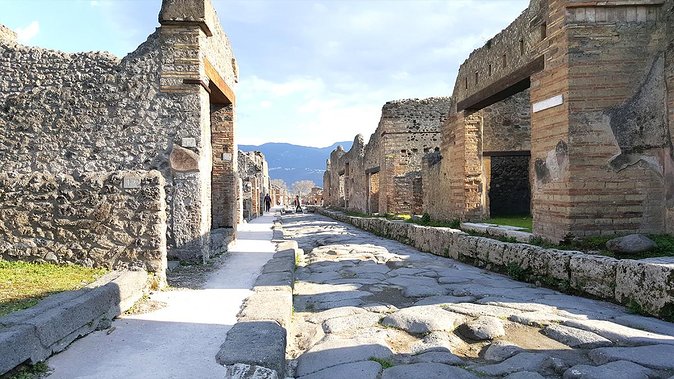
The quality of this visit depends heavily on the individual guide. A good guide does more than identify buildings. The guide connects each place to a larger picture of Pompeii and keeps the pace moving when the site is crowded or the weather turns unpleasant.
Anna is described as punctual and effective at helping the group avoid lines and move into different areas with priority. Livio is described as fun to spend time with and well informed about the site. Lello is praised for enthusiasm, an informative approach, and a pace that worked well for a family.
Those details point to the main strength of the experience: the human element. You are not simply hiring an entrance ticket. You are paying for someone to organize a short visit, explain what matters, and help you use your limited time well.
The guide can also help with photographs. One early group received assistance taking pictures, a small service that can be useful when you want a group shot without handing your phone to a stranger.
Still, the guide’s style may vary. The experience includes a local guide, professional guide, and professional art historian guide, but the specific person is not guaranteed in the information provided. If a particular subject matters to you, state your interests at the beginning.
Price, timing, and group value
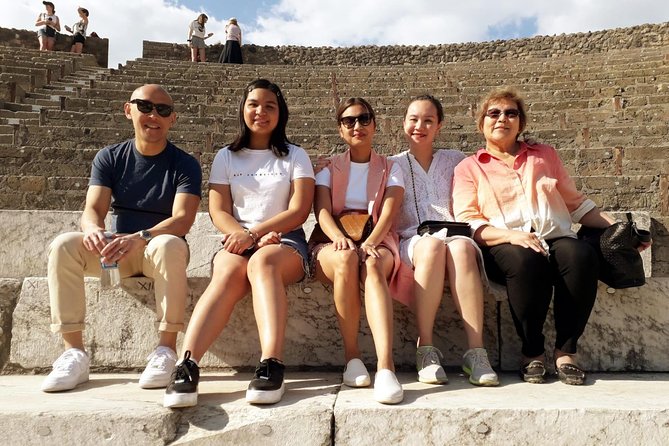
At $203.95 per person, this is not a budget way to see Pompeii. The price makes the most sense when you value private attention, priority access, and a tightly planned route.
For a couple or family, the cost buys more than commentary. You avoid spending time in long lines, and you can ask questions without waiting for a large group to catch up. The group discount feature may improve the value for a larger party, though the exact discount is not provided.
For one person, the price is harder to justify unless your schedule is tight or you strongly prefer a private guide. A shared tour or self-guided visit may cost less, but those options would not provide the same control over the pace and subject matter.
The two-hour length is another value question. It is enough for the major stops listed here, but Pompeii contains more than any short visit can cover. I would choose this tour if you have limited time and want a clear introduction. I would look for a longer option if Pompeii is one of the main reasons for your trip.
Morning and afternoon departures give you useful flexibility. The early start appears especially attractive if you want a quieter entrance and a chance to reach major areas before the day becomes busier. Afternoon may suit you better if you are coordinating with other plans.
Who should book this Pompeii tour
This tour suits you best if you want a private introduction rather than a full-day archaeological study. It works particularly well for couples, families, and small groups who prefer to ask questions and keep moving.
It is also a good match if you are visiting Pompeii on a tight schedule. The route covers the main theater, smaller theater, central street, baths, and Lupanar, giving you several types of site in a short period.
You should think twice if you dislike walking, need hotel transportation, or want a slow visit with long periods for independent exploration. The meeting point is fixed, transport is not included, and a moderate fitness level is advised.
Families should remember that children must be accompanied by an adult. The Lupanar may also require some thought depending on the ages and interests of your children.
The tour is offered in English. Dress for the weather because it operates in all conditions. Comfortable footwear is essential for a site where you will spend the visit on foot.
Cancellation and planning details
You receive confirmation at booking. Free cancellation is available if you cancel at least 24 hours before the scheduled start time. Cancellations made less than 24 hours before the start are not refunded, and changes inside that period are not accepted.
Cutoff times use local time in Italy. Keep that in mind if you are booking from another country.
Because the tour ends where it starts, you can plan your next activity from Piazza Esedra. Hotel pickup and drop-off are not part of the service, so allow time for your own transportation before and after the visit.
Should you book it?
Book this tour if you want to see Pompeii’s essential sights with a private English-speaking guide and as little entrance-line waiting as possible. Anna, Livio, and Lello are names associated with strong visits, and the early-start strategy can help you reach important buildings before crowds grow.
I would recommend it most for a couple or family that values structure and personal attention. The price is high for two hours, but the private format and priority access can make it worthwhile when your time is limited.
Skip it if you want the lowest possible cost, plan to spend most of the day at Pompeii, or prefer to wander alone. For everyone else, this is a focused way to make a short visit count.
FAQ
How long does the Pompeii tour last?
The tour lasts approximately two hours. The exact duration may vary, and one reported family visit lasted about two and a half hours.
Where does the tour begin?
The meeting point is Piazza Esedra, 80045 Pompei NA, Italy.
Where does the tour end?
The activity ends back at the meeting point.
Is hotel pickup included?
No. Hotel pickup and drop-off are not included.
Is the tour private?
Yes. Only your group participates in this private activity.
Is entrance to Pompeii included?
Yes. Admission tickets are included, along with guaranteed assistance to skip long lines.
What language is the tour offered in?
The tour is offered in English.
Can I choose a morning or afternoon start?
Yes. Morning and afternoon tour options are available.
What sights are included?
The route includes Pompeii, Teatro Grande, the Odeon or Teatro Piccolo, Via dell’Abbondanza, Terme del Foro, and the Lupanar.
Can children join the tour?
Yes, but children must be accompanied by an adult. A moderate level of physical fitness is recommended for all participants.
What happens if the weather is bad?
The tour operates in all weather conditions, so you should dress appropriately.
Do I need identification?
Yes. A current valid passport is required on the day of the tour.
Can I cancel for a full refund?
Yes, if you cancel at least 24 hours before the experience start time. Cancellations made less than 24 hours before the start are not refunded.
Newest reviews from Pompeii Ruins
- Private Tour Pompeii and Winery★ 5.0 · 4 reviews
- Visit the Pompeii ruins from Salerno with Pizza Lunch★ 5.0 · 4 reviews
- Pompeii Private Tour for Kids and Their Families★ 4.8 · 4 reviews
- From Sorrento: Pompeii & Vesuvius tour small group★ 4.8 · 4 reviews
- Pompeii Sorrento and Positano Tour★ 5.0 · 4 reviews
- From Naples_ Pompeii Tour_Skip the line ticket + audioguide★ 4.3 · 4 reviews
- Pompeii, skip-the-line ticket with smartphone audio guide on App★ 3.0 · 4 reviews
- Pompeii Private Half-Day Tour from: Naples,Sorrento, Amalfi Coast★ 5.0 · 4 reviews
Guided, compared.

Entry Ticket and Guided Tour with an Archaeologist
Read our review →

Skip-the-Line Entrance Ticket with Audio Guide
Read our review →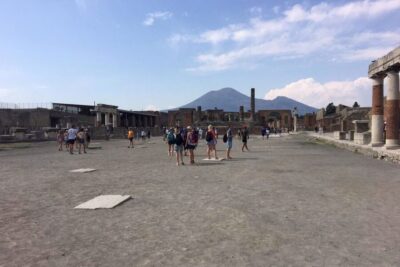



Skip-the-Line Entry Ticket with Digital Guide App
Read our review →