Reviewed · POMPEII RUINS TOURS
Wheelchair Accessible Skip-the-lines Tour of Pompeii Including all Highlights
Pompeii is easier to visit when someone knows which ancient streets, buildings, and ramps work best for a wheelchair. This private tour follows a special route of about 2 kilometers, taking you through the Forum, theaters, baths, homes, mills, Gladiators’ Gym, and Lupanare, the house known for its erotic frescoes.
I like the skip-the-line ticket and the fact that only your group takes part. I also like the guide-led storytelling, since Pompeii can otherwise feel like a vast field of ruins without enough clues. The main drawback is getting to the meeting point: this tour does not include transport, and one booking party found the journey from Rome involved three trains.
In This Review
- Key points to know before booking
- Why this Pompeii route matters for wheelchair users
- Starting at the Amphitheatre of Pompeii
- Following the ancient streets for two hours
- The Forum and public life in Pompeii
- Theaters, baths, and the Gladiators’ Gym
- Domus, mills, and the Lupanare
- What the private format adds
- Is $254.67 per person good value?
- Who should book this Pompeii experience?
- Cancellation and planning advice
- Should you book this accessible Pompeii tour?
- FAQ
- How long does the Pompeii tour last?
- Where does the tour begin?
- Where does the tour end?
- Is admission to Pompeii included?
- Is this a private tour?
- Is the tour wheelchair accessible?
- Can I use a mobility scooter?
- Is transport to Pompeii included?
- Can I cancel for a full refund?
Key points to know before booking
- A 2-kilometer accessible route: The itinerary is designed to make major parts of Pompeii reachable by wheelchair and mobility scooter.
- A private two-hour visit: Your own group joins the guide, so the pace can be more personal than on a large group tour.
- Major highlights included: Expect the Forum, theaters, thermal baths, domus, mills, Gladiators’ Gym, Lupanare, and other key ruins.
- Guides add the human story: Guides such as Momma and Mariano have been singled out for warmth, humor, and care with mobility needs.
- Transport is your responsibility: The meeting point is at the Amphitheatre of Pompeii, not in Rome or Naples.
- The price buys access and help: At $254.67 per person, this is costly, but the value improves for anyone who needs a practical route and personal assistance.
Why this Pompeii route matters for wheelchair users
Pompeii is not a tidy archaeological museum. It is an ancient city spread across a large site, with uneven surfaces, old paving stones, slopes, and long stretches between major buildings. For someone using a wheelchair or scooter, simply arriving at the entrance does not guarantee an easy visit.
This tour uses a planned accessible path of about 2 kilometers. That does not mean every corner of Pompeii is reachable, or that the route will feel like a modern paved promenade. It means the guide has a route designed to connect as many major sights as possible while keeping access in mind.
That distinction matters. You are not buying a general walking tour and hoping the guide can improvise around the site. You are booking a private visit built around a route intended to include people with mobility needs.
The experience is also useful for families. A person recovering from an injury, using a walking boot, or alternating between walking and a wheelchair may find the planned route less stressful than trying to work out Pompeii alone. One account describes a participant in a walking boot using a wheelchair while the guide led the family through the ruins.
I would still contact the provider before booking if your chair is unusually wide, your scooter is large, or you need very specific assistance. The supplied information confirms wheelchair and scooter access in practice, but it does not give vehicle-width limits, restroom details, or a full surface report.
More Pompeii excavation visits:
- Pompeii: Entry Ticket and Guided Tour with an Archaeologist
★ 4.8 · 19,459 reviews - Pompeii: Entry Ticket with Optional Audio Guide
★ 4.2 · 12,360 reviews - Pompeii: Small Group Tour with an Archaeologist
★ 4.8 · 12,264 reviews
Starting at the Amphitheatre of Pompeii
The tour begins at the Amphitheatre of Pompeii, at Piazza Immacolata in Pompei. This is an important detail if you are coming from Rome, Naples, or another base. The ticket does not include a pickup, and the tour does not begin in central Rome.
The meeting point is especially important for anyone who needs step-free transport. One booking party found that reaching Pompeii from Rome required three trains and only discovered the problem while planning the route the night before. The practical lesson is simple: check your entire journey to Piazza Immacolata before paying for the tour.
Once you arrive, the guide takes over the complicated part. You will not need to build your own route through the archaeological park or guess which buildings can be reached by a wheelchair.
The tour ends back at the same meeting point. That makes planning easier, since you are not left at a different gate or on another side of the archaeological park.
Following the ancient streets for two hours
The guide’s job here is more than naming buildings. Pompeii works best when you understand it as a city where people lived, worked, worshipped, bathed, shopped, and sought entertainment before the eruption of Mount Vesuvius in 79 AD.
As you move along the ancient streets, the guide explains daily life in Roman times and points out details that can be easy to miss. The preserved streets and buildings give you a sense of how the city was organized, but the stories help turn stone walls into homes, businesses, public spaces, and places of leisure.
The route is about 2 kilometers and lasts roughly two hours. That is enough time for a focused introduction to Pompeii, but not enough for every street and building. You should think of this as a highlights tour, not a complete archaeological survey.
That shorter format can be a benefit. Pompeii is physically demanding even when access is good, and a two-hour visit gives you a defined goal. If you want to study every fresco, inscription, and side street, you will need more time. If your priority is seeing the main sights without exhausting yourself, the length is sensible.
One guide named Momma is described as warm, entertaining, and deeply familiar with Pompeii’s past. That kind of personality matters here. A guide who treats you like a companion rather than a number can make the pace feel less formal, especially when your group needs extra time at a doorway or on a rough section of pavement.
The Forum and public life in Pompeii
The Forum is one of the essential stops. This was the civic heart of Pompeii, where public, religious, and commercial life came together.
Your guide uses the open space and surrounding structures to explain how the city worked. You can expect to hear about Roman public life rather than simply receive a list of dates and architectural terms.
For wheelchair users, the Forum also provides a useful sense of scale. Pompeii is not just a collection of isolated houses. The broad public spaces help you understand the relationship between the streets, temples, shops, and civic buildings.
Because the route is adapted for access, your exact viewing position may differ from that of someone walking freely through every section. A private guide is valuable here because the experience can be explained from the accessible route rather than treated as a one-size-fits-all visit.
A completely different way to spend a day in Pompeii Ruins:
- Pompeii Small Group Tour with an Archaeologist
★ 5.0 · 6,593 reviews - Pompeii: Skip-the-Line Entrance Ticket with Audio Guide
★ 4.0 · 2,509 reviews - Naples: Pompeii and Mt. Vesuvius with Lunch and Wine Tasting
★ 4.5 · 2,454 reviews - Pompeii: Archaeological Park Tour with Ticket on request
★ 4.5 · 2,283 reviews
Theaters, baths, and the Gladiators’ Gym
The itinerary includes Pompeii’s theater area, thermal baths, and Gladiators’ Gym. These places show the social side of Roman life, from public performances to bathing and athletic preparation.
The theater gives the ruins a human scale. It was a place for shared entertainment, not simply an impressive stone structure. The baths reveal how important washing, exercise, and social contact were in Roman daily life.
The Gladiators’ Gym adds a more dramatic chapter. The name alone can tempt a guide into exaggeration, so listen for the practical details about how the complex functioned and how it fit into the city.
The route also includes the thermal baths. These interiors may have uneven approaches or restricted areas, which is one reason a guide familiar with the accessible path helps. The supplied details do not promise that every room or threshold is fully reachable, so you should expect the guide to show you the best available viewpoints rather than guarantee complete access to every section.
Domus, mills, and the Lupanare
Pompeii’s private houses, or domus, are among the most revealing stops. The remains show how Roman families arranged domestic space and how decoration could signal status.
A guide can help you read these homes as lived-in places. Look for the relationship between rooms, courtyards, wall decoration, and household activity. Even when only walls and floors remain, the layout gives you a glimpse of ordinary routines.
The mills add another practical layer. They connect the grand public buildings with the work that fed the city. Pompeii was not only a place of temples and theaters. It was also a working town with food production, trade, and daily labor.
The Lupanare is famous for its erotic frescoes. This is one of Pompeii’s most talked-about stops, but the guide’s explanation should give it context rather than turn it into a cheap joke. The paintings and small rooms provide a glimpse into an aspect of Roman society that can be uncomfortable, fascinating, or both.
The Lupanare may also be one of the places where access is limited by the ancient structure itself. The tour includes it among the major highlights, but inclusion should not be read as a promise that every interior space is reachable by every chair or scooter. Ask the provider for current access details if this sight is a top priority.
What the private format adds
This is a private tour, so only your group participates. That is a major advantage for a wheelchair user, a family, or anyone who needs a slower and more flexible pace.
In a large group, you may feel pressure to keep moving while the guide talks ahead of you. Here, the guide can stop, adjust the route, repeat an explanation, and give your party more time at a sight.
The private format also helps mixed-mobility groups. One person may walk, another may use a wheelchair, and a third may need frequent pauses. The itinerary is still fixed at about two hours, but the setting is more personal than a standard group excursion.
A guide named Mariano has been associated with taking special care of a guest using a mobility scooter and making sure that person could see as much as possible. That is the kind of attention you are paying for here: not just archaeological information, but help making the site workable.
There is one limit. Private does not mean unlimited. The route remains tied to the accessible path, the archaeological park’s conditions, and the two-hour schedule. If you need a very slow pace, ask whether the full listed route can still be completed comfortably.
Is $254.67 per person good value?
At $254.67 per person, this is an expensive Pompeii tour. The price is far above a basic admission ticket or a large group walk.
The value comes from three things: skip-the-line admission, a private guide, and a route planned around wheelchair access. If you can walk easily and are happy to navigate Pompeii independently, the price may be hard to justify.
If you use a wheelchair or scooter, the calculation changes. Finding a workable path through a vast ancient site can take time, patience, and research. A private guide reduces that burden and gives your group a better chance of seeing the main sights without wasting energy on inaccessible routes.
Families may also find the cost easier to justify when several people can share the private experience, though the listed rate is per person and group discounts are available. Ask how the discount applies to your party before booking.
Tips are not included. You should treat that as a separate cost if you want to thank the guide, but tipping is not part of the advertised price.
Who should book this Pompeii experience?
I would put this tour high on the list for anyone using a wheelchair or mobility scooter who wants to see Pompeii with a guide rather than attempt the site alone. It also suits families with mixed mobility, people recovering from an injury, and visitors who prefer a private pace.
The tour is a good fit if you want the major sights in two hours. You will see the Forum, theaters, baths, domus, mills, Gladiators’ Gym, Lupanare, and other important remains without trying to cover every part of the park.
I would hesitate if you are starting from Rome and have not confirmed the journey to Pompeii. The tour begins at the Amphitheatre of Pompeii, and the transport challenge may be greater than the archaeological visit itself.
I would also hesitate if you want a long, highly detailed exploration of the entire city. Two hours is a useful introduction, but Pompeii is too large for one short route to cover everything.
Cancellation and planning advice
You can cancel for a full refund up to 24 hours before the start time. Changes or cancellations made less than 24 hours before the start are not accepted for a refund, and the cut-off follows local time.
Confirmation arrives when you book, and mobile tickets are supported. Service animals are allowed, and the site is near public transportation. The activity is described as suitable for most people, but mobility equipment can vary widely, so give Accessible Italy Tours clear details about your chair or scooter before the visit.
Should you book this accessible Pompeii tour?
Book it if wheelchair access, a private guide, and the major Pompeii sights matter more to you than finding the lowest price. The planned 2-kilometer route and personal attention can make the difference between seeing Pompeii with confidence and spending the visit worrying about surfaces and entrances.
Before booking, solve the transport question first. Confirm how you will reach Piazza Immacolata, then ask about your specific wheelchair or scooter. If that plan works, this is a practical and thoughtful way to see the ancient city in a focused two-hour visit.
FAQ
How long does the Pompeii tour last?
The tour lasts approximately two hours.
Where does the tour begin?
It begins at the Amphitheatre of Pompeii, Piazza Immacolata, 80045 Pompei, Italy.
Where does the tour end?
The activity ends back at the meeting point.
Is admission to Pompeii included?
Yes. The tour includes a skip-the-line admission ticket to Pompeii Archaeological Park.
Is this a private tour?
Yes. Only your group participates in the activity.
Is the tour wheelchair accessible?
Yes. The itinerary follows a specially planned route of about 2 kilometers designed to make Pompeii accessible to people using wheelchairs.
Can I use a mobility scooter?
The experience is suitable for mobility scooter users. One booking party specifically used a scooter during the visit.
Is transport to Pompeii included?
No. The tour begins at the Amphitheatre of Pompeii, and transport to the meeting point is not included.
Can I cancel for a full refund?
Yes. You can cancel at least 24 hours before the experience start time for a full refund. Cancellations made less than 24 hours before the start are not refundable.
Newest reviews from Pompeii Ruins
- Private Tour Pompeii and Winery★ 5.0 · 4 reviews
- Visit the Pompeii ruins from Salerno with Pizza Lunch★ 5.0 · 4 reviews
- Pompeii Private Tour for Kids and Their Families★ 4.8 · 4 reviews
- From Sorrento: Pompeii & Vesuvius tour small group★ 4.8 · 4 reviews
- Pompeii Sorrento and Positano Tour★ 5.0 · 4 reviews
- From Naples_ Pompeii Tour_Skip the line ticket + audioguide★ 4.3 · 4 reviews
- Pompeii Private Half-Day Tour from: Naples,Sorrento, Amalfi Coast★ 5.0 · 4 reviews
- Pompeii, skip-the-line ticket with smartphone audio guide on App★ 3.0 · 4 reviews
Pompeii Ruins Tours, compared.

Entry Ticket and Guided Tour with an Archaeologist
Read our review →

Pompeii Small Group Tour with an Archaeologist
Read our review →
Skip-the-Line Entrance Ticket with Audio Guide
Read our review →
Pompeii and Mt. Vesuvius with Lunch and Wine Tasting
Read our review →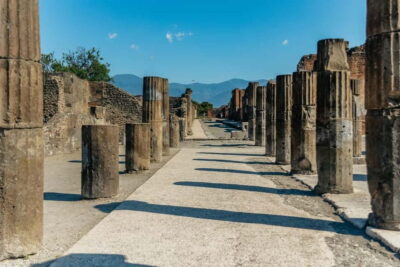
Archaeological Park Tour with Ticket on request
Read our review →