Reviewed · TICKETS
Small-Group Tour in Pompeii with a Real Archeologist, ticket included
Pompeii makes much more sense when someone explains the small clues: a mosaic warning visitors to beware of the dog, a narrow room used as a brothel, or a house built around an open-air pool. This small-group tour with an archaeologist turns a vast field of ruins into a city of real homes, businesses, temples, and public spaces.
I like the maximum group size of 15, which keeps questions possible and makes it easier to hear through a headset. I also like the focus on ordinary Roman life, not just the eruption of Mount Vesuvius. The main drawback is time: two and a half hours cannot cover every major corner of Pompeii, and some advertised houses may be closed or skipped during the guided walk.
In This Review
- Key points to know before booking
- Why an archaeologist changes the Pompeii visit
- From the Cave Canem mosaic to elegant Roman houses
- The Lupanar and the less polished side of Roman life
- The Forum, where Pompeii conducted public business
- The Suburban Baths and Pompeii’s travelers
- The House of the Faun and the House of Menander
- The amphitheatre and gymnasium area
- The Temple of Apollo and changing Roman worship
- What the two-and-a-half-hour pace feels like
- Price, group size, and what you receive
- Heat, shoes, and a smarter Pompeii day
- Who should book this Pompeii tour?
- Should you book it?
- FAQ
- How long does the Pompeii tour last?
- What is included in the price?
- How large is the group?
- Where does the tour start and finish?
- Is transportation included?
- Can I cancel for a refund?
Key points to know before booking
- An archaeologist leads the walk: Guides such as Teresa, Paolo, and Alfredo explain how to read Pompeii’s buildings, artwork, and changing interpretations.
- Priority entry is included: Your ticket gets you into the Archaeological Park without arranging separate admission.
- The group is capped at 15 people: That is small enough for questions, though not a private tour.
- Nine important sites are planned: Expect Roman houses, the Forum, the Lupanar, baths, the Temple of Apollo, and the amphitheatre area.
- The tour lasts about 2 hours and 30 minutes: Your ticket remains valid for the day, so you can continue exploring afterward.
- Prepare for heat and rough walking: Good shoes and plenty of water matter, especially in summer.
Why an archaeologist changes the Pompeii visit
Pompeii is not a tidy museum. It is a broad ancient city with streets, walls, courtyards, shops, religious buildings, and grand homes spread across a large archaeological park. Without help, you can see plenty and still miss what makes a doorway, floor, or painted wall important.
An archaeologist guide gives you a way to read the remains. You might learn how a building’s design suggests its purpose, how decoration reflects a family’s wealth, or how scholars form and test ideas about the people who lived there. Teresa, Paolo, and Alfredo are named guides associated with this experience, and each brings a slightly different style. Teresa is especially good at linking objects and buildings to Roman customs, while Paolo is praised for clear historical explanation and a steady pace. Alfredo is particularly useful on Pompeii’s main road, where shade can be scarce.
The headset is a practical touch. Pompeii can be noisy, and stone streets do not make good acoustics. You can keep your eyes on the ruins instead of leaning toward the guide or guessing at every other sentence.
The guided portion gives you structure, but it is not the whole Pompeii experience. Once the walk ends, your ticket is valid for the rest of the day, allowing you to return to places that caught your eye or seek out areas not covered with the group.
More Pompeii excavation visits:
- Pompeii: Entry Ticket and Guided Tour with an Archaeologist
★ 4.8 · 19,459 reviews - Pompeii: Entry Ticket with Optional Audio Guide
★ 4.2 · 12,360 reviews - Pompeii: Small Group Tour with an Archaeologist
★ 4.8 · 12,264 reviews
From the Cave Canem mosaic to elegant Roman houses
The first stop is the House of the Tragic Poet, a useful introduction to Pompeii’s better-off residents. The house is known for its famous Cave Canem mosaic, a black-and-white floor image warning people to beware of the dog.
This is more than a memorable photograph. The house shows how a Roman home could combine decoration, social display, and practical design. The mosaic greeted people near the entrance, while the rest of the house reflected the taste and status of its owners.
From there, the House of the Vettii offers a look at one of Pompeii’s most luxurious residences. It takes its name from Aulus Vettius Restitutus and Aulus Vettius Conviva, the men connected with the property. The house is known for its decorated rooms and careful layout around open courtyards.
The Vettii house can be one of the most rewarding stops, but access is not always predictable. A wait of around 20 minutes may occur, and a guide may decide that the group cannot spare the time. If this house matters to you, ask about it early and use your day ticket to return after the tour. That small bit of planning can prevent disappointment.
The Lupanar and the less polished side of Roman life
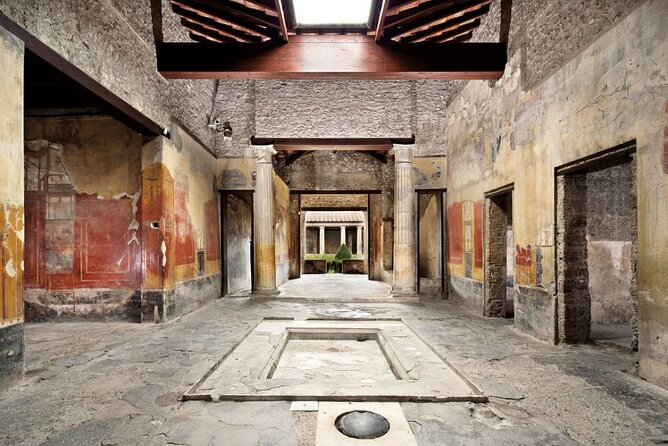
The Lupanar is one of Pompeii’s most talked-about buildings. It was a two-story brothel with five rooms on the ground floor and five above. The rooms were basic, with concrete beds that may have held a mat or mattress.
The building gives you a blunt look at a part of Roman life that grand houses and temples tend to hide. Small paintings and the cramped rooms help explain how the business worked, though the site can feel crowded because it is one of the most visited places in Pompeii.
The guide’s interpretation matters here. It is easy to reduce the Lupanar to a collection of crude images and jokes. A good archaeologist places it within the wider town, explaining that other brothels may have operated above taverns or in private homes. The point is not simply that Pompeii had a brothel. The point is that commerce, lodging, food, sex, and daily work often occupied the same streets.
Expect a short stop of about 15 minutes. That is enough for context and a quick look, but not a long, quiet examination.
The Forum, where Pompeii conducted public business
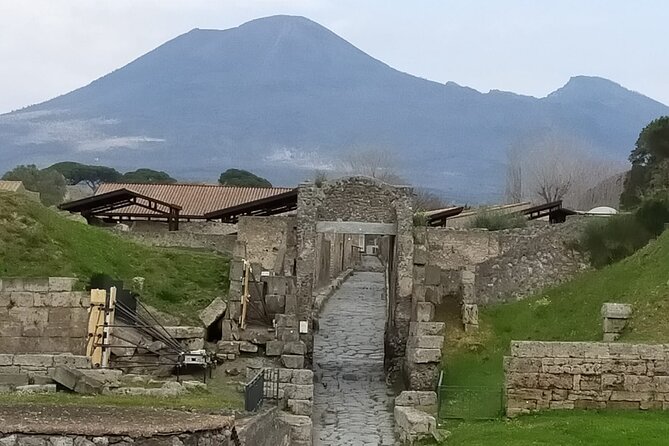
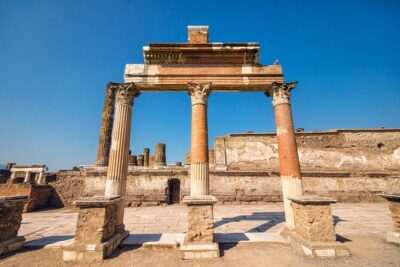
The Forum was the city’s main public square. It was reserved for pedestrians, and carts were not permitted in the central area. The space measured roughly 142 metres by 38 metres, with public buildings around it.
Today, the Forum can look surprisingly bare. Statues, marble details, and parts of the decorated paving disappeared after the eruption, likely because later digging removed them for use elsewhere. Your guide can help you picture the square as a working civic centre rather than an empty rectangle of stone.
I find this kind of explanation especially useful at Pompeii. The ruins do not always look impressive at first glance. Their value often comes from understanding what once happened there: government, worship, trade, announcements, and public gatherings.
The open Forum also shows one of the tour’s practical challenges. Shade may be limited, and summer heat can build quickly over the stone. Carry water, wear a hat if you use one, and do not underestimate the effort of walking from one exposed area to another.
More Pompeii Ruins tours worth comparing
- Pompeii: Skip-the-Line Entrance Ticket with Audio Guide
★ 4.0 · 2,509 reviews - Pompeii: Archaeological Park Tour with Ticket on request
★ 4.5 · 2,283 reviews - Pompeii: Guided Walking Tour with Entrance Ticket
★ 4.3 · 1,423 reviews - Pompeii: Skip-the-line-Ticket and Guided Tour
★ 4.6 · 1,152 reviews
The Suburban Baths and Pompeii’s travelers
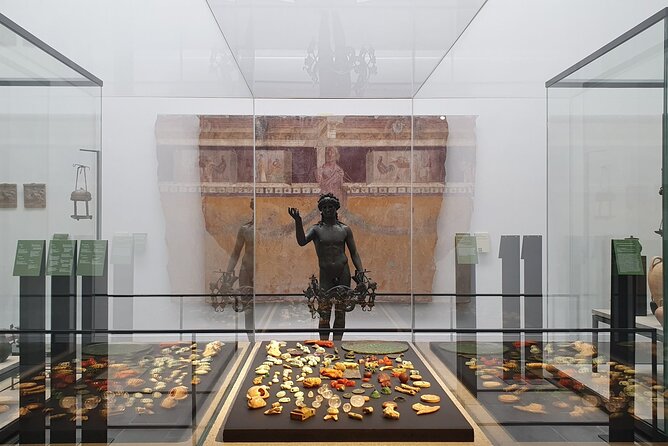
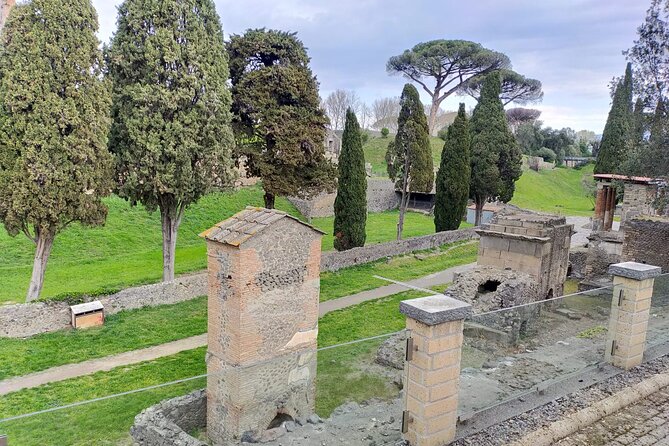
The Suburban Baths sat outside the city walls near the port area, where several large rocks could be used to moor boats. They may have served people arriving from outside Pompeii rather than local residents.
That setting adds a useful layer to the visit. Pompeii was not an isolated town frozen in time. It had movement, trade, visitors, and connections beyond its walls. The baths were part of that wider network.
This stop may appeal most to people who enjoy how archaeologists build an argument from location. The evidence is not always a neat sign saying exactly who used a building. Instead, position, nearby facilities, and the building’s design help suggest its role. An archaeologist can explain the difference between what is known and what remains an informed interpretation.
The baths are one of the shorter stops, and some visitors may find them less immediately dramatic than a lavish house or famous temple. Their value comes from the story they add to the city’s connections.
The House of the Faun and the House of Menander
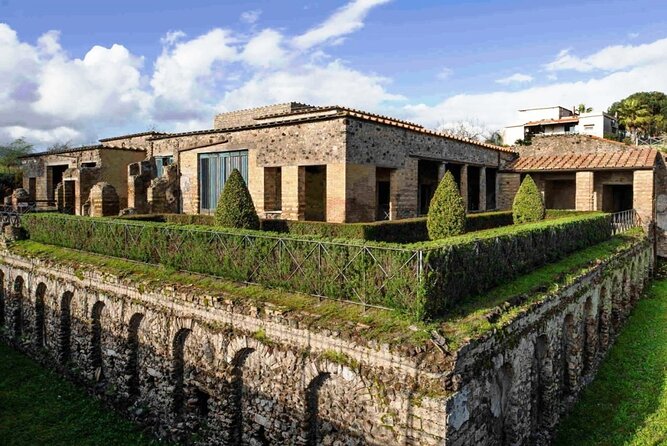
The House of the Faun is one of Pompeii’s most famous residences. Its name comes from a bronze statue of a faun placed in the impluvium, the basin in the central courtyard that collected rainwater.
The size and layout of the home help show the scale of elite Roman domestic life. This was not a simple dwelling. It was a place for family life, social display, and receiving guests, with decoration used to signal wealth and taste.
The House of Menander is also large, covering about 2,000 square metres. It takes its name from a fresco of the poet Menander. Excavations there produced 118 silver objects, including tableware, and the painted rooms include scenes linked to the Trojan War.
The story of Laocoön’s death, Cassandra, and Ulysses gives the artwork a mythological frame. You do not need to know every figure in advance. The guide can point out how these images worked inside a Roman home, where myths were part of education, conversation, and social identity.
These houses are where an archaeologist’s training pays off most clearly. The guide can help you compare a home’s size, decoration, courtyard design, and objects without turning the visit into a list of names. You begin to see the difference between a practical house and a residence built to impress.
The amphitheatre and gymnasium area
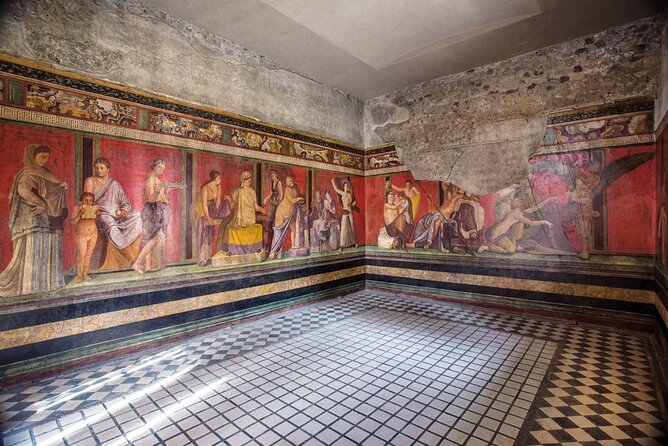
The Pompeii amphitheatre could hold up to 20,000 people on three levels. That is a striking figure when you consider the size of the ancient town. Romans took public games seriously, and gladiatorial contests were a major part of civic entertainment.
During hot summer months, spectators could be protected by a dark linen covering stretched above the seating. This detail helps make the structure feel less like a silent ruin and more like a functioning venue, filled with noise, heat, crowds, and strong public emotions.
The great gymnasium beside the arena served as a place where young men worked out. The relationship between exercise, public spectacle, and civic identity is worth noticing. The amphitheatre was not simply a sports building. It was part of how the town gathered and entertained itself.
The park entry ticket is included, but the stop information identifies admission for the amphitheatre area separately. Your guide may not enter every section during the group walk, so confirm what you will see with the guide on the day. Since your ticket is valid for the day, you can revisit the area independently if needed.
The Temple of Apollo and changing Roman worship
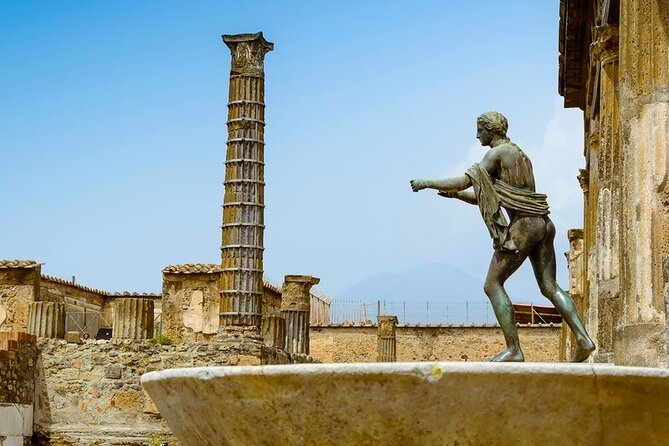
The Temple of Apollo offers a look at religion in Pompeii before the eruption in 79 AD. The cult of Apollo arrived before the disaster, but Jupiter had become the stronger religious presence for many residents.
The temple area includes a bronze statue of Apollo with bow and arrow, along with a statue of Diana. These figures give you a clear visual link between Roman worship and the wider Greek traditions that shaped Roman art and religion.
This is a good stop for anyone interested in how beliefs changed over time. Pompeii’s religious life was not fixed. Different gods had different roles, and the popularity of a cult could shift. The ruins also remind you that a city could contain several religious traditions at once.
The Temple of Apollo is near the Forum, so the sequence of these sites helps connect public life and religious life. Temples were not hidden away from the community. They formed part of the city’s central spaces.
What the two-and-a-half-hour pace feels like
The planned stops are generally about 15 minutes each. That creates a brisk rhythm, with enough time for an explanation and a close look, but not enough for long independent wandering at every location.
I like this format for a first visit because Pompeii can be overwhelming. A guide helps you cover important themes without spending your entire morning trying to find the entrance to a particular house. The small group also makes it easier to pause for a question.
The tradeoff is coverage. You may see only about half of the places described in the full plan if access, queues, walking time, or the group’s pace interfere. The House of the Vettii is one example where a wait can change the route. Pompeii also changes from day to day, with some rooms or buildings unavailable at certain times.
Plan to treat the guided walk as an introduction, not a complete tour of the park. If you have several favourite sites, write them down before arriving. After the group portion, use the included ticket to spend more time on those priorities.
Price, group size, and what you receive
At $66.23 per person, this is not the cheapest way to enter Pompeii, but the price includes more than admission. You receive a priority entrance ticket, a guide in English, and a headset, with the group limited to 15 people.
The value depends on how you like to visit archaeological sites. If you enjoy reading every sign at your own pace, you may prefer a self-guided day. If you want someone to explain why the House of Menander matters, how the Forum functioned, or what can and cannot be proved about the Suburban Baths, the guide fee earns its keep.
Private transportation is not included. You make your own way to the starting point at Hotel Vittoria on Piazza Esedra in Pompeii, and the tour ends back there. Check the meeting location carefully before setting out. One misplaced meeting point has caused a late start for some visitors, although the local team was able to help and a guide waited in that case.
The tour is offered in English and confirmation arrives when you book. Service animals are allowed, and most people can participate, but Pompeii’s ancient streets can be uneven and the route includes outdoor walking in heat.
Heat, shoes, and a smarter Pompeii day
Summer conditions deserve real attention. Bring plenty of water, since the open streets and pale stone reflect heat. Shade exists in places, and a good guide can use shaded spots along the main road, but you should not count on constant cover.
Wear solid walking shoes. Pompeii is not a flat modern pavement route, and the combination of stone streets, exposed areas, and two and a half hours on foot can tire you before you begin exploring independently.
Try to leave energy for the rest of the day. The included ticket gives you a chance to continue after the guide leaves, but that extra freedom has little value if you have rushed in without water or proper footwear.
The activity requires good weather and a minimum number of participants. If poor weather or low enrollment cancels the tour, you are offered another date or experience, or a full refund. You can cancel for a full refund up to 24 hours before the start time. Changes made within 24 hours are not accepted, and the amount paid is not refunded for a late cancellation.
Who should book this Pompeii tour?
I would choose this tour for a first visit, especially if you want historical context without hiring a private guide. It suits people who enjoy archaeology, Roman social life, ancient art, and the practical story of how a city worked.
It is also a good match if you want a human guide who can answer questions. The strongest guides on this experience, including Teresa and Paolo, explain both firm evidence and competing interpretations. That approach is more useful than a string of dates and famous names.
I would think twice if you want a slow photographic visit or plan to see every major building with the group. The two-and-a-half-hour route is selective, and access to a particular house can change. The best plan is to enjoy the guided overview, then use the day ticket for your own second pass.
Should you book it?
Book this Pompeii tour if you value expert explanation, a manageable group, and priority entry more than complete site coverage. The most praised feature is the quality of the archaeology-based guiding, with clear explanations that connect Roman buildings to real people and customs.
Skip it if you already know Pompeii well or prefer total control over your route. For everyone else, the combination of an English-speaking archaeologist, headset, included ticket, and a group capped at 15 makes $66.23 a fair price for a strong first look. Bring water, protect yourself from the sun, and keep the rest of the day free to see what the guided walk cannot fit in.
FAQ
How long does the Pompeii tour last?
The guided experience lasts approximately 2 hours and 30 minutes.
What is included in the price?
The price includes an English-speaking guide service, a priority entrance ticket for the Archaeological Park of Pompeii, and a headset.
How large is the group?
The group can include a maximum of 15 participants.
Where does the tour start and finish?
The meeting point is Hotel Vittoria on Piazza Esedra in Pompeii. The activity ends back at the same meeting point.
Is transportation included?
No. Private transportation is not included, so you must arrange your own way to the meeting point.
Can I cancel for a refund?
Yes. You can cancel at least 24 hours before the start time for a full refund. Cancellations or changes made less than 24 hours before the start time are not accepted for a refund. If poor weather or failure to meet the minimum number of participants cancels the experience, you are offered another date or experience, or a full refund.
Newest reviews from Pompeii Ruins
- Private Tour Pompeii and Winery★ 5.0 · 4 reviews
- Visit the Pompeii ruins from Salerno with Pizza Lunch★ 5.0 · 4 reviews
- Pompeii Private Tour for Kids and Their Families★ 4.8 · 4 reviews
- From Sorrento: Pompeii & Vesuvius tour small group★ 4.8 · 4 reviews
- Pompeii Sorrento and Positano Tour★ 5.0 · 4 reviews
- From Naples_ Pompeii Tour_Skip the line ticket + audioguide★ 4.3 · 4 reviews
- Pompeii, skip-the-line ticket with smartphone audio guide on App★ 3.0 · 4 reviews
- Pompeii Private Half-Day Tour from: Naples,Sorrento, Amalfi Coast★ 5.0 · 4 reviews
Tickets, compared.

Entry Ticket and Guided Tour with an Archaeologist
Read our review →

Skip-the-Line Entrance Ticket with Audio Guide
Read our review →
Archaeological Park Tour with Ticket on request
Read our review →


Skip-the-Line Entry Ticket with Digital Guide App
Read our review →