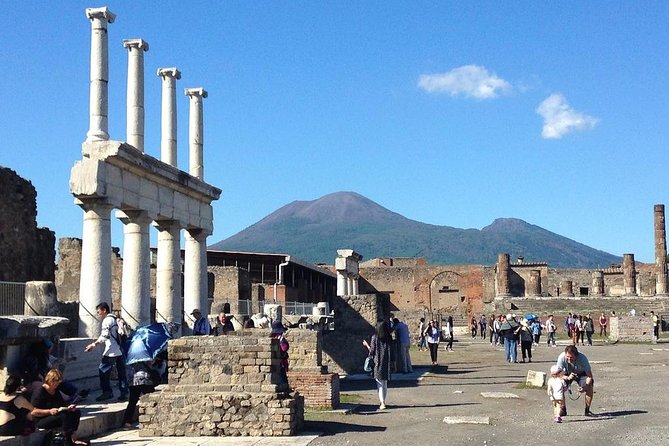
Reviewed · POMPEII RUINS TOURS
Sharing Tour of Pompeii
The most striking part of this Pompeii tour is its focus on three very different sides of the buried city: religion, private wealth, and everyday Roman sex. In about two and a half hours, your private guide takes your group from a Roman temple to the elegant Casa dei Vettii and then to the lupanari, the city’s brothels.
I like the small private format, which keeps the visit limited to your own group of up to eight people. I also like the clear focus on places that help you picture real life in Pompeii, not just grand public ruins. The main consideration is cost: the $193.49 group price does not include the €20 Pompeii entrance ticket per person.
In This Review
- Key points at a glance
- A Short Route Through Pompeii’s Most Human Stories
- Meeting at Pompei Scavi Villa Dei Misteri
- The Roman Temple: Pompeii’s Public Face
- Casa dei Vettii and the Art of Roman Wealth
- The Lupanari: A Frank Look at Roman Commercial Sex
- Why a Private Group Changes the Visit
- Is Two and a Half Hours Enough?
- Price, Tickets, and What You Really Pay
- Who Will Get the Most From This Pompeii Tour?
- Booking Timing and Cancellation
- Should You Book the Sharing Tour of Pompeii?
- FAQ
- How much does the Sharing Tour of Pompeii cost?
- How long does the tour last?
- What does the tour include?
- Where does the tour begin?
- Which Pompeii sights are included?
- Can I cancel for a full refund?
Key points at a glance
- Three sharply different Pompeii stops: See a Roman temple, an upper-class home, and the lupanari.
- Private guide for up to eight people: The tour is sold as a sharing tour, but only your own group participates.
- About 2 hours and 30 minutes: This is a focused introduction rather than a full-day archaeological visit.
- Admission costs extra: Pompeii tickets are bought separately and cost €20 per person.
- Simple meeting point: Meet at Pompei Scavi Villa Dei Misteri, where your guide waits with a Sharing Tour of Pompei sign.
- Strong overall rating: The experience is rated 4.9 out of 5 from 487 reviews, with 98 percent recommending it.
A Short Route Through Pompeii’s Most Human Stories
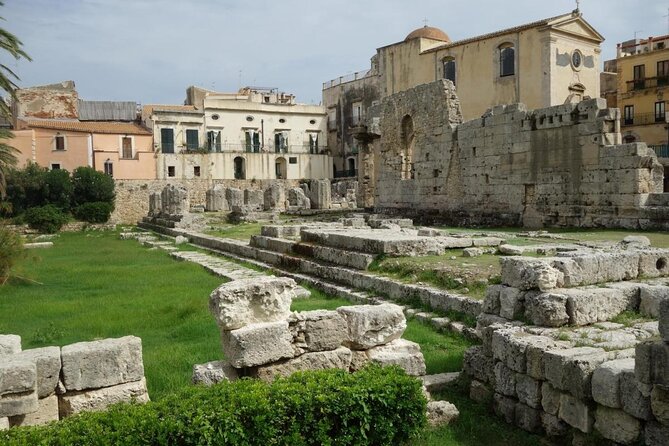
Pompeii can feel overwhelming. Its streets, villas, shops, temples, theaters, baths, and houses cover a large archaeological area, and it is easy to spend hours wandering without understanding what you are seeing.
This tour gives you a tighter route. You are not trying to cover every corner of the site. Instead, you visit three locations that show how Roman life worked at different levels: public worship, private luxury, and commercial sex.
That focus has real value if you have limited time in Pompeii. A guide can explain what you are looking at as you move between sites, rather than leaving you to decode walls and foundations on your own. The tradeoff is just as clear: in 150 minutes, you will not see everything.
The price is $193.49 per group of up to eight, not per person. For a full group, that works out to roughly $24 per person before admission. Add the €20 entrance ticket for each person, and the total becomes a more serious expense. For two people, the guide fee is much less attractive per person. For six to eight people, the private format makes better financial sense.
More Pompeii excavation visits:
- Pompeii: Entry Ticket and Guided Tour with an Archaeologist
★ 4.8 · 19,459 reviews - Pompeii: Entry Ticket with Optional Audio Guide
★ 4.2 · 12,360 reviews - Pompeii: Small Group Tour with an Archaeologist
★ 4.8 · 12,264 reviews
Meeting at Pompei Scavi Villa Dei Misteri
The tour begins at Pompei Scavi Villa Dei Misteri, in Pompei. This is the practical starting point for entering the archaeological site, and the guide waits with a Sharing Tour of Pompei sign.
Pickup is offered, but the supplied details identify the archaeological entrance as the start point. If you are staying elsewhere, confirm the pickup arrangement before the day of the visit rather than assuming it is included automatically.
The tour ends back at the meeting point. That makes planning easier if you are using local transport or have another activity afterward. The location is near public transportation, and service animals are allowed.
You receive booking confirmation at the time of reservation. One caution is worth keeping in mind: the activity requires a minimum number of participants and can be canceled if that minimum is not met. In one particularly harsh account, notice came in the middle of the night, with the experience described as confirmed but not guaranteed. That appears to be an exception rather than the usual pattern, but it is a good reason not to schedule an important train, flight, or dinner immediately afterward.
The Roman Temple: Pompeii’s Public Face
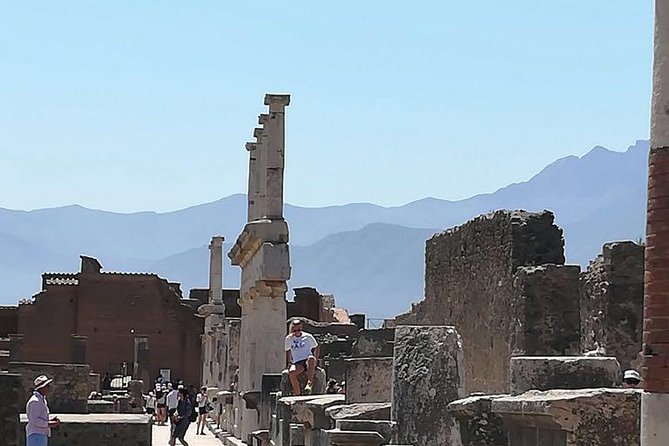
The first stop is a Roman temple buried by the eruption of Mount Vesuvius in AD 79 and later exposed by archaeological excavation.
The name of the temple is not specified in the supplied details, so you should not expect a particular sanctuary to be guaranteed by name. What is clear is the role this stop plays in the route. It introduces Pompeii as a functioning Roman city, not simply a pile of volcanic remains.
A temple gives your guide a chance to explain public religion and the way worship occupied a visible place in city life. Look for the basic elements of Roman sacred architecture: the raised setting, the approach, the columns or column bases, and the relationship between the temple and the surrounding public space.
The value here lies in context. Without an explanation, an ancient temple can look like a few broken stones. With a guide, those remains can be connected to civic life, ritual, and the organization of the town.
This stop may appeal most to first-time visitors who want a clear introduction to Pompeii. It may feel brief to anyone hoping for a highly specialized archaeological discussion, since the experience has two other major stops to cover in the same session.
Casa dei Vettii and the Art of Roman Wealth
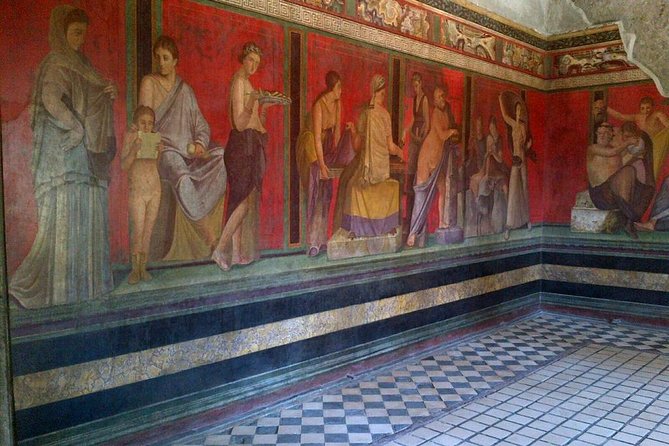
The Casa dei Vettii is the most visually rewarding stop listed on the route. This Roman domus was buried in the eruption and later found during excavations. It takes its name from the Vettii family, identified as the owners.
The house is known as one of the strongest examples of Roman art from the first century. That matters because Pompeii’s private homes reveal details that large monuments cannot. A house lets you see how status was displayed inside a domestic setting, through decoration, layout, and painted scenes.
You might find the Casa dei Vettii more memorable than the temple because it brings Roman taste down to a human scale. This was not an abstract civic building. It was a home, shaped by the habits, wealth, ambitions, and social position of its owners.
Pay attention to how a Roman domus presented itself. The arrangement of rooms and decoration could guide visitors through the house and signal the standing of the family. The art was not placed randomly. It helped create an impression.
The supplied information does not promise access to every room or guarantee that every decoration will be visible on the day of your visit. Pompeii conditions can affect what is open. Still, this is the stop that gives the tour its strongest connection to Roman art and private life.
If you enjoy architecture, paintings, or social history, this part may justify the guided visit on its own. A guide can point out why details matter instead of leaving you to admire the color and move on.
A completely different way to spend a day in Pompeii Ruins:
- Pompeii Small Group Tour with an Archaeologist
★ 5.0 · 6,593 reviews - Pompeii: Skip-the-Line Entrance Ticket with Audio Guide
★ 4.0 · 2,509 reviews - Naples: Pompeii and Mt. Vesuvius with Lunch and Wine Tasting
★ 4.5 · 2,454 reviews - Pompeii: Archaeological Park Tour with Ticket on request
★ 4.5 · 2,283 reviews
The Lupanari: A Frank Look at Roman Commercial Sex
The lupanari, from the Latin word lupa, meaning prostitute, were places devoted to paid sexual encounters. In plain terms, they were brothels, and some remain visible in the ruins of Pompeii.
This stop adds an important dose of everyday reality. Ancient cities were not made only of temples, villas, and official buildings. Pompeii also had businesses that served ordinary appetites, and the lupanari show how commercial sex formed part of Roman urban life.
The subject can be awkward, especially for families or visitors who prefer to keep the tour centered on art and architecture. Yet it is also one of the most useful stops for understanding Pompeii as a lived-in city. Your guide can explain the function of these spaces and place them within Roman society without turning the visit into a cheap joke.
Expect this section to be more direct than polished. That is part of its value. The lupanari show a side of Roman life that grand monuments tend to hide.
The supplied details do not promise a particular brothel, set of paintings, or preserved feature. Conditions inside archaeological sites can change. You are guaranteed the lupanari as part of the stated route, but not every detail you may have seen in photographs.
Why a Private Group Changes the Visit
The tour is described as a sharing tour, but the practical format is private: only your group participates, with up to eight people included in the group price.
That is a useful distinction. You are not paying for a large public group where the guide must keep pace with strangers or answer questions for twenty or thirty people. You can ask about the house, the temple, or the lupanari as you go, and the guide can adjust the explanation to your interests.
For a couple, the fixed group price can feel high. For a family or group of friends, the economics improve quickly. At eight people, the guide fee is spread across the whole group, while you still get a more personal format.
The English-language option also makes the tour easy to compare with other Pompeii visits. The guide’s name is not provided in the available information, so you cannot choose a named specialist in advance.
The small format is especially useful if someone in your party has never visited an archaeological site. A guide can help you get your bearings and make the ruins less abstract. On the other hand, independent visitors who prefer to set their own pace may find the fixed route restrictive.
Is Two and a Half Hours Enough?
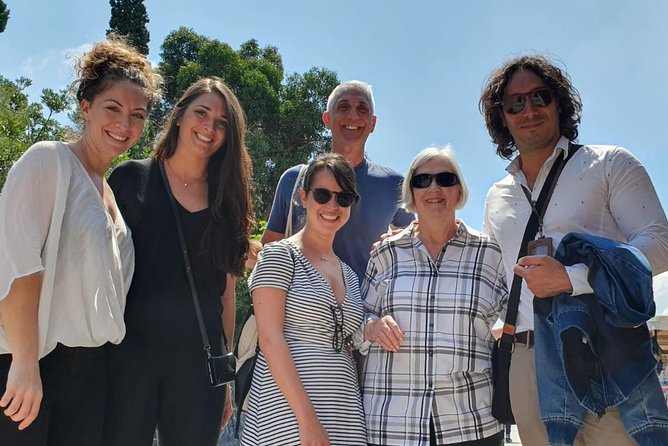
Two hours and thirty minutes is enough to build a strong first impression of Pompeii. It is not enough to see the entire site in detail.
The timing works because the route has a clear theme. The temple, Casa dei Vettii, and lupanari give you three different ways to think about the city. You get public religion, domestic wealth, and commercial life without spending a full day on site.
You should book this as an introduction or a focused visit. If you have already seen Pompeii and want to revisit specific streets, baths, theaters, or public buildings, you may want more time on your own before or after the guided portion.
The biggest practical question is how much of Pompeii you expect to cover. If you want an overview of the entire archaeological park, this is too short. If you want a guide-led route with several distinctive stops, the duration is sensible.
Because the tour finishes at its original meeting point, you can potentially continue exploring on your own if time and site access allow. The supplied information does not specify extra entry arrangements, so do not assume the guided tour automatically includes extended access beyond the scheduled activity.
Price, Tickets, and What You Really Pay
The listed price is $193.49 per group, with a maximum of eight people. That covers the private tour guide.
Pompeii admission is separate. The entrance ticket costs €20 per person and is bought daily for customers, but it is never included in the tour price. This distinction matters because a group of eight adds €160 in admission fees, in addition to the guide charge.
The total value depends heavily on group size:
- Two people pay a high effective price per person for the guide.
- Four people get a more reasonable split.
- Six to eight people receive the clearest value from the fixed group rate.
The available details also list soda or pop and a tip among items not included. Bring your own budget for those extras, and treat the guide’s gratuity as optional rather than an automatic part of the advertised price.
I would compare this experience with a standard shared group tour if you are traveling alone or as a couple. The private arrangement makes more sense when you have a larger party or care about asking questions without a crowded group around you.
Who Will Get the Most From This Pompeii Tour?
I would recommend this experience to you if:
- You have about half a day for Pompeii.
- You want an English-language guide rather than a self-guided visit.
- You are traveling with family or friends and can split the group price.
- You want Roman homes and daily life, not only temples and public monuments.
- You prefer a planned route through a large archaeological site.
- You want to see a brothel as part of a frank look at Roman society.
I would think twice if you are visiting alone and mainly want the lowest possible price. I would also choose a longer experience if Pompeii is one of the main reasons for your trip and you want to explore many parts of the city.
Families should consider the age and interest level of everyone in the group. The lupanari are a factual historical stop, but the subject may not suit every child.
The experience is open to most participants, and service animals are allowed. No special physical restrictions are stated, so you should confirm any personal mobility concerns directly before booking.
Booking Timing and Cancellation
This experience is booked, on average, about 50 days in advance. That suggests you should reserve early if your dates are fixed, especially during a busy Pompeii visit.
Free cancellation is available if you cancel at least 24 hours before the scheduled start time. Cancellations made less than 24 hours before the start are not refunded, and changes inside that window are not accepted. The cut-off uses local time in Pompeii.
A minimum number of participants is required. If the operator cancels because that minimum is not reached, you are offered another date or experience, or a full refund.
Because one account describes a late cancellation notice despite the booking being confirmed, I would avoid placing this tour immediately before a nonrefundable commitment. The overall rating is very strong, at 4.9 from 487 reviews, and 98 percent of customers recommend it, but a high rating does not remove the need for sensible scheduling.
Should You Book the Sharing Tour of Pompeii?
Book it if you want a short, private introduction to Pompeii and can divide the $193.49 guide fee among several people. The route covers three useful contrasts: a Roman temple for public religion, Casa dei Vettii for private wealth and art, and the lupanari for a candid look at urban life.
The tour is less compelling for a solo visitor or a couple focused mainly on price. In that case, a regular group tour may cost less per person. It is also not the right choice if you want to cover every major part of Pompeii in one visit.
For a family or group of friends, the balance is better. You get an English-speaking private guide, a fixed meeting point, a manageable two-and-a-half-hour schedule, and a route that goes beyond the usual grand monuments. Just budget separately for the €20 entrance ticket per person, confirm any pickup details, and leave some flexibility around the booking.
FAQ
How much does the Sharing Tour of Pompeii cost?
The tour costs $193.49 per group of up to eight people. Pompeii admission is separate and costs €20 per person.
How long does the tour last?
The experience lasts approximately 2 hours and 30 minutes.
What does the tour include?
A private tour guide is included. The tour is offered in English.
Where does the tour begin?
It begins at Pompei Scavi Villa Dei Misteri, 80045 Pompei, Metropolitan City of Naples, Italy. The guide waits with a Sharing Tour of Pompei sign.
Which Pompeii sights are included?
The route includes a Roman temple, Casa dei Vettii, and the lupanari, the ancient brothels of Pompeii.
Can I cancel for a full refund?
Yes. You can cancel at least 24 hours before the experience start time for a full refund. Cancellations or changes made less than 24 hours before the start are not refunded or accepted.
Newest reviews from Pompeii Ruins
- Private Tour Pompeii and Winery★ 5.0 · 4 reviews
- Visit the Pompeii ruins from Salerno with Pizza Lunch★ 5.0 · 4 reviews
- Pompeii Private Tour for Kids and Their Families★ 4.8 · 4 reviews
- From Sorrento: Pompeii & Vesuvius tour small group★ 4.8 · 4 reviews
- Pompeii Sorrento and Positano Tour★ 5.0 · 4 reviews
- From Naples_ Pompeii Tour_Skip the line ticket + audioguide★ 4.3 · 4 reviews
- Pompeii Private Half-Day Tour from: Naples,Sorrento, Amalfi Coast★ 5.0 · 4 reviews
- Pompeii, skip-the-line ticket with smartphone audio guide on App★ 3.0 · 4 reviews
Pompeii Ruins Tours, compared.

Entry Ticket and Guided Tour with an Archaeologist
Read our review →

Pompeii Small Group Tour with an Archaeologist
Read our review →
Skip-the-Line Entrance Ticket with Audio Guide
Read our review →
Pompeii and Mt. Vesuvius with Lunch and Wine Tasting
Read our review →
Archaeological Park Tour with Ticket on request
Read our review →