Reviewed · POMPEII RUINS TOURS
Private Pompeii Tour with 3D Virtual Reality Headset – Tour Assistant Only
Pompeii becomes easier to picture when its broken walls turn into homes, temples, shops, theaters, streets, and markets through a 3D virtual reality headset. This private, roughly two-and-a-half-hour experience pairs those digital scenes with a walk through the actual archaeological park, giving you both the ruins and a sense of how they once looked.
I like the up to 15 virtual reality videos, which give structure to a large site, and I like the helpful tour assistant who keeps the group moving and helps you balance headset stops with time for photographs. The main drawback is clear: the assistant is not a licensed guide and cannot answer archaeological questions. You rely on the headset commentary instead.
- Fifteen possible VR scenes bring Pompeii’s buildings and daily life back into view.
- A five-minute headset lesson helps you learn the equipment before entering the ruins.
- Skip-the-line admission is included in the $124.02 per-person price.
- Audio commentary comes in six languages: English, Italian, German, French, Spanish, and Russian.
- The tour assistant speaks only English and Italian and does not provide licensed guiding.
- Private participation means only your own group takes part.
In This Review
- Seeing Pompeii Before the Eruption
- The Five-Minute Headset Lesson
- Walking Through the Archaeological Park
- What the Fifteen Virtual Scenes Add
- Audio Commentary Instead of a Licensed Guide
- A Private Tour for Your Own Group
- Is $124.02 Per Person a Fair Price?
- Who Will Enjoy This Most?
- Should You Book the Pompeii VR Tour?
- FAQ
- How long does the private Pompeii VR tour last?
- Where does the tour begin and end?
- Is admission to Pompeii included?
- Does the tour include transportation or hotel pickup?
- Is this tour led by a licensed guide?
- What languages are available?
- Can children use the virtual reality headset?
Seeing Pompeii Before the Eruption
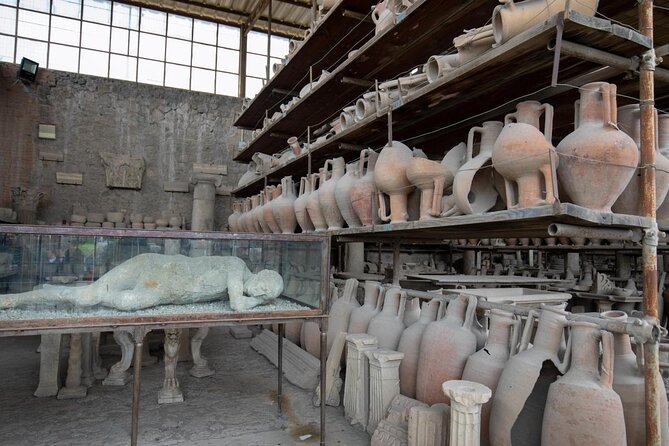
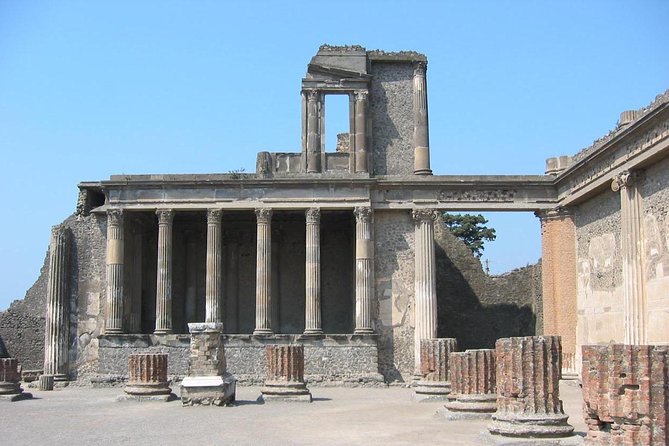
Pompeii can be a strange place to visit. You walk along ancient streets and see walls, columns, doorways, and fragments of decoration, but much of the city is no longer complete. The VR headset addresses that problem directly by showing reconstructed scenes while you are standing near the real remains.
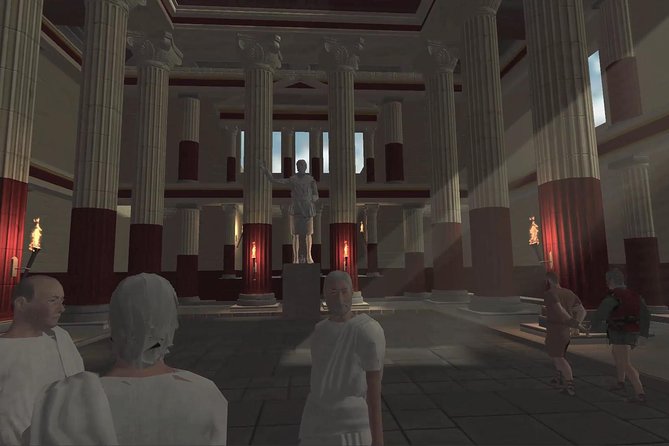
The effect is not a replacement for the ruins. It is a visual aid. You look at a surviving structure, put on the headset, and see a digital version that helps you understand its original scale and use. Then you remove the headset and compare the recreation with what remains.
That approach is especially useful at Pompeii because the site is large and its buildings can be hard to read without context. A home may look like a set of rooms without roofs. A public building may seem like a pile of stones. The digital scenes give you a working picture of the city before you continue walking.
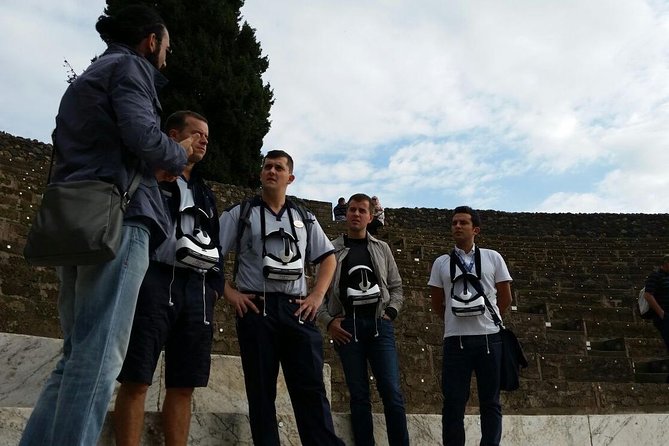
The experience is also practical for anyone who prefers a clear route. The assistant leads you through the archaeological park and indicates when to use the headset. You are not left to wander around a huge site while trying to guess which ruins matter most.
The Five-Minute Headset Lesson
At the start, a staff member gives you about five minutes of training. This is brief, but it matters. You learn how to use the Samsung or Oculus Gear VR equipment before you are inside the archaeological park.
The headset is supplied to each adult and youth who uses one. Children under nine cannot use it. The manufacturer recommends that it not be used by children under 13, so families should consider the equipment guidance carefully rather than treating the headset as a simple toy.
You should also pay attention to how your body reacts. Virtual reality can cause dizziness, disorientation, nausea, eye strain, blurred or double vision, loss of balance, or motion-sickness-like symptoms. Stop using it at once if any of these occur. Symptoms can continue for hours after use, so this is not something to push through.
The safety warnings are unusually detailed for a sightseeing activity. You should consult a doctor before using the headset if you are pregnant, elderly, have binocular vision problems, a psychiatric disorder, a heart condition, or another serious medical condition. Anyone with a history of seizures or symptoms linked to epilepsy should also seek medical advice first.
The Gear VR can emit radio waves that affect nearby electronics. If you have a pacemaker or another implanted medical device, consult your doctor or the device manufacturer before using it.
More Pompeii excavation visits:
- Pompeii: Entry Ticket and Guided Tour with an Archaeologist
★ 4.8 · 19,459 reviews - Pompeii: Entry Ticket with Optional Audio Guide
★ 4.2 · 12,360 reviews - Pompeii: Small Group Tour with an Archaeologist
★ 4.8 · 12,264 reviews
Walking Through the Archaeological Park
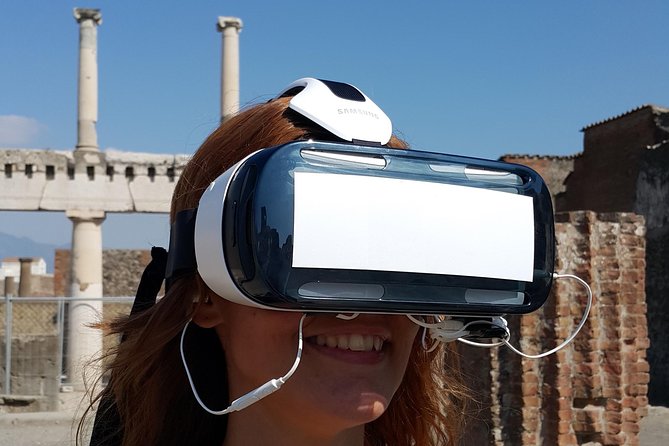
Once the short training is finished, you enter Pompeii with the tour assistant. Skip-the-line admission is included, which can be useful at a major archaeological site where entrance delays can cut into your limited time.
The walk lasts about two hours and 30 minutes in total. Expect uneven ground, so comfortable shoes are essential. You should also travel light. A small shoulder bag is recommended, while large backpacks, pocketbooks, and extra luggage can make the walk and headset use less comfortable.
The assistant’s role is to guide the route, manage the timing, and help you get the most from the stops. One useful detail is that the assistant can help you divide your time between watching the VR scenes and taking photographs. That balance matters because it is easy to focus on the screen and forget that you are standing in one of Italy’s most important archaeological sites.
This is a walking tour, not a ride through the ruins. The combination of stone streets and virtual scenes requires attention. You will want to look around before and after each headset sequence so the digital reconstruction supports your visit instead of taking it over.
The tour operates in safe weather conditions. Dress for the forecast, since much of the experience takes place outdoors and there is no promise of shelter during every part of the route.
What the Fifteen Virtual Scenes Add
The headset can show up to 15 videos. You may see ancient temples, houses, shops, theaters, streets, and markets rebuilt in 3D. These are the places where virtual reality has the greatest value: not in showing you a pretty digital city, but in helping you understand how different parts of Pompeii fit together.
Homes can be easier to read when you see them as functioning spaces rather than roofless rooms. Shops and markets can make the streets feel connected to daily life. The theaters and temples help explain that Pompeii was not simply a collection of private houses, but a working city with public places and religious buildings.
The recreation also gives you a better idea of height, decoration, and enclosure. A wall fragment may not tell you much about the room behind it. A digital scene can suggest the missing volume, even though it remains a modern reconstruction.
The technology has limits. One family found the historical recreations very helpful, while the computer scientist father and video-game-playing son wished the graphics were more advanced. That is a fair expectation to set. This is educational VR, not a high-end gaming experience. The strength lies in the historical presentation and the way it connects to the ruins around you.
I would treat the videos as short windows into Pompeii, not as a flawless digital replica. You are there to make comparisons. The best use is to watch a scene, remove the headset, and study the actual walls, paving, or remains nearby.
Audio Commentary Instead of a Licensed Guide
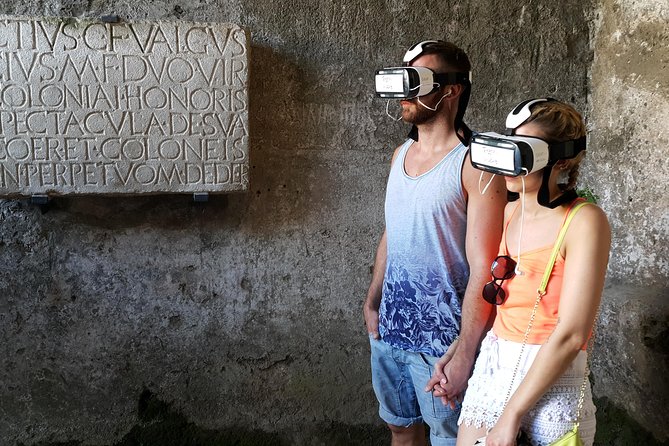
The headset includes commentary in six languages: English, Italian, German, French, Spanish, and Russian. This gives you more language choice than the tour assistant can provide in person.
The assistant speaks only English and Italian. More important, the assistant is not a licensed guide and is not allowed to answer questions about the archaeological site. If you want detailed answers about construction methods, politics, religion, eruption evidence, or the interpretation of individual buildings, this tour may leave you wanting more.
That limitation should shape your decision. You receive an organized visit with audio information and visual reconstructions, but not a traditional expert-led explanation. You cannot simply stop the assistant and ask for a detailed discussion of a statue or inscription.
For some visitors, the tradeoff works well. You get a private route, your preferred audio language, and the freedom to absorb the site without listening to a long speech at every stop. Families may also appreciate the headset’s ability to hold attention, especially when the children are old enough to use it safely.
For others, a licensed guide will be the better choice. Pompeii rewards questions, and the site contains many details that a recorded commentary cannot address in response to your interests. You should book this VR experience for its visual tool and structure, not under the impression that it includes a private archaeologist.
More Pompeii Ruins tours worth comparing
- Pompeii Ruins Private Tour with Optional Skip-the-Line Entry
★ 4.9 · 732 reviews - Pompeii private tour with an Official Guide
★ 5.0 · 631 reviews - Pompeii Private Tour with an Archaeologist and Skip The Line – 3 hours
★ 5.0 · 564 reviews - Visit in Pompeii – Pompeii Private Tour with Ada
★ 5.0 · 436 reviews
A Private Tour for Your Own Group
Only your group participates, which gives the visit a more personal rhythm than a large shared walk. You can move at your group’s pace within the route, take photographs, and discuss what you are seeing without being tied to strangers.
The private format is particularly useful for families or friends with different interests. One person can spend a little longer studying the ruins while others prepare for the next video, with the assistant helping keep the visit on track.
There are morning and afternoon departure choices. You must provide your preferred starting time in the special requirements section when confirming the reservation. The tour begins at Hotel Vittoria on Piazza Esedra in Pompeii and ends at Piazza Immacolata.
Transportation to and from Pompeii is not included. The meeting point is near public transportation, and trains are described as convenient and inexpensive, with regular service during the day and evening. You need to plan your own arrival and departure rather than expecting hotel pickup.
The tour is often booked well ahead, with an average advance booking period of about 41 days. That does not guarantee a particular departure will sell out, but it is a good reason to arrange the tour early if your Pompeii visit is fixed.
Is $124.02 Per Person a Fair Price?
At $124.02 per person, this is not the cheapest way to enter Pompeii. The price includes the skip-the-line entrance ticket, the headset, the tour assistant, and a private experience for your own group. It does not include transportation, hotel pickup, or a licensed guide.
The value depends on what you want to buy. If you mainly need admission and can happily explore with a map or audio guide, you may find the price high. If you want a structured route and a visual explanation of buildings that are difficult to imagine from ruins alone, the VR element gives the cost a clear purpose.
The group discount option may improve the value for larger parties, though the exact reduction is not provided. Since only your group participates, the per-person cost can make more sense when shared by family or friends who would otherwise book several separate tickets or guiding services.
I would compare this experience with the cost of a standard licensed guide before booking. The two products offer different things. This tour gives you reconstruction videos and multilingual headset commentary. A licensed guide gives you live answers and interpretation. Decide which gap you most want to fill.
Who Will Enjoy This Most?
I would recommend this tour to families with children old enough to use the headset, couples who enjoy technology, and first-time visitors who want help making sense of Pompeii’s remains. It also suits groups that prefer private participation and a set route rather than an unplanned walk.
The experience worked especially well for one family with children aged 11 and 14. The adults and children all found the historical recreations useful, even though the more technology-minded members wanted sharper graphics. That is a helpful picture of the tour’s appeal: the educational idea is stronger than the technical spectacle.
You should think twice if you are prone to motion sickness or have any of the medical concerns in the safety guidance. You should also reconsider if your main goal is a detailed conversation with an expert. The absence of a licensed guide is not a minor footnote. It defines the experience.
Wear sturdy, comfortable shoes and keep your bag small. Choose the morning or afternoon time that matches your energy and transport plan. Because the tour operates in safe weather conditions, dress for outdoor walking rather than for a museum visit.
Cancellation is free if you cancel at least 24 hours before the local start time. Changes or cancellations inside that window are not accepted for a refund.
Should You Book the Pompeii VR Tour?
Book it if you want Pompeii’s walls to make more visual sense, enjoy a private route, and are comfortable learning from a headset rather than asking a live guide questions. The strongest feature is the pairing of real ruins with up to 15 digital reconstructions, not the sophistication of the graphics.
Skip it if you want a licensed guide, detailed archaeological discussion, or a lower-cost entrance-only visit. For the right group, this is a clever way to give ancient Pompeii a visible shape while still leaving room for photographs and quiet time among the ruins.
FAQ
How long does the private Pompeii VR tour last?
The tour lasts approximately two hours and 30 minutes, including the walk through the archaeological park and the virtual reality stops.
Where does the tour begin and end?
It begins at Hotel Vittoria, Piazza Esedra, 80045 Pompei, Italy, and ends at Piazza Immacolata, 80045 Pompei, Italy.
Is admission to Pompeii included?
Yes. The skip-the-line entrance fee to the Pompeii ruins is included.
Does the tour include transportation or hotel pickup?
No. Transportation to and from the attractions, hotel pickup, and hotel drop-off are not included. Public transportation is available near the meeting point, and trains operate regularly during the day and evening.
Is this tour led by a licensed guide?
No. A tour assistant leads the group, but the assistant is not a licensed guide and cannot answer questions about the archaeological site. Commentary is provided through the headset.
What languages are available?
The tour assistant speaks English and Italian. The headset commentary is available in English, Italian, German, French, Spanish, and Russian.
Can children use the virtual reality headset?
Children under nine cannot use the headset. The manufacturer does not recommend the equipment for children under 13. Children must be accompanied by an adult, and adults are responsible for monitoring children during and after headset use.
Newest reviews from Pompeii Ruins
- Wine Tour + Pompeii★ 5.0 · 4 reviews
- Full-Day Sorrento Positano Pompeii Tour★ 5.0 · 4 reviews
- Pompeii: Skip The Line Entrance Tickets + Audioguides★ 3.2 · 4 reviews
- Pompeii ruins★ 5.0 · 4 reviews
- Pompeii: Entry Ticket & Guided Tour with an Expert Historian★ 5.0 · 4 reviews
- Private Tour Pompeii and Winery★ 5.0 · 4 reviews
- Visit the Pompeii ruins from Salerno with Pizza Lunch★ 5.0 · 4 reviews
- Pompeii Private Tour for Kids and Their Families★ 4.8 · 4 reviews
Pompeii Ruins Tours, compared.

Entry Ticket and Guided Tour with an Archaeologist
Read our review →

Pompeii Small Group Tour with an Archaeologist
Read our review →
Skip-the-Line Entrance Ticket with Audio Guide
Read our review →
Pompeii and Mt. Vesuvius with Lunch and Wine Tasting
Read our review →
Archaeological Park Tour with Ticket on request
Read our review →