Reviewed · POMPEII RUINS TOURS
Pompeii Tour & Admission included in a Small Group
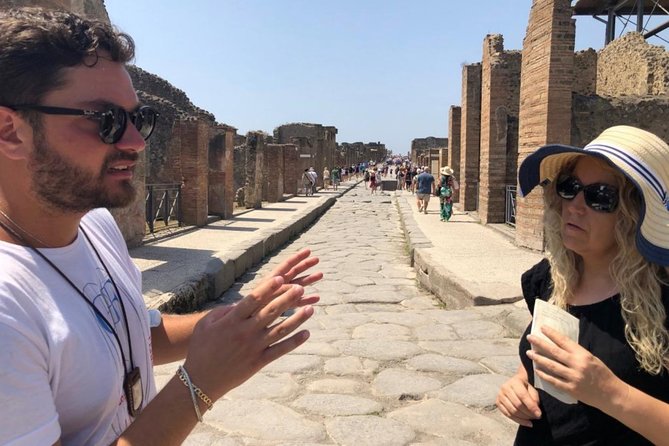
Pompeii is far larger and more physical than many first-time visitors expect. This two-hour small-group tour gives you a brisk route through the city’s major sights, from the Forum and Temple of Jupiter to bakeries, bathhouses, theaters, and the haunting plaster casts of eruption victims.
I like that your site admission is included, so you can begin at Porta Marina without sorting out a separate ticket. I also like the use of an authorized guide or archaeologist, especially guides such as Livio, Riccardo, Antonio, and Ornella, who are praised for making Roman life understandable rather than simply reciting dates. The drawback is simple: Pompeii’s uneven paving and broad streets demand steady walking, and two hours is enough for highlights, not every corner.
In This Review
- Key points to know before booking
- Starting at Porta Marina with Vesuvius in view
- The Forum: Pompeii’s political and religious center
- Food, commerce, and the plaster casts
- The Forum Baths and Roman habits
- Houses that show Pompeii’s private world
- Via dell’Abbondanza and the city’s main street
- The Great Theatre and Gladiators’ Barracks
- What the guide adds to Pompeii
- Is $66.01 good value for two hours?
- Practical matters for a smoother visit
- Who should book this Pompeii tour?
- Should you book it?
- FAQ
- Is admission to Pompeii included?
- How long does the tour last?
- What language is the tour offered in?
- Where does the tour meet?
- How large is the group?
- Are the House of the Faun and House of the Vettii always open?
Key points to know before booking
- Admission is included: Enter Pompeii as part of the tour without arranging a separate archaeological park ticket.
- A focused two-hour route: See the Forum, temples, baths, shops, theatres, Via dell’Abbondanza, and other major areas.
- Small group format: The stated maximum is 15 people, with headsets provided if the site is crowded.
- Strong guide element: Guides including Livio, Riccardo, Antonio, Annalisa, Angelo, Antonio, and Ornella are noted for clear storytelling and Roman daily-life details.
- Uneven walking is part of the deal: Expect ancient paving, curbs, stepping stones, and plenty of time on your feet.
- Some houses and buildings can close seasonally or early: The House of the Faun and House of the Vettii are subject to opening changes, and some guarded sites have closed by 6 p.m.
Starting at Porta Marina with Vesuvius in view
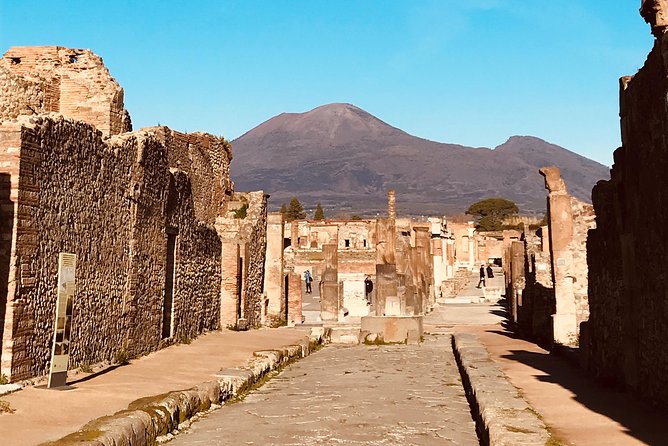
The meeting point is at Villa of the Mysteries, on Via Villa dei Misteri, 2, near Pompeii’s main archaeological area. The tour begins at the Porta Marina entrance, where the setting gives you an immediate sense of scale: ancient streets ahead, Mount Vesuvius behind, and a city that was suddenly cut off in 79 AD.
That opening view matters. Pompeii is not just a collection of isolated ruins. It was a working Roman city with public squares, shops, homes, religious buildings, entertainment venues, and busy streets. Your guide first sets out what happened during the eruption and how the city’s burial helped preserve so many details.
The experience is offered in English and includes a paper map. Headsets may be used when the site is crowded, which is useful in a busy ruin where stopping in a narrow street can make it hard to hear. The guide sets the pace, so you can spend less time trying to work out where you are and more time looking at the remains around you.
More Pompeii excavation visits:
- Pompeii: Entry Ticket and Guided Tour with an Archaeologist
★ 4.8 · 19,459 reviews - Pompeii: Entry Ticket with Optional Audio Guide
★ 4.2 · 12,360 reviews - Pompeii: Small Group Tour with an Archaeologist
★ 4.8 · 12,264 reviews
The Forum: Pompeii’s political and religious center
The first major part of the walk centers on the Forum, Pompeii’s main square. This was the city’s public heart, a place tied to religion, government, business, and daily activity. From here, the guide can help you read the city plan instead of seeing only scattered columns and walls.
The Basilica sits beside the Forum. Despite its name, this was not a Christian church. It was one of Pompeii’s grandest buildings and served business dealings and the administration of justice. I find this kind of explanation especially useful because ruins often mislead modern visitors. A guide can show you how the building’s form matched its public role.
The Temple of Apollo is another early stop. It was among Pompeii’s oldest worship sites, placed along the route from Porta Marina toward the city center. The Temple of Venus, dedicated to Pompeii’s patron goddess, adds another piece to the religious picture. These sites are close enough to fit into a compact route, but each helps explain how Roman public space was organized.
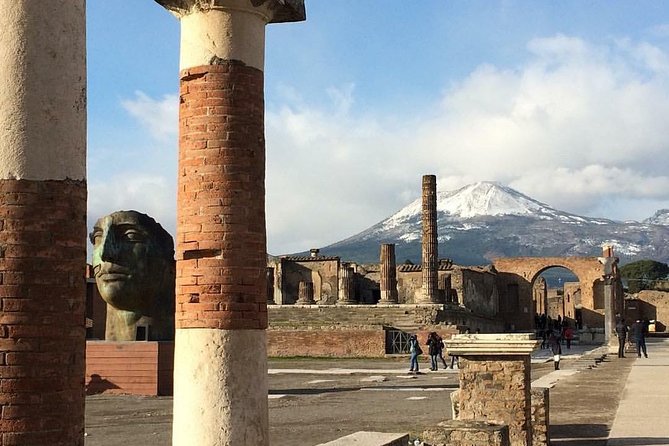
At the northern side of the Forum, the Temple of Jupiter frames the square. Vesuvius rises behind it, creating one of the clearest visual links between Pompeii’s public life and the disaster that ended it. The view is powerful, but the guide’s explanation gives it meaning. You learn not only what the building was, but why its location mattered.
Food, commerce, and the plaster casts
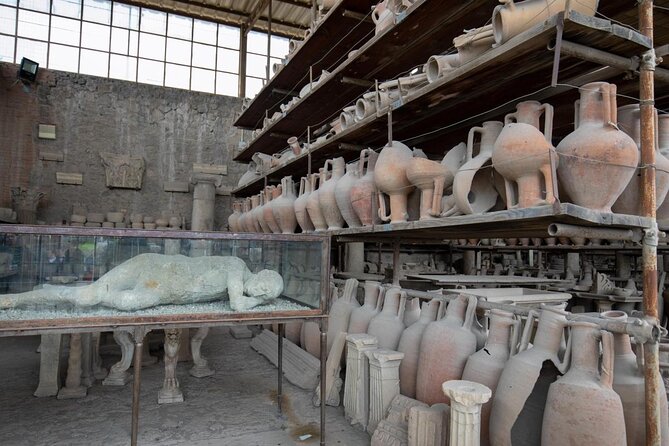
The Macellum was a monumental market building used for food and everyday goods. It is also one of the places where you may see plaster casts of bodies. These casts were made through an archaeological method that filled voids left in the hardened volcanic material, preserving the positions and forms of people caught during the eruption.
This is the most emotionally difficult part of the route. The subject is presented as part of Pompeii’s archaeology, but it is still important to pause and treat the remains with respect. The guide’s tone matters here. Several guides are praised for handling the eruption with care rather than turning it into spectacle.
The Thermopolium of Vetuzio Placido offers a different view of daily life. A thermopolium was an old diner or refreshment stop for city residents. Along with the bakeries and Roman shops included on the route, it helps you picture Pompeii as a lived-in place. You can imagine people buying food, working, meeting others, and moving through the city before the eruption froze those routines.
I particularly like this part of the tour because it moves beyond grand temples. Public monuments tell you how Pompeii wanted to present itself. Shops, counters, ovens, and streets tell you how ordinary people used the city.
The Forum Baths and Roman habits
The Forum Baths are among Pompeii’s best-preserved buildings. The male and female sections had separate entrances, a detail that gives the remains a human scale. Instead of seeing the baths as empty rooms, you can follow how the complex was divided and used.
A short explanation here can make Roman engineering and social habits easier to understand. The point is not simply that the baths survived. It is that they reveal how important public bathing was to city life and how carefully the buildings were planned.
The route also includes one of Pompeii’s recently reopened Roman baths. Openings can change, so you should treat access to individual buildings as subject to conditions on the day. Still, when the baths are available, they add one of the clearest examples of everyday public life to the walk.
Two hours does not allow for a long study of every room. You will get the main layout and the most useful context, then keep moving. That pace suits anyone who wants an organized introduction, but it may feel quick if Roman architecture is your main passion.
A completely different way to spend a day in Pompeii Ruins:
- Pompeii Small Group Tour with an Archaeologist
★ 5.0 · 6,593 reviews - Pompeii: Skip-the-Line Entrance Ticket with Audio Guide
★ 4.0 · 2,509 reviews - Naples: Pompeii and Mt. Vesuvius with Lunch and Wine Tasting
★ 4.5 · 2,454 reviews - Pompeii: Archaeological Park Tour with Ticket on request
★ 4.5 · 2,283 reviews
Houses that show Pompeii’s private world
The House of the Faun is one of Pompeii’s largest homes. Its entrance carries the Latin greeting HAVE on the sidewalk, a small detail that makes the ancient street feel surprisingly personal. The house helps you see the difference between a public monument and a private residence built to impress.
The House of the Vettii is another major domus, known as one of the city’s richest and most famous homes. It is associated with Priapus, a god linked with prosperity. Both the House of the Faun and House of the Vettii can be affected by seasonal opening and closing schedules, so do not book this tour on the assumption that every named house will be accessible.
That point is worth stressing. Pompeii is an active archaeological site, not a museum with every room permanently open. A route can include a building as a target while access changes because of conservation, staffing, or opening hours. Your guide can still explain its place in the city, but the exact interiors available may vary.
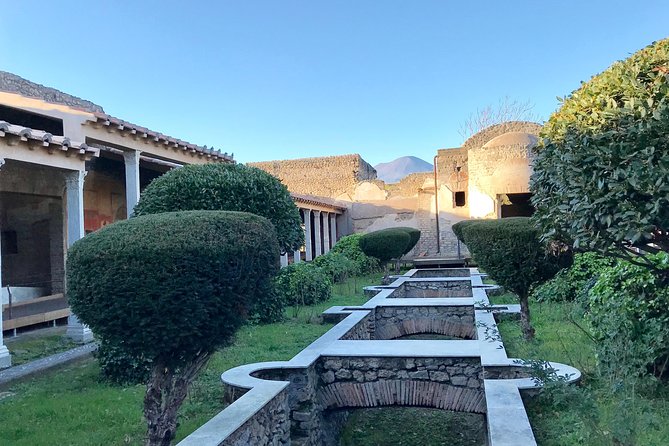
The home stops are valuable because they add balance. Without them, a Pompeii visit can become a parade of official buildings. Here, you get signs of status, religion, domestic life, and the way wealthy families arranged their spaces.
Via dell’Abbondanza and the city’s main street
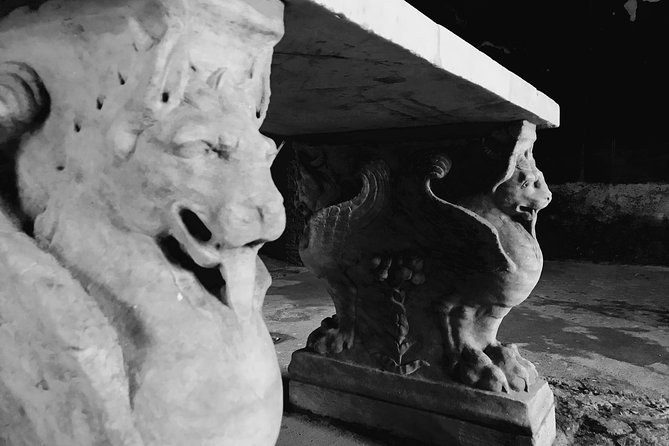
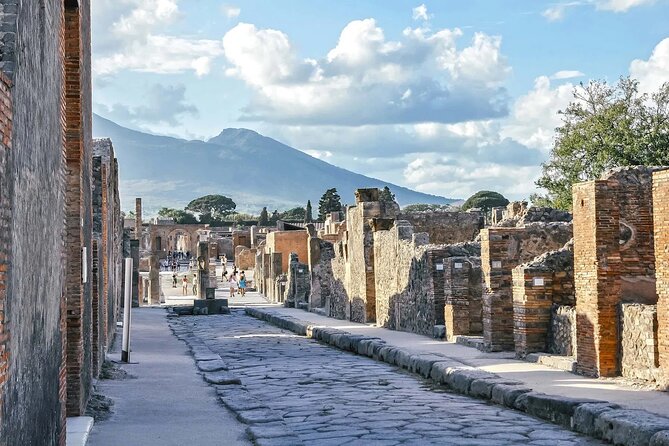
Via dell’Abbondanza was Pompeii’s ancient main street and is identified with the Decumanus Maximus. Walking along it gives you a strong sense of how the city connected its public center with homes, shops, food counters, and entertainment sites.
This is also where you feel the ground under your feet. Ancient paving is uneven, and curbs and stepping stones can make the walk slower than a normal city stroll. Wear secure shoes and expect to adjust your stride. Pompeii is not difficult because of steep mountain walking, but the surface can be tiring, especially in heat.
The stepping stones are worth noticing. They helped people cross streets while avoiding water and waste in the roadway. Modern visitors often see them first as obstacles. Your guide can help you understand their practical purpose and how the street worked as part of the city’s infrastructure.
Because the tour is guided, you do not need to stop at every junction to consult the paper map. You can keep your attention on the paving, storefronts, columns, and wall remains. The map is still useful afterward if you want to revisit a section independently.
The Great Theatre and Gladiators’ Barracks
The Great Theatre is the final named stop. Comedies and tragedies in the Greco-Roman tradition were performed here, offering another view of how Pompeii’s residents spent their free time. The theater is a good closing point because it shifts the story from work, worship, and shopping to public entertainment.
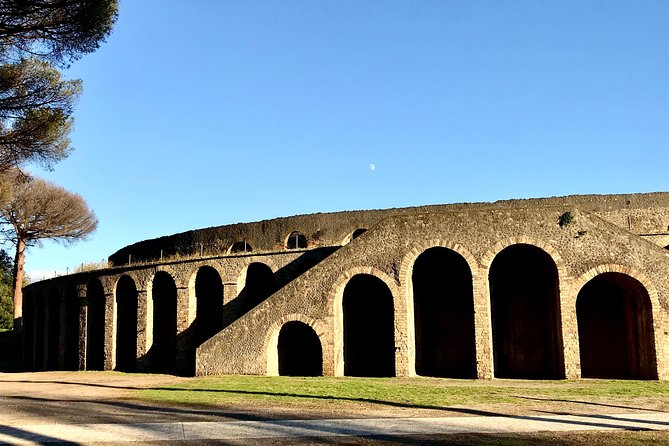
The route also includes the Large and Small Theatres and the Gladiators’ Barracks. These buildings help explain the scale of Pompeian entertainment. You are not simply looking at a beautiful auditorium. You are seeing part of an organized world of performances, performers, spectators, and public gatherings.
The theater area can also make the tour feel less crowded than the Forum, depending on conditions at the site. Still, the group must keep to the guide’s schedule. If you want to sit quietly and study the architecture for a long time, you will probably need a separate return visit.
After the guided route, there may be time to explore on your own, depending on the pace of the group and the day’s conditions. One practical example from the tour experience is especially useful: a participant who needed to leave early for a ship-bound bus received directions from the guide to find the exit. If you have a tight onward connection, tell the guide at the beginning rather than waiting until the last minute.
What the guide adds to Pompeii
The best reason to choose this tour is the guide. Pompeii’s ruins can be read at several levels, but the basic signs and walls do not explain themselves. An archaeologist or authorized guide can connect a bathhouse to Roman customs, a thermopolium to food service, and a temple to the city’s political geography.
Different guides bring different strengths. Livio is praised for enthusiasm and for explaining how people lived in the city. Antonio is noted for passion and clear teaching. Riccardo connects Pompeii and Roman architecture with modern terminology, which can help you understand why some words and ideas still exist today. Ornella is described as engaging and expert, while Annalisa is praised for patience and attention to small details of ancient Roman life.
That does not mean every tour will feel identical. One experience involved a guide becoming flustered during a difficult day, and a group reached 16 people during a strike, despite the stated maximum of 15. The normal advertised group limit is 15, but if exact group size is central to your decision, confirm it close to the date.
The overall rating is 4.8 from 23 reviews, with 96 percent recommending the experience. The strongest pattern is clear: people value the guide’s storytelling, enthusiasm, and ability to bring the city’s residents into focus.
Is $66.01 good value for two hours?
At $66.01 per person, this is not the cheapest way to enter Pompeii. But the price includes the archaeological park admission, an authorized guide or archaeologist, a paper map, and headsets when crowds make hearing difficult.
The real value is time and interpretation. You could enter on your own for less, but you would need to plan your route through a huge site and decide which buildings matter most. This tour gives you a clear selection of major public buildings, houses, shops, baths, streets, and theaters in about two hours.
I would choose it if Pompeii is part of a wider Naples or Campania trip and you want a strong introduction without spending an entire day on the ruins. I would not choose it as your only Pompeii experience if you want to examine the excavation process in detail. One participant specifically found that the route did not go far into how the excavations were carried out.
The cost also makes more sense if you value a small group. The stated cap of 15 is not an intimate private tour, but it is more manageable than a large coach group. Headsets help when the site is noisy, and the guide can usually maintain a better pace with a smaller party.
Practical matters for a smoother visit
The tour lasts about two hours and ends back at the meeting point. It is near public transportation, and most people can take part, but the physical demands should guide your choice. Pompeii means prolonged walking over uneven ancient streets, with curbs and stepping stones underfoot.
Bring your own water because bottled water is not included. Confirmation is issued at booking, and the ticket is mobile, which reduces the need to carry printed paperwork. English is the offered language.
Keep an eye on the clock. Some guarded buildings have closed at 6 p.m., and seasonal openings can affect the House of the Faun, House of the Vettii, and other individual sights. If a particular house is essential to you, ask about its status before the tour begins.
Free cancellation is available if you cancel at least 24 hours before the local start time. Cancellations or changes made later are not refunded or accepted, so do not leave the decision until the final day.
Who should book this Pompeii tour?
I recommend this experience for first-time visitors who want the major sights explained by a person who understands archaeology and Roman daily life. It also suits families, since an energetic guide can turn temples, bakeries, baths, and theatres into a story rather than a list of ruins.
It works well for people arriving by public transportation or fitting Pompeii into a tight day. The guide can keep you moving and help you find the exit if you have a bus, ship, or other connection afterward.
I would be more cautious if you have limited walking ability, dislike uneven ground, or want a slow photographic visit. I would also look for a longer experience if your main interest is excavation methods, conservation, or less visited parts of the park.
Should you book it?
Book this Pompeii tour if you want admission, a focused route, and strong interpretation in one package. The Forum, Temple of Jupiter, baths, market, thermopolium, houses, Via dell’Abbondanza, theatres, and plaster casts give you a well-rounded first look.
Skip it if you prefer to wander alone for several hours or need guaranteed access to a specific house. For most first visits, though, the price is fair because it replaces guesswork with structure and gives the ruins a human story. Just wear good shoes, carry water, allow for changing site openings, and arrive ready to walk.
FAQ
Is admission to Pompeii included?
Yes. The archaeological park admission ticket is included in the tour price.
How long does the tour last?
The tour lasts approximately two hours and ends back at the meeting point.
What language is the tour offered in?
The tour is offered in English.
Where does the tour meet?
The meeting point is Villa of the Mysteries, Via Villa dei Misteri, 2, 80045 Pompei, Italy. The walk begins at the Porta Marina entrance.
How large is the group?
The stated maximum is 15 people. One unusual day affected by a strike had a group of 16, so exact group size can occasionally vary.
Are the House of the Faun and House of the Vettii always open?
No. Both houses are subject to seasonal openings and closings. Other guarded areas may also close by a set time, including around 6 p.m. on some days.
Newest reviews from Pompeii Ruins
- Private Tour Pompeii and Winery★ 5.0 · 4 reviews
- Visit the Pompeii ruins from Salerno with Pizza Lunch★ 5.0 · 4 reviews
- From Sorrento: Pompeii & Vesuvius tour small group★ 4.8 · 4 reviews
- Pompeii Private Tour for Kids and Their Families★ 4.8 · 4 reviews
- Pompeii Sorrento and Positano Tour★ 5.0 · 4 reviews
- From Naples_ Pompeii Tour_Skip the line ticket + audioguide★ 4.3 · 4 reviews
- Pompeii, skip-the-line ticket with smartphone audio guide on App★ 3.0 · 4 reviews
- Pompeii Private Half-Day Tour from: Naples,Sorrento, Amalfi Coast★ 5.0 · 4 reviews
Pompeii Ruins Tours, compared.

Entry Ticket and Guided Tour with an Archaeologist
Read our review →

Pompeii Small Group Tour with an Archaeologist
Read our review →
Skip-the-Line Entrance Ticket with Audio Guide
Read our review →
Pompeii and Mt. Vesuvius with Lunch and Wine Tasting
Read our review →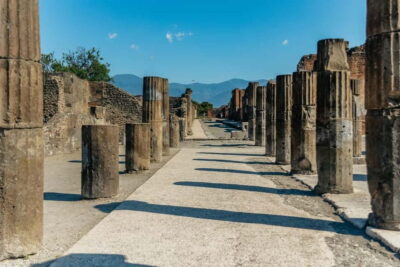
Archaeological Park Tour with Ticket on request
Read our review →