Reviewed · POMPEII RUINS TOURS
Pompeii Ruins Special
Pompeii is easiest to understand when you follow its streets with someone who can explain what you are seeing. This private three-hour walk covers the Forum, theaters, and thermal baths, then brings the ancient city to life through bakeries, shops, homes, fountains, frescoes, and mosaics. I like the focused length and the chance to ask questions without a larger group slowing you down.
I also like that the guide, Lucia, known in some comments as Lucy or Zia Lucy, is a licensed guide from the Campania Region and can add local insight beyond the ruins themselves. The main thing to watch is the price: $335.48 per group of up to eight does not include admission tickets, fees, or taxes.
In This Review
- Key points to know before you book
- Why three hours works well at Pompeii
- Meeting Lucia at Pompei Scavi Villa Dei Misteri
- The Forum: Pompeii’s civic center
- The theaters and thermal baths
- Streets, fountains, bakeries, and fast-food counters
- Frescoes and mosaics that survived
- What the private format changes
- Lucia’s local point of view
- Is the $335.48 group price fair?
- Who should book this Pompeii walk?
- Booking, confirmation, and cancellation
- Should you book Pompeii Ruins Special?
- FAQ
- How long does the Pompeii tour last?
- Where does the tour start?
- Where does the tour end?
- Is this a private tour?
- Is a tour guide included?
- Are Pompeii admission tickets included?
- Are fees and taxes included?
- Can I cancel for a full refund?
Key points to know before you book
- Three hours gives you a useful middle ground: You can see Pompeii’s major areas without committing to a full day inside the archaeological park.
- The private format keeps the pace personal: Only your group participates, so you can ask questions and spend more time on subjects that interest you.
- Lucia brings local Campania connections: She lives near Positano and has also helped arrange a driver for transportation in some cases, though transport is not listed as part of the tour.
- The route covers daily Roman life: Look for streets, fountains, bakeries, fast-food counters, houses, shops, frescoes, and mosaics, not just grand public buildings.
- Admission is extra: The guide is included, but the archaeological park entrance and all fees and taxes are not.
- The meeting point is practical: You begin and end at Pompei Scavi Villa Dei Misteri, near public transportation.
Why three hours works well at Pompeii
Pompeii is large enough to fill an entire day, yet a first visit does not have to last that long. Three hours gives you time to see the central sights and gain a clear sense of how the city worked without turning the day into a long march through ruins.
I find this length especially useful if you are combining Pompeii with other parts of Campania. You might be staying near Positano, visiting Naples, or fitting the archaeological park into a day with limited time. A private guide also helps you avoid wandering from one surviving wall to the next without knowing why it matters.
The tour is described as a walk through the most important parts of Pompeii. That means you should expect a broad introduction rather than an exhaustive visit to every open street and building. If you want to inspect every house, read every inscription, and cover a large share of the park, three hours will feel short.
For most first-time visitors, though, the timing is sensible. You get a solid introduction, some context, and a chance to see the city’s most important public and private spaces. You can then decide if you want to return for a longer visit.
More Pompeii excavation visits:
- Pompeii: Entry Ticket and Guided Tour with an Archaeologist
★ 4.8 · 19,459 reviews - Pompeii: Entry Ticket with Optional Audio Guide
★ 4.2 · 12,360 reviews - Pompeii: Small Group Tour with an Archaeologist
★ 4.8 · 12,264 reviews
Meeting Lucia at Pompei Scavi Villa Dei Misteri
The tour starts at Pompei Scavi Villa Dei Misteri, at 80045 Pompei, in the Metropolitan City of Naples. It also ends at the same meeting point, which keeps the plan simple and avoids finishing at an unfamiliar corner of the archaeological park.
The meeting point is near public transportation. That matters because Pompeii is commonly reached as part of a wider Campania trip, and you may not have a rental car. The provided information does not include a transfer, taxi, or train fare, so you will need to arrange your own way to the starting point.
Lucia has also arranged a driver to and from Pompeii for at least one booking. Treat that as a possible extra arrangement, not as part of the advertised tour. Ask about it before booking if you need a private transfer from Positano or another town.
The guide’s formal qualification is important here. Every tour is led by a licensed guide from the Campania Region. Lucia is also familiar with the surrounding area near Positano, so you can ask local questions as well as questions about the ruins.
The Forum: Pompeii’s civic center
The Forum is the natural anchor for this visit. This large ancient square was the city’s main public center, and the tour uses it to explain how Pompeii was organized.
You will not just be looking at a single monument. The Forum helps connect the rest of the city: public business, civic life, religion, and movement through the streets all meet here. A guide can give you a framework for the ruins before you move into smaller spaces.
I like beginning with a city center because it makes the later stops easier to read. After seeing the Forum, a bakery or shop feels less random. You begin to understand these buildings as parts of a functioning Roman town rather than isolated archaeological remains.
The Forum can also be one of the busiest and most exposed parts of a Pompeii visit. Your guide controls the route and timing, but the exact amount of time available at each stop can change based on conditions inside the park.
The theaters and thermal baths
The theaters show another side of Pompeii’s public life. The tour includes the theaters among its main stops, giving you a look at entertainment and shared civic spaces.
The thermal baths add a useful contrast. They help explain how Romans spent time away from home and how public buildings served social as well as practical purposes. Together, the theaters and baths keep the tour from focusing only on politics and wealthy houses.
These stops are valuable because they make Roman life easier to picture. You can compare the open public spaces with the more intimate rooms found in houses and shops later in the walk.
The description does not specify which individual theaters or bath complexes are open on the day of your visit. Pompeii’s accessible areas can change, and one past visit took place while some parts of the park were closed. Lucia adjusted that tour so the group still felt it had seen the important material, but you should understand that the exact route may vary.
A completely different way to spend a day in Pompeii Ruins:
- Pompeii Small Group Tour with an Archaeologist
★ 5.0 · 6,593 reviews - Pompeii: Skip-the-Line Entrance Ticket with Audio Guide
★ 4.0 · 2,509 reviews - Naples: Pompeii and Mt. Vesuvius with Lunch and Wine Tasting
★ 4.5 · 2,454 reviews - Pompeii: Archaeological Park Tour with Ticket on request
★ 4.5 · 2,283 reviews
Streets, fountains, bakeries, and fast-food counters
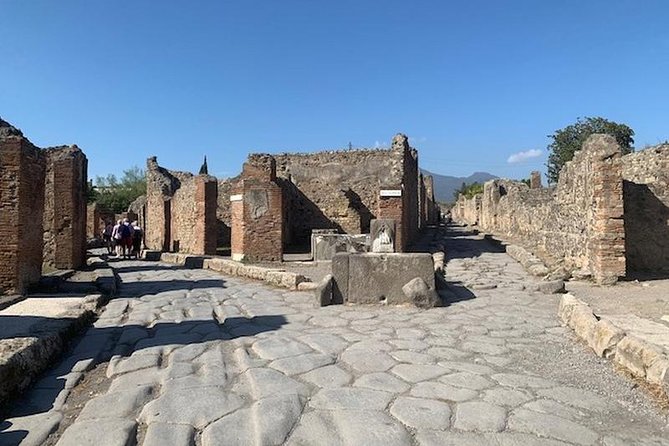
The most revealing parts of Pompeii are often the ordinary ones. The tour includes ancient streets, fountains, bakeries, fast-food counters, shops, and houses. These details show how people moved, bought food, worked, and lived.
The streets give you the city’s basic shape. Fountains point to daily water use. Bakeries reveal food production, while fast-food counters show that eating away from home was part of city life in the Roman world.
Shops and houses then fill in the human side of the visit. You can compare spaces built for business with those designed for private life. A guide’s explanations are especially useful here because a worn doorway or counter may not be obvious without context.
I like this part of the route more than a simple monument checklist. Grand buildings are memorable, but everyday spaces often make Pompeii feel like a real town. The mix also suits different interests within one private group. One person can focus on architecture, another on food, and another on domestic life.
Frescoes and mosaics that survived
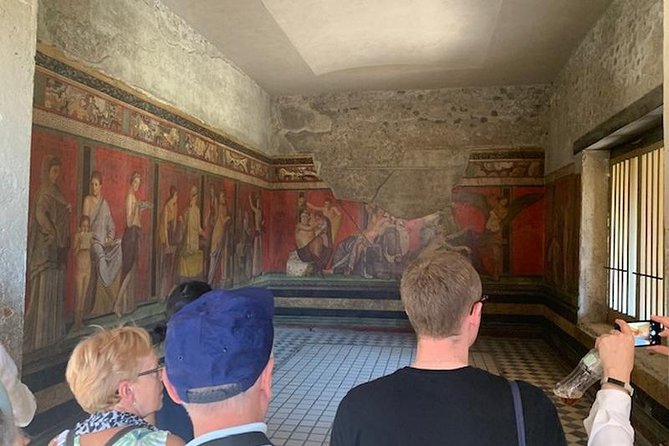
The tour also includes frescoes and mosaics. These are among Pompeii’s most attractive remains, but their value goes beyond decoration.
Painted walls and patterned floors show how Romans used color and design inside their homes and public spaces. They also help you imagine how different the city looked before the eruption, when buildings were not reduced to bare stone and brick.
The exact frescoes and mosaics you see depend on which buildings are open. Since admission to the park is not included, your entry ticket is a separate cost, and access can change with park operations.
This is another place where Lucia’s explanations matter. Without guidance, it is easy to spend more time on a famous image than on the larger story of how art fitted into Roman daily life. A private tour lets you ask why a decoration appears in a certain room and what that room was used for.
What the private format changes
This is a private activity for your group only. The maximum size is eight people, and the price is charged per group rather than per person.
That structure can be good value for a family or group of friends. At the full capacity of eight, the guide cost works out to about $42 per person before entrance tickets and other fees. A smaller group pays more per person, so you should compare the total against a shared tour if budget is your main concern.
The real benefit is control. You can ask Lucia to explain a particular subject, pause for questions, or adjust the emphasis within the planned three-hour visit. You are not listening to a large group’s unrelated questions, and you do not have to match the pace of strangers.
The tradeoff is that the advertised price is not the final cost of the outing. Admission tickets, all fees, and taxes are excluded. You should add those costs before deciding if the private format fits your budget.
Lucia’s local point of view
Lucia is identified as a licensed Campania guide, and the supplied comments use several names for her: Lucia, Lucy, and Zia Lucy. That may reflect friendly nicknames rather than different guides, but it is worth confirming the guide’s name when you book.
Her appeal is not limited to reciting dates and building names. She is based near Positano and knows the wider Campania area. That can be useful if Pompeii is one stop in a longer trip and you want practical ideas for nearby places.
Her style also appears to include humor and personal storytelling. One Italian account describes a memorable five-hour visit with Zia Lucy, even though this product is advertised at about three hours. That difference is important: do not assume the longer experience is included here. The three-hour tour is the format you are booking.
The strongest theme in the feedback is her ability to make the ancient city engaging and understandable. She also responds warmly to questions and takes pride in sharing the area she knows. Still, guide style is personal, so if you prefer a very academic or highly structured lecture, ask about the approach in advance.
Is the $335.48 group price fair?
The price makes the most sense when you use the private capacity. For eight people, $335.48 is a reasonable guide fee for a licensed private walk, though tickets and taxes raise the total. For two people, it becomes a much more expensive way to enter Pompeii.
I would look at the cost in three parts:
- The private guide fee is $335.48 for up to eight people.
- The archaeological park admission is extra.
- All fees and taxes are extra.
The value comes from time saved and explanations gained. Pompeii is not difficult to enter, but it is easy to lose your route and miss the meaning of what you are seeing. A guide gives the visit shape and helps you focus on the Forum, theaters, baths, streets, shops, homes, and decorative remains in a limited period.
If you already know Pompeii well or plan to spend a full day studying the site at your own pace, a private three-hour introduction may not be the best fit. If this is your first visit and you want a guided overview without a full-day commitment, the price is easier to justify.
Who should book this Pompeii walk?
This tour suits you if you want a private introduction to Pompeii and have about three hours available. It is particularly practical for families, couples traveling with friends, or any group that values its own pace.
It also suits people who care about context. The route is not limited to headline monuments. It includes the small evidence of daily life: fountains, bakeries, food counters, shops, houses, frescoes, and mosaics.
You may want a different option if you want to explore the park for an entire day, require guaranteed access to a particular building, or need admission and transportation bundled into one price. The tour does not promise a fixed list of every open structure, and entrance is not included.
Most people can participate, according to the supplied information. The activity is near public transportation, but no detailed mobility information is provided, so ask the provider about the walking conditions if that is important for your group.
Booking, confirmation, and cancellation
Confirmation is sent within 48 hours of booking, subject to availability. Since this is a private tour, make sure your preferred date and time are confirmed before arranging other parts of your day.
The mobile ticket format is convenient, but you still need to account for the separate park admission. The activity begins and ends at the stated meeting point.
Free cancellation is available if you cancel at least 24 hours before the local start time. Cancellations made less than 24 hours ahead are not refunded, and changes within that period are not accepted.
Should you book Pompeii Ruins Special?
Book it if you want Pompeii explained clearly in three hours, prefer a private group, and are willing to pay separately for entry. The mix of public buildings and ordinary streets gives you a better feel for the city than a quick march past the Forum alone.
I would especially consider it for a group of six to eight, where the per-person cost is more attractive. Lucia’s Campania background and flexible local perspective add useful value, particularly if your trip also includes Positano or Naples.
Skip it if you want an all-day archaeological study or need one fixed price with tickets and transport included. For a first visit with limited time, though, this is a well-focused way to meet Pompeii without giving the ruins your entire day.
FAQ
How long does the Pompeii tour last?
The tour lasts approximately three hours.
Where does the tour start?
It starts at Pompei Scavi Villa Dei Misteri, 80045 Pompei, Metropolitan City of Naples, Italy.
Where does the tour end?
The activity ends back at the meeting point.
Is this a private tour?
Yes. Only your group participates, with a maximum of eight people.
Is a tour guide included?
Yes. A licensed guide from the Campania Region is included. The guide is identified as Lucia, also called Lucy or Zia Lucy in the supplied information.
Are Pompeii admission tickets included?
No. The archaeological park admission ticket is not included.
Are fees and taxes included?
No. All fees and taxes are excluded from the listed price.
Can I cancel for a full refund?
Yes, if you cancel at least 24 hours before the experience start time. Cancellations made less than 24 hours ahead are not refunded, and changes within that period are not accepted.
Newest reviews from Pompeii Ruins
- Private Tour Pompeii and Winery★ 5.0 · 4 reviews
- Visit the Pompeii ruins from Salerno with Pizza Lunch★ 5.0 · 4 reviews
- Pompeii Private Tour for Kids and Their Families★ 4.8 · 4 reviews
- From Sorrento: Pompeii & Vesuvius tour small group★ 4.8 · 4 reviews
- Pompeii Sorrento and Positano Tour★ 5.0 · 4 reviews
- From Naples_ Pompeii Tour_Skip the line ticket + audioguide★ 4.3 · 4 reviews
- Pompeii, skip-the-line ticket with smartphone audio guide on App★ 3.0 · 4 reviews
- Pompeii Private Half-Day Tour from: Naples,Sorrento, Amalfi Coast★ 5.0 · 4 reviews
Pompeii Ruins Tours, compared.

Entry Ticket and Guided Tour with an Archaeologist
Read our review →

Pompeii Small Group Tour with an Archaeologist
Read our review →
Skip-the-Line Entrance Ticket with Audio Guide
Read our review →
Pompeii and Mt. Vesuvius with Lunch and Wine Tasting
Read our review →
Archaeological Park Tour with Ticket on request
Read our review →