Reviewed · POMPEII RUINS TOURS
Pompeii: living with the volcano
Pompeii is most powerful when you stop seeing it as a field of ruins and start seeing it as a living city. This two-hour walk follows its streets, shops, theaters, homes, baths, election notices, and Forum as they might have looked just before the eruption of 79 AD. I like the strong focus on daily life, and I like that guide Michele Arpa brings an archaeologist’s eye to small details and symbols.
I also like the private format, since your group can keep the pace and ask questions without being folded into a large crowd. The main drawback is practical: the entrance ticket is not included, and Pompeii’s uneven roads make this a poor fit if you have mobility difficulties.
In This Review
- Key points at a glance
- Pompeii before the ash fell
- A private two-hour walk with Michele Arpa
- Walking the streets and shops of Pompeii
- Theaters and the amphitheater
- Wealthy homes and the Roman social divide
- Baths, the Forum, and the city’s public center
- Meeting the people trapped by the eruption
- What the $33.36 price really covers
- Physical demands and practical planning
- Who will get the most from this Pompeii tour
- Should you book it?
- FAQ
- Where does the Pompeii tour begin?
- Where does the activity end?
- How long does the tour last?
- What time is the experience scheduled?
- Is the tour offered in English?
- Is the Pompeii entrance ticket included?
- Is this a private tour?
- Is the tour suitable for people with mobility difficulties?
- What is the cancellation policy?
Key points at a glance
- Daily life comes first: See where Pompeiians ate, shopped, voted, relaxed, and watched public entertainment.
- Michele Arpa leads the walk: He guides in English and is praised for clear explanations, friendly service, and good organization.
- The tour is private: Only your group takes part, giving you more room for questions and discussion.
- The route covers major highlights: Expect theaters, the amphitheater, a first-century BC takeaway shop, homes, baths, and the Forum.
- Plan for extra costs: Pompeii admission and all entrance fees are separate from the $33.36 guide price.
- Allow for uneven footing: You need a moderate level of fitness, and the roads are not recommended for people with mobility problems.
Pompeii before the ash fell
The clever idea behind this tour is to visit Pompeii as a functioning town, not just as a disaster site. Instead of moving from one famous ruin to another with a list of dates, you follow the habits of the people who lived here: eating, bathing, voting, watching theater, and spending time in public spaces.
That approach matters because Pompeii can feel overwhelming. The archaeological park is large, and its streets are lined with walls, doorways, shops, and half-seen rooms. Without a clear story, you may walk past an important building and remember only another stretch of stone.
Michele’s route gives those remains a human scale. You look at a shop and consider what it sold. You read political notices painted on walls and see that local elections were part of everyday street life. You enter homes and compare the public image of wealthy families with the practical spaces used by ordinary residents.
The eruption remains the central shadow over the visit, but it is not the only subject. The walk spends much of its time on the city as it was before the catastrophe, which makes the final encounter with the victims more difficult and more meaningful.
More Pompeii excavation visits:
- Pompeii: Entry Ticket and Guided Tour with an Archaeologist
★ 4.8 · 19,459 reviews - Pompeii: Entry Ticket with Optional Audio Guide
★ 4.2 · 12,360 reviews - Pompeii: Small Group Tour with an Archaeologist
★ 4.8 · 12,264 reviews
A private two-hour walk with Michele Arpa
Michele Arpa is the guide named for this experience, and the available feedback consistently praises his command of Pompeii, friendly manner, and English. He is also described as well organized and willing to tailor a longer visit around Pompeii, Herculaneum, or the National Archaeological Museum.
For this experience, you meet at the Archaeological Park of Pompeii and return to the same meeting point. The scheduled time is 9:30 AM to 11:30 AM, every day during the stated operating period. A morning start is useful because you have the rest of the day free, though you should be ready to walk for the full two hours.
The private setup is one of the better reasons to choose this tour over a lower-cost group walk. Your group alone participates, so you can ask about a wall painting, a street feature, or a building that catches your eye. You can also tell Michele if you want more attention on politics, homes, public entertainment, or the eruption, although the supplied details do not promise a customized route.
One useful sign of Michele’s style is that he has helped people beyond the formal sightseeing itself. He has met a group at Naples train station for a Pompeii visit and helped with an Italian parking ticket problem during a wider trip. That does not mean station pickup is included here. It does suggest a guide who takes practical questions seriously and may be a helpful local contact during your visit.
Walking the streets and shops of Pompeii
The first part of the route places you in the city’s ordinary streets. Pompeii is especially good at showing how public and private life sat close together. Doorways open onto lanes, shops sit beside homes, and political messages appear on walls where people could read them as they went about their day.
The takeaway shop is a particularly useful stop. It lets you picture a quick meal in a first-century BC business rather than thinking only about grand villas and temples. You can expect Michele to use the building as a way to explain how people ate outside the home and how commercial life worked in the city.
The wall notices add another practical touch. Names of candidates for local magistrate elections were painted where residents would see them. This is one of those details that can make Pompeii feel less distant. The city was not silent or empty. It had arguments, campaigns, meals, errands, and public choices.
I like this part of the route because it gives you a way to read Pompeii. You are not simply admiring old masonry. You are looking for evidence of who used a space, what happened there, and how that place fit into city life.
Theaters and the amphitheater

The itinerary includes Pompeii’s theater and its immense amphitheater. These buildings show a different side of the town, where entertainment drew people together and public spectacles could be harsh.
The amphitheater is tied to gladiatorial combat, and the tour presents the brutal nature of those fights rather than smoothing it into a cheerful ancient-world story. That frankness is useful. Pompeii’s public life included pleasure and social ritual, but it also included violence performed for crowds.
The theater offers a contrast. Here, the focus shifts toward staged performance and civic gathering. Together, the two stops help explain how public entertainment shaped the city’s identity.
You should not expect a separate long lecture on every building. This is a two-hour tour, so the value lies in Michele’s selection and explanation. If you want an exhaustive archaeological survey, you will need more time in the park after the guided walk. If you want a clear route through several major public spaces, the pace should suit you.
A completely different way to spend a day in Pompeii Ruins:
- Pompeii Small Group Tour with an Archaeologist
★ 5.0 · 6,593 reviews - Pompeii: Skip-the-Line Entrance Ticket with Audio Guide
★ 4.0 · 2,509 reviews - Naples: Pompeii and Mt. Vesuvius with Lunch and Wine Tasting
★ 4.5 · 2,454 reviews - Pompeii: Archaeological Park Tour with Ticket on request
★ 4.5 · 2,283 reviews
Wealthy homes and the Roman social divide
The tour also enters luxurious domus, the large homes of Pompeii’s wealthier residents. These houses offer a chance to look at how status was displayed through space, decoration, and the relationship between public reception areas and more private rooms.
The important point is not simply that the houses are attractive. They help you compare different levels of life within the same city. A prosperous family could receive visitors in carefully arranged surroundings, while other Pompeiians lived and worked in far less grand settings nearby.
Michele’s explanations are valuable here because a house can look like a collection of empty rooms unless someone explains how it was used. Look for the movement from the street into the home, the difference between spaces meant for visitors and spaces meant for household work, and the signs of social rank.
Access to individual buildings can change. One person who took a longer Pompeii visit during a period of restricted exhibition areas was warned in advance and still received detailed explanations. That is a useful reminder not to build your expectations around seeing every interior. Conditions can limit access, but a good guide can still explain what is closed and why the remaining route is worthwhile.
Baths, the Forum, and the city’s public center
The baths provide the tour’s quieter pause. After the noise of theaters, shops, and political notices, you reach a place linked with washing, rest, and social time. The route presents the baths as part of normal urban life, not as an isolated monument.
That emphasis helps you understand the city as a complete system. Pompeii needed places for commerce, religion, government, entertainment, food, and personal care. A visit that includes each of these functions gives you a more useful picture than one that focuses only on villas.
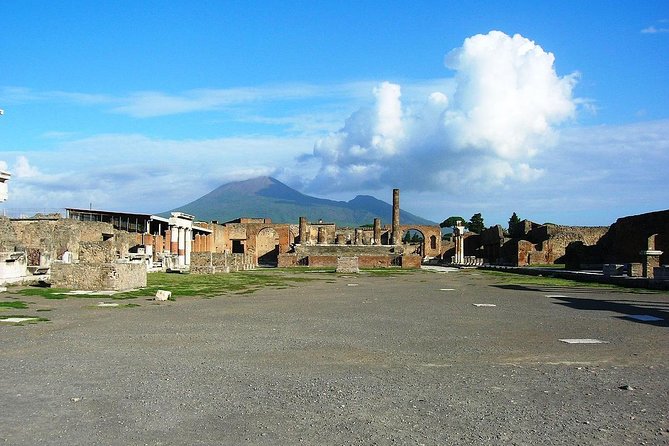
The walk finishes with the civil Forum, the splendid public square at the heart of civic life. This is a natural place to pull the story together. By the time you reach it, you have seen private homes, commercial spaces, political writing, public entertainment, and the bath culture that connected people.
The Forum can also be one of Pompeii’s most demanding places because there is so much to look at. A guide keeps the final stop from becoming a blur of columns and open space. You should expect interpretation rather than a long period of quiet independent exploration.
Meeting the people trapped by the eruption
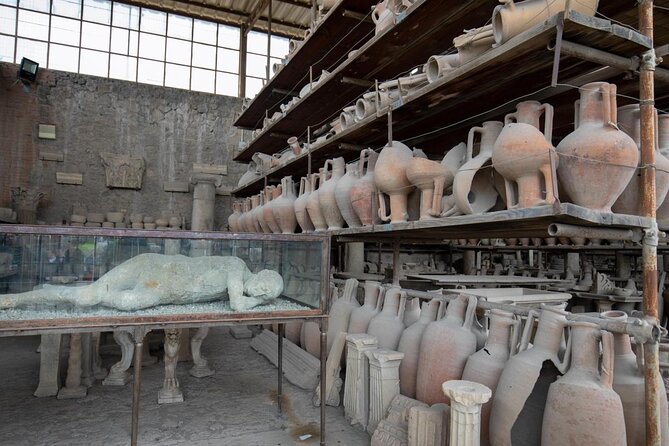
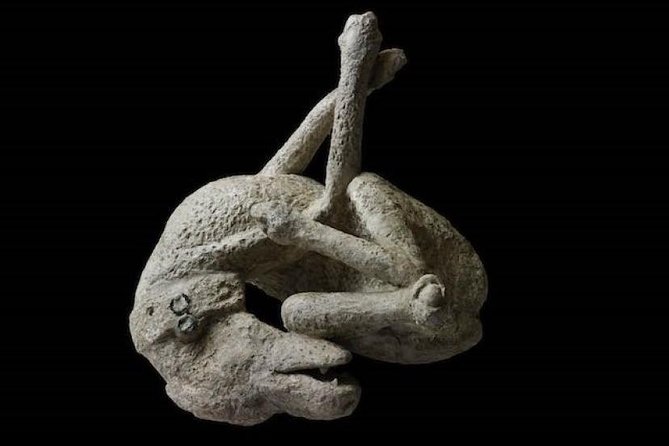
The most serious part of the walk comes when you encounter the Pompeiians who died during the eruption, their final moments preserved through archaeological work. This is not a light sightseeing stop, and the experience is stronger because it follows the earlier picture of daily life.
You have already seen the city as a place where people ate, voted, bathed, worked, and watched shows. The victims are therefore not anonymous figures from a textbook. They belong to the same streets and buildings you have just been learning to understand.
Michele’s role here is important. The material calls for care and clarity, not drama for its own sake. The supplied feedback describes him as passionate about Pompeii and good at sharing its less obvious details. That kind of explanation can help you approach the casts and archaeological evidence with respect.
This part may not be suitable for very young children or anyone who prefers to avoid difficult archaeological displays, but the tour information does not set an age restriction. Use your own judgment, especially if your group includes children who may find the final scenes upsetting.
What the $33.36 price really covers
At $33.36 per person, the price is reasonable if you want a private English-language guide for a focused two-hour visit. The cost pays for guide service, not your entry into Pompeii.
You need to budget separately for the archaeological park admission and all site fees. That distinction is easy to miss, so check the total cost before booking. A cheap guide price can look less attractive once you add admission, but the private format may still offer good value if you are sharing the cost with family or friends.
The value comes from interpretation and time saved. Pompeii is not hard to enter and walk through on your own, but it is easy to miss the meaning of a takeaway counter, a painted election notice, or the layout of a wealthy home. Michele’s explanations are meant to turn those details into a connected story.
If you are traveling alone, the per-person cost may feel higher than a group tour. If you have several people in your party, the private arrangement becomes easier to justify. The experience also suits someone who wants to ask questions freely rather than follow a fixed large-group script.
Physical demands and practical planning
You should be prepared for about two hours on foot over Pompeii’s uneven roads. The activity calls for moderate physical fitness and is not recommended for people with mobility difficulties because of the condition of the streets.
Wear practical shoes and plan your energy. The supplied details do not promise seating, shade, hotel pickup, or transport within the park, so do not treat this as a gentle promenade. You meet and finish at the archaeological park.
The tour is offered in English. Service animals are allowed, and the park is near public transportation. The stated daily schedule is 9:30 AM to 11:30 AM, so confirm the exact date and meeting details when you book.
Free cancellation is available if you cancel at least 24 hours before the start time. Cancellations made later are not refunded, and changes within that window are not accepted. The activity also requires a minimum number of participants, and if that minimum is not met, you are offered another date or experience, or a full refund.
Who will get the most from this Pompeii tour
I would choose this experience if you want Pompeii explained through ordinary life rather than presented as a checklist of famous ruins. It is a good match for first-time visitors who want the Forum, amphitheater, homes, baths, shops, and theaters placed in one clear story.
It also suits families and small groups who value direct contact with a guide. Michele’s friendly approach and willingness to help with wider trip questions can be useful if you are spending time around Naples and want practical suggestions for food or other sights.
History-minded visitors may appreciate the focus on symbols, political names, domestic spaces, and the final moments of the city. The tour is less suitable if you want a full-day archaeological study, a very slow photography walk, or a route designed for limited mobility.
You should also remember that two hours is an introduction, not a complete visit to Pompeii. The park contains more than any short tour can cover. If the subject catches you, plan extra time after the guided portion, but only the two-hour route itself is described here.
Should you book it?
Book this tour if you want a private, English-language guide who can make Pompeii’s streets and buildings easier to read. The best reasons are the daily-life focus, Michele Arpa’s strong reputation for clear and friendly guiding, and the chance to ask questions within your own group.
Skip it if you need an accessible route, want admission included in the advertised price, or prefer to spend the entire day exploring independently. For most first-time visitors who can manage uneven streets, the price offers a sensible way to turn a huge archaeological park into a human story.
FAQ
Where does the Pompeii tour begin?
The tour begins at the Archaeological Park of Pompeii, 80045 Pompei, Metropolitan City of Naples, Italy.
Where does the activity end?
The activity ends back at the meeting point at the Archaeological Park of Pompeii.
How long does the tour last?
The guided visit lasts approximately two hours.
What time is the experience scheduled?
The stated opening hours are Monday through Sunday from 9:30 AM to 11:30 AM during the listed operating period.
Is the tour offered in English?
Yes. English is the listed language for the experience.
Is the Pompeii entrance ticket included?
No. The entrance ticket is not included, and all entrance fees and taxes are also excluded.
Is this a private tour?
Yes. Only your group participates in the private activity.
Is the tour suitable for people with mobility difficulties?
The tour requires a moderate level of physical fitness. Because of the condition of Pompeii’s roads, it is not recommended for visitors with mobility difficulties.
What is the cancellation policy?
You can cancel up to 24 hours before the start time for a full refund. Cancellations or changes made less than 24 hours before the start time are not accepted for a refund.
Newest reviews from Pompeii Ruins
- Private Tour Pompeii and Winery★ 5.0 · 4 reviews
- Visit the Pompeii ruins from Salerno with Pizza Lunch★ 5.0 · 4 reviews
- Pompeii Private Tour for Kids and Their Families★ 4.8 · 4 reviews
- From Sorrento: Pompeii & Vesuvius tour small group★ 4.8 · 4 reviews
- Pompeii Sorrento and Positano Tour★ 5.0 · 4 reviews
- From Naples_ Pompeii Tour_Skip the line ticket + audioguide★ 4.3 · 4 reviews
- Pompeii Private Half-Day Tour from: Naples,Sorrento, Amalfi Coast★ 5.0 · 4 reviews
- Pompeii, skip-the-line ticket with smartphone audio guide on App★ 3.0 · 4 reviews
Pompeii Ruins Tours, compared.

Entry Ticket and Guided Tour with an Archaeologist
Read our review →

Pompeii Small Group Tour with an Archaeologist
Read our review →
Skip-the-Line Entrance Ticket with Audio Guide
Read our review →
Pompeii and Mt. Vesuvius with Lunch and Wine Tasting
Read our review →
Archaeological Park Tour with Ticket on request
Read our review →