Reviewed · POMPEII RUINS TOURS
Pompeii Archaeological Small-Group tour for 15 people
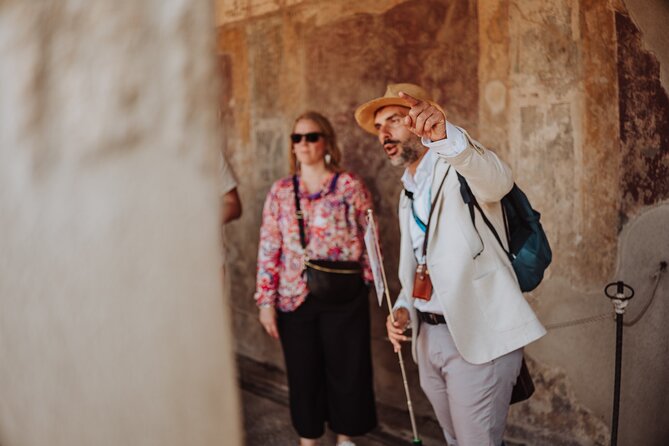
Pompeii is best understood piece by piece: a public square, a bath complex, a wealthy home, a shop-lined street, then the sudden, sobering casts left by the eruption. This two-hour small-group tour gives you that framework without asking you to tackle the enormous ruins alone.
I like the archaeological background of the guides, and I like that the tour ends inside the site, leaving you free to continue toward the Amphitheatre and necropolis. The main consideration is time. Two hours is enough for a strong introduction, but not enough to see every major corner of Pompeii.
In This Review
- Key points
- Why a guided first look at Pompeii helps
- Meeting at Porta Marina and getting oriented
- The Basilica and the Forum: Pompeii’s public heart
- Granaries and the casts left by the eruption
- House of Menander and the world of Pompeii’s elite
- Stabian Baths and the daily business of washing
- The Lupanar, Pompeii’s most talked-about stop
- House of the Faun and Pompeii’s grandest private scale
- Teatro Grande and the tour’s natural finish
- What the $77.06 price includes
- Timing, crowds, and who will enjoy it most
- Guide style and the value of expert explanation
- Should you book this Pompeii tour?
- FAQ
- How long does the Pompeii tour last?
- How many people can join the group?
- Is the Pompeii entrance ticket included?
- What language is the tour offered in?
- Where does the tour meet?
- Where does the tour finish?
- Are food, drinks, and transportation included?
- Can I cancel for a full refund?
Key points
- A maximum of 15 people keeps the group smaller than a large coach tour.
- Licensed guides with archaeological backgrounds lead the visit in English.
- The route includes Pompeii’s Forum, casts, baths, brothel, grand houses, and theater.
- Headsets are provided for groups of 10 or more, useful in noisy or crowded areas.
- The tour ends inside the ruins, so you can keep exploring after the guided portion.
- The $77.06 price includes the Pompeii Express entrance ticket, guide, assistance, and headsets when needed.
Why a guided first look at Pompeii helps
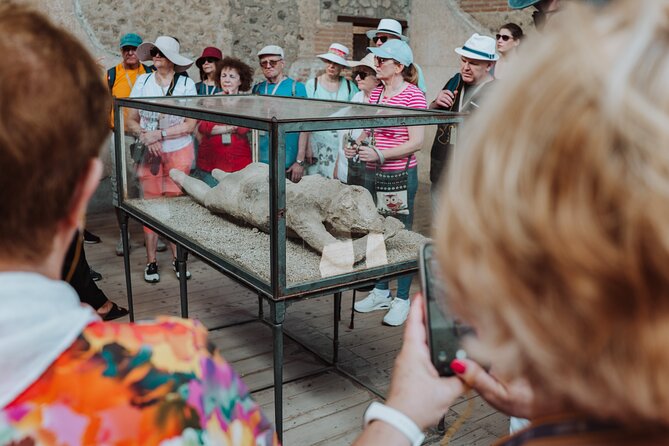
Pompeii can feel confusing at first. You enter a huge archaeological site filled with broken walls, paved roads, columns, courtyards, and fragments of painted plaster. Without context, it is easy to admire the remains without understanding how the city worked.
This route gives you a useful sequence. You begin at the entrance, move through civic and commercial spaces, then see private houses, public baths, and entertainment buildings. By the time you reach the theater, you have a clearer picture of daily life in the Roman city.
The guides are a major part of the experience. Names associated with this tour include Mario Celebtano, Raffaele, Antonella, Camillo Sorrentino, Teresa, Nicoletta, and Hugo, who has also led a German-language version. The strongest descriptions focus on guides who connect ancient life with the present, explain current archaeological work, and use anecdotes without losing the main story.
I would especially value an archaeologist such as Antonella if you want more than a basic walk through the ruins. Her explanations have included information about active excavations in Pompeii and nearby areas. That sort of context helps you see the site as a living field of research, not a finished museum.
More Pompeii excavation visits:
- Pompeii: Entry Ticket and Guided Tour with an Archaeologist
★ 4.8 · 19,459 reviews - Pompeii: Entry Ticket with Optional Audio Guide
★ 4.2 · 12,360 reviews - Pompeii: Small Group Tour with an Archaeologist
★ 4.8 · 12,264 reviews
Meeting at Porta Marina and getting oriented
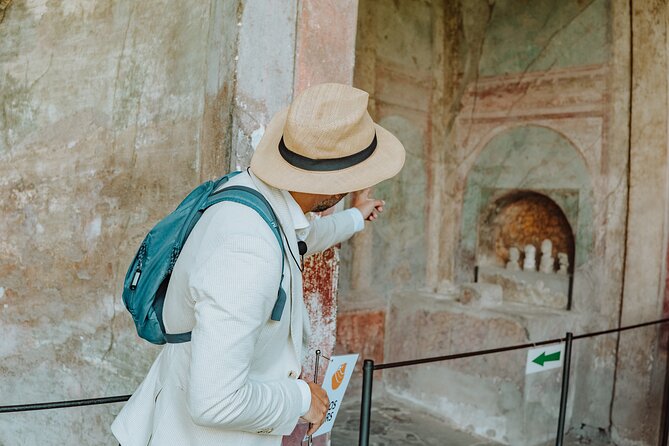
The tour begins near Pompeii’s Porta Marina Superiore entrance. The instructions identify Piazza Porta Marina and say to meet in front of the Hortus bar and restaurant, where the Askos Tours guide will hold a company sign.
The stated start address is Via Villa dei Misteri, 2, while the meeting directions refer to Porta Marina Superiore. I would check the exact meeting point carefully before setting out, especially if you are arriving by train, bus, or taxi. The information is close enough to create confusion if you simply rely on a map pin.
Your first ten minutes are spent getting oriented around the entrance. Admission is included in the tour price, so you do not need to arrange a separate Pompeii ticket for this visit. Once inside, the guide can help you understand the scale of the archaeological area and the basic layout before the route moves toward the city center.
Pompeii is an outdoor site, and the streets can be uneven. Wear shoes that are comfortable on old paving stones and plan for the weather. Food and drinks are not included, although the tour ends inside the ruins and there is an on-site café where you can take a break before continuing on your own.
The Basilica and the Forum: Pompeii’s public heart
The Basilica is an early stop, with about ten minutes devoted to the building and its portico. It provided shelter for merchants and other public activity, so this is a useful place to begin thinking about Pompeii as a working city rather than just a collection of houses.
From there, the route reaches the Forum, the ancient main square. The Forum was the setting for civic, religious, and commercial life, and it is one of the places where Pompeii’s scale becomes clear. You can look across the open space and see how temples, public buildings, and business activity were arranged around it.
The Forum visit is short, listed at about ten minutes. That is enough for a guide to point out the main features and explain why the square mattered, but it is not a long architectural lecture. If you enjoy standing still to study columns and building plans, you may want to return here after the tour.
The route then follows Pompeii’s main street. Walking this road gives you a better sense of how people moved through the city. The paving, walls, doorways, and surviving building fronts make the street feel more immediate than an isolated monument.
Granaries and the casts left by the eruption
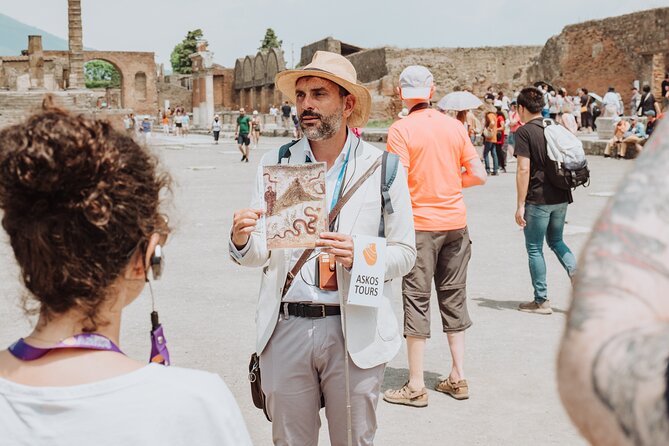
The granaries of the Forum offer one of the tour’s most memorable stops. You can see marble tables, fountain baths, and other pieces connected with houses and public spaces. The area also contains casts of eruption victims, including a dog and a tree.
These casts are powerful, but they should be approached with care. They are not simply dramatic displays. They give physical form to the final moments of people and animals caught in the disaster. A good guide can help you understand what you are seeing without turning the stop into spectacle.
The visit lasts roughly ten minutes. That may feel brief, particularly if you want time to study the casts closely. Still, the placement of this stop early in the route gives the rest of the tour a more human frame. After seeing the city’s public buildings and grand residences, you remember that Pompeii was also a place where ordinary lives ended suddenly.
A completely different way to spend a day in Pompeii Ruins:
- Pompeii Small Group Tour with an Archaeologist
★ 5.0 · 6,593 reviews - Pompeii: Skip-the-Line Entrance Ticket with Audio Guide
★ 4.0 · 2,509 reviews - Naples: Pompeii and Mt. Vesuvius with Lunch and Wine Tasting
★ 4.5 · 2,454 reviews - Pompeii: Archaeological Park Tour with Ticket on request
★ 4.5 · 2,283 reviews
House of Menander and the world of Pompeii’s elite
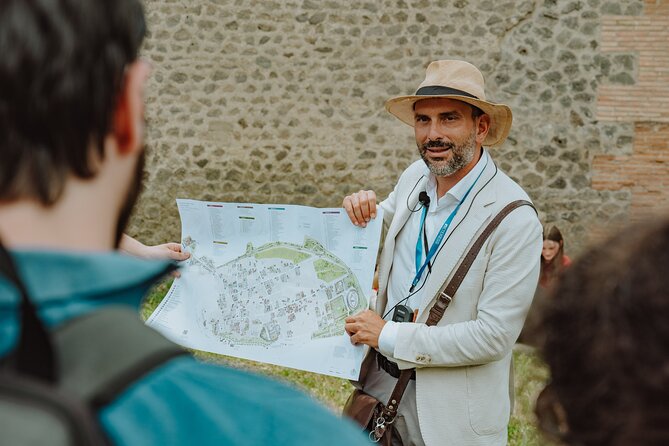
The House of Menander is scheduled for about fifteen minutes. It is described as one of Pompeii’s most impressive residences, both for its architecture and decoration and for the contents found there.
This is where the difference between a private home and a public building becomes clear. The house gives you a look at wealth, status, design, and domestic life. Rather than only seeing ruins from the street, you can begin to imagine how the rooms and courtyards were arranged for family life, social visits, and display.
The name refers to Menander, the Greek playwright, and the house is known for its fine decoration. Your guide’s explanation is especially useful here because a quick walk through a large Roman home can otherwise become a blur of walls and thresholds.
Fifteen minutes is a sensible introduction, but it is not enough to examine every detail. If this is the part of Pompeii you care about most, note what the guide points out and return later. The tour’s route gives you a sample of the house, not an exhaustive study.
Stabian Baths and the daily business of washing
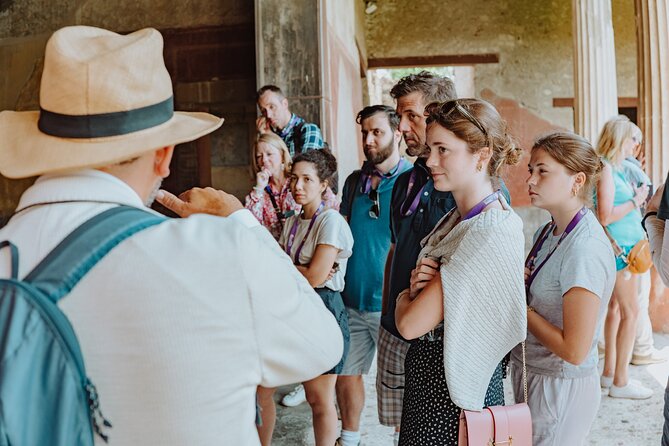
The Stabian Baths occupy a broad area between the Brothel Lane, the Holconius crossroads, and Via Stabiana. They are identified as the oldest thermal complex in the city, making them an important stop for understanding public life.
Roman baths were not only places to wash. They were social spaces, and the layout can help you see how people moved through different rooms and facilities. The guide can explain the complex in relation to Pompeii’s streets and public routine.
The visit lasts about fifteen minutes. That is long enough to make the baths meaningful, especially if you have never studied Roman bath architecture, but the site contains enough detail to reward another look. I like this stop because it shifts the focus away from wealthy villas and famous casts. It shows a more regular part of city life.
The Lupanar, Pompeii’s most talked-about stop
The Lupanar is the city’s best-known brothel and usually attracts plenty of attention. The small rooms, surviving decorations, and compact layout offer a direct look at a part of Roman urban life that is often softened or ignored in general histories.
The tour allows about ten minutes here. That keeps the visit focused, but you may need to wait or move carefully if the area is crowded. One of the practical benefits of a guide is knowing what details matter and how this building fits into Pompeii’s wider street network.
This stop may not suit every child. The tour overall is considered suitable for most people, but the Lupanar and the level of historical discussion may be better for teenagers and adults. A family with younger children should decide in advance whether this portion feels appropriate.
House of the Faun and Pompeii’s grandest private scale
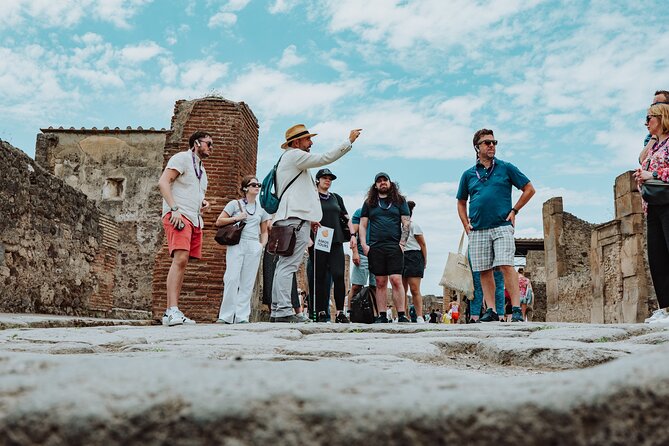
The House of the Faun is one of Pompeii’s largest and most impressive private residences. Its size alone helps you understand the gap between an ordinary home and an elite Roman property.
A fifteen-minute visit lets the guide point out the house’s scale, design, and place among Pompeii’s major residences. The house is associated with the famous dancing faun statue, though the original statue is now in the Naples Archaeological Museum. The important point on this tour is the setting itself: the broad rooms and open spaces show how wealth could be displayed through architecture.
This is another stop where a guide adds real value. Without explanation, a large Roman house can seem like a series of empty rooms. With the right context, you can read the layout as a statement about status and hospitality.
Teatro Grande and the tour’s natural finish
The route ends at Teatro Grande, Pompeii’s most important theater. The visit lasts about ten minutes and provides a final look at public entertainment in the city.
The theater is a good closing stop because it brings together architecture, performance, and social life. After seeing the Forum, baths, shops, homes, and brothel, you finish in a place built for a large public audience.
The official end point is Piazza Esedra, but the tour ends inside the archaeological site. This matters. You are not pushed out immediately after the final explanation. You can keep exploring on your own, which is exactly what I would do.
One useful plan is to continue toward the Amphitheatre and necropolis after the guided route. A guide has directed people to those areas before, and the extra time can turn a two-hour introduction into a much fuller Pompeii visit. You can also return to the Forum, House of Menander, or House of the Faun if one stop caught your attention.
What the $77.06 price includes
At $77.06 per person, this is not the cheapest way to enter Pompeii. The value rests on what comes with the ticket: a licensed guide with an archaeological background, guidance for the full tour, the Pompeii Express entrance ticket, a group capped at 15, and headsets for groups of 10 or more.
For me, the small group is important. Pompeii is too large for a guide’s explanation to carry across a loose crowd, and a group of 15 is easier to keep together than a large bus group. Headsets also help when the streets are noisy or the group spreads out around a monument.
The price makes more sense if you want structure and interpretation. If you are happy to read signs, use a guidebook, and spend the whole day setting your own route, independent entry may suit you better. If you have only a morning or afternoon, the guided route helps you spend those hours on the city’s most important themes.
Private transportation is not included. You need to make your own way to the starting point, and food and drinks are also separate. That is normal for a walking visit, but include those costs and the time needed to reach the entrance when planning your day.
Timing, crowds, and who will enjoy it most
The tour is advertised at about two hours, though one guided visit ran closer to two and a half hours. The exact pace can depend on the guide, crowd levels, and conditions inside the ruins.
Crowds can change the experience. On Italy’s Liberation Day, April 25, the site was very busy and the tour time had to be moved earlier. The guide still managed the route through the crowds, but this is a reminder to avoid major holidays when possible or stay flexible about the start time.
I think this tour suits:
- First-time visitors who want a clear introduction
- Adults and teenagers interested in archaeology and Roman life
- People with limited time in Pompeii
- Families who prefer a guide to make the ruins easier to follow
- Visitors who want advice about what to see after the tour
Younger children may struggle with the amount of explanation, especially during the longer stops at the houses and baths. The experience is also not a complete visit to Pompeii. You will need extra time if you want the Amphitheatre, necropolis, Villa dei Misteri, or other outlying sections.
One important expectation: Villa dei Misteri is not included in this route. If you specifically want that building, check its location and allow additional time after the tour, rather than assuming it forms part of the guided visit.
Guide style and the value of expert explanation
The strongest feature here is the guide. Mario Celebtano has been praised for passionate, thoughtful explanations. Raffaele has handled heavy crowds while keeping the group moving. Camillo Sorrentino is described as prepared, meticulous, and polite, while Teresa is known for linking ancient events to modern life and using anecdotes to bring places into focus.
Nicoletta has been described as both entertaining and informative, which is a useful combination for a two-hour walk. An enthusiastic guide can keep the pace lively without making the subject shallow.
Askos Tours also runs tours in other languages, including German, but this specific experience is offered in English. If language matters to your booking, confirm that you are choosing the English departure.
Cancellation is flexible if your plans change: you can receive a full refund by cancelling at least 24 hours before the local start time. Cancellations or changes made inside that window are not refunded or accepted.
Should you book this Pompeii tour?
I would book it if you are visiting Pompeii for the first time, want an archaeologically informed guide, and have about two hours for a focused introduction. The route covers the city’s essential mix: the public Forum, unsettling casts, wealthy homes, baths, the Lupanar, and a theater.
I would not book it as your only Pompeii plan if you want to see every major building. Treat it as the guided core of a longer visit, then continue independently toward the Amphitheatre, necropolis, or other areas. At $77.06, the tour is most useful when you value a clear route, a small group, and expert explanation more than the lowest possible admission cost.
FAQ
How long does the Pompeii tour last?
The tour lasts approximately two hours. One guided visit ran about two and a half hours, so allow a little flexibility.
How many people can join the group?
The maximum group size is 15 people.
Is the Pompeii entrance ticket included?
Yes. The Pompeii Express entrance ticket is included in the price.
What language is the tour offered in?
This experience is offered in English.
Where does the tour meet?
The meeting directions identify Porta Marina Superiore, in front of the Hortus bar and restaurant at Piazza Porta Marina. The guide will hold an Askos Tours sign. The stated starting address is Via Villa dei Misteri, 2, so confirm the exact meeting point before arrival.
Where does the tour finish?
The tour ends inside the ruins at Piazza Esedra. You are free to continue exploring Pompeii on your own.
Are food, drinks, and transportation included?
No. Food, drinks, and private transportation are not included.
Can I cancel for a full refund?
Yes, if you cancel at least 24 hours before the experience start time. Cancellations or changes made less than 24 hours before the start are not refunded.
Newest reviews from Pompeii Ruins
- Private Tour Pompeii and Winery★ 5.0 · 4 reviews
- Visit the Pompeii ruins from Salerno with Pizza Lunch★ 5.0 · 4 reviews
- Pompeii Private Tour for Kids and Their Families★ 4.8 · 4 reviews
- From Sorrento: Pompeii & Vesuvius tour small group★ 4.8 · 4 reviews
- Pompeii Sorrento and Positano Tour★ 5.0 · 4 reviews
- From Naples_ Pompeii Tour_Skip the line ticket + audioguide★ 4.3 · 4 reviews
- Pompeii Private Half-Day Tour from: Naples,Sorrento, Amalfi Coast★ 5.0 · 4 reviews
- Pompeii, skip-the-line ticket with smartphone audio guide on App★ 3.0 · 4 reviews
Pompeii Ruins Tours, compared.

Entry Ticket and Guided Tour with an Archaeologist
Read our review →

Pompeii Small Group Tour with an Archaeologist
Read our review →
Skip-the-Line Entrance Ticket with Audio Guide
Read our review →
Pompeii and Mt. Vesuvius with Lunch and Wine Tasting
Read our review →
Archaeological Park Tour with Ticket on request
Read our review →