Reviewed · POMPEII RUINS TOURS
Pompei Adventure: A Tailored Tour for Families with Kids!
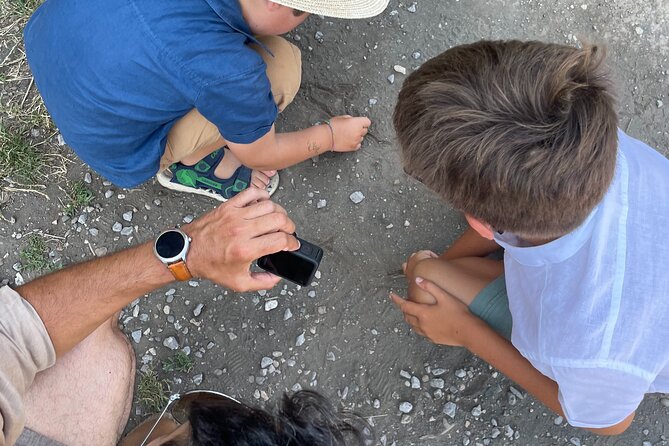
Pompeii can be hard work with children, but this private tour gives the ruins a clear shape and a playful purpose. I like the family-made route, which covers the amphitheater, Venus in a Shell, Via dell’Abbondanza, the Stabian Baths, and the Forum without asking young visitors to wander through miles of ruins. I also like the way Annarosa and Matteo use games, maps, stories, and a treasure hunt to keep children involved while adults get solid explanations.
The main drawback is the fixed two-and-a-half-hour format. Pompeii is enormous, and this tour gives you a useful introduction rather than a full archaeological site visit. The price is $360.42 per private group, and admission is extra at €18 per person, so it makes the most financial sense for a larger family group or several families sharing the guide.
In This Review
- Key points at a glance
- Why Pompeii Works Better With a Family Guide
- Starting at the Amphitheater
- The Venus in a Shell Treasure Hunt
- Walking Via dell’Abbondanza
- The Stabian Baths and Roman Daily Life
- Ending at the Forum With Mount Vesuvius
- How the Games Help Adults Too
- Price, Group Size, and Overall Value
- Who Should Book This Pompeii Tour
- Practical Details Before You Go
- Should You Book It?
- FAQ
- How long does the Pompeii family tour last?
- What time does the tour begin?
- Where does the tour begin?
- Where does the tour end?
- Are Pompeii entrance tickets included?
- How many people can join the private tour?
- Is the tour offered in English?
Key points at a glance
- A route built for young children: The tour uses games, maps, stories, and a treasure hunt instead of relying on long lectures.
- Five major Pompeii sights: You visit the amphitheater, Venus in a Shell, Via dell’Abbondanza, the Stabian Baths, and the Forum.
- Annarosa and Matteo lead the experience: Annarosa guides the history, while Matteo helps keep the activities moving for children.
- Private groups of up to eight: Your party has the guide to itself, which makes it easier to adjust the pace and answer questions.
- A useful two-and-a-half-hour visit: The route focuses on major highlights and aims to avoid much of the crowd pressure.
- Admission costs extra: The tour price does not include the €18 archaeological-site ticket per person.
Why Pompeii Works Better With a Family Guide
Pompeii is not a tidy museum with one room leading naturally to the next. It is a large ancient city spread across uneven streets, open courtyards, houses, public buildings, and broad spaces exposed to the sun. Without a plan, children can tire before the most memorable sights appear.
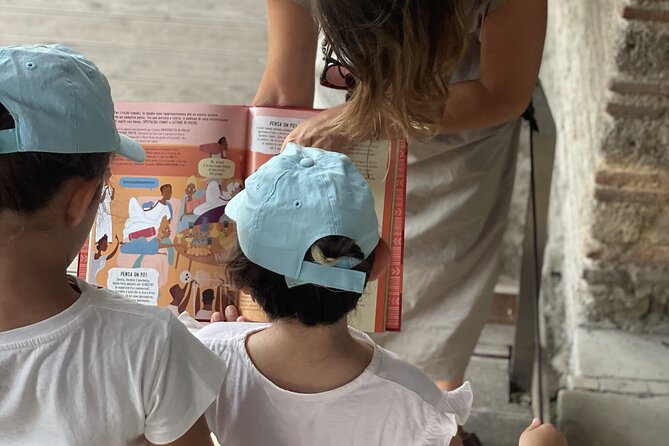
That is where this tour earns its keep. Annarosa presents Pompeii as a place to investigate. Children are given activities and maps, and the visit includes a treasure hunt inside the House of Venus in the Shell. These tasks give young visitors something specific to look for, which is often more effective than asking them to listen quietly while an adult explains Roman urban planning.
The approach also works for adults. Annarosa covers Pompeii’s traditions, daily life, and food culture, not just dates and ruins. You can expect explanations designed to answer children’s questions while still giving parents useful context about politics, religion, shopping, public bathing, and entertainment.
The guides have also managed groups that included children from two to eight years old, as well as families with children aged six and ten. That does not guarantee that every child will respond in the same way, but it does show that the tour is built around the real limits of younger children rather than an adult sightseeing schedule.
More Pompeii excavation visits:
- Pompeii: Entry Ticket and Guided Tour with an Archaeologist
★ 4.8 · 19,459 reviews - Pompeii: Entry Ticket with Optional Audio Guide
★ 4.2 · 12,360 reviews - Pompeii: Small Group Tour with an Archaeologist
★ 4.8 · 12,264 reviews
Starting at the Amphitheater
The meeting point is Via Roma 101 in Pompei, and the tour begins at 10:00 am. The first stop is the Roman amphitheater, where you spend about 30 minutes looking at the arena associated with gladiatorial contests.
This is a smart opening for children. An amphitheater immediately gives them a picture of public entertainment, competition, and crowd life. The subject is easy to grasp, and the scale of the building helps Pompeii feel like a real city rather than a collection of broken walls.
I like beginning here because it puts human drama before technical detail. A guide can explain how the arena functioned, what gladiators represented, and why public spectacles mattered in Roman society. Children have a natural entry point, while adults can place the building within Pompeii’s wider civic life.
The stop lasts around half an hour, with admission included in the tour itinerary but the archaeological-site entrance ticket paid separately. Expect open-air conditions and walking from the start, so comfortable shoes, water, and protection from the sun matter, especially during warmer months.
The Venus in a Shell Treasure Hunt
Next comes the House of Venus in the Shell, one of Pompeii’s especially attractive private houses. Its name comes from the Venus imagery associated with the site, and the house gives the tour a chance to shift from public spectacle to domestic life.
The treasure hunt is the key feature here. Instead of simply being told to admire a wall or garden, children are encouraged to search and notice. That small change can turn a quiet archaeological space into a puzzle. It also helps them look at details that adults might otherwise pass by.
For parents, this stop adds balance to the tour. Pompeii was not only a place of theaters, roads, and public offices. It was also a city of homes, decoration, status, family life, and private taste. The House of Venus in the Shell helps Annarosa explain how people used their living spaces and how art shaped the feel of a Roman home.
The house receives about 30 minutes. That is enough time for a focused visit, but not enough for an exhaustive examination of every room. I see that as a benefit for families. A short, purposeful stop is less likely to become the point when a six-year-old decides that all ancient walls look alike.
Walking Via dell’Abbondanza
Via dell’Abbondanza was one of Pompeii’s main streets, and the tour uses it to explain everyday movement through the city. This is where you get the clearest sense of shopping, errands, and street food in ancient Pompeii.
The road is particularly useful for children because it connects several ideas they already understand. People bought food, met friends, moved around town, and stopped at businesses. The ancient version of fast food gives the guide an easy way to discuss eating habits and commerce without turning the lesson into a formal history class.
For adults, this is one of the most informative parts of the route. A street can tell you how a city worked. You begin to see Pompeii as a place where people lived ordinary lives, not only as a site linked to disaster and volcanic ash.
The tour allows roughly 30 minutes here. That is a brisk introduction, not a leisurely street-by-street study. You will walk on ancient paving and deal with the normal demands of a large archaeological site. If your children are young, the guide’s activities and steady narration should help, but the route is still physical. Pompeii is not a sit-down attraction.
A completely different way to spend a day in Pompeii Ruins:
- Pompeii Small Group Tour with an Archaeologist
★ 5.0 · 6,593 reviews - Pompeii: Skip-the-Line Entrance Ticket with Audio Guide
★ 4.0 · 2,509 reviews - Naples: Pompeii and Mt. Vesuvius with Lunch and Wine Tasting
★ 4.5 · 2,454 reviews - Pompeii: Archaeological Park Tour with Ticket on request
★ 4.5 · 2,283 reviews
The Stabian Baths and Roman Daily Life
The Stabian Baths, or Terme Stabiane, show the public side of Roman comfort and routine. Public baths were important social spaces, and this stop lets the guide explain how ancient Pompeiians used them.
The baths are valuable because they move the story beyond famous ruins. You are not only looking at grand monuments. You are seeing part of the daily rhythm of the city, where people went to wash, exercise, socialize, and spend time in a public setting.
For children, baths can be easier to understand than an abstract discussion of Roman government. The guide can point out how different spaces served different purposes and how a public building was organized. Maps and questions help young visitors connect what they see to the activities that once took place there.
The stop lasts around 30 minutes. As with the other sections, the benefit is focus. You get a guided explanation before fatigue sets in. The limitation is that anyone wanting a long architectural study will need more time at Pompeii after the tour.
Ending at the Forum With Mount Vesuvius
The final stop is the Forum, Pompeii’s central public square. This was the city’s political, economic, and religious center, so it provides the broadest view of how Pompeii functioned.
Ending here makes sense. The amphitheater introduces public entertainment, the house shows private life, the main road reveals commerce, and the baths cover daily routine. The Forum brings those pieces together. It is the place to talk about civic power, religious activity, trade, and the public identity of the city.
The view toward the volcano adds emotional weight. From the Forum, you can look across the remains with Mount Vesuvius in the distance and understand the setting that shaped Pompeii’s fate. The view is not just a photo stop. It gives the whole visit a strong final image.
The Forum receives about 30 minutes, and the tour ends at Foro di Pompei, Via Villa dei Misteri 2. Since the ending point differs from the starting address, you should note the route before booking and plan your onward movement from the Forum area.
How the Games Help Adults Too
The family activities are not merely distractions. They solve a real problem at Pompeii: the site requires attention, but much of what you see needs explanation. A child may not care about a wall until the guide turns it into a clue, a map exercise, or a story about the people who used the space.
Annarosa’s style appears to combine clear teaching with patience and empathy. Matteo helps with the children, which matters when one child wants to listen, another wants to move, and a third needs a break. In larger family groups, this support can reduce the pressure on parents to manage every moment themselves.
I would still set reasonable expectations. Games do not erase heat, uneven ground, or walking. They make the effort easier to handle. Children who are very young or easily tired may still need snacks, water, and pauses, though the tour information does not specify whether breaks can be added to the route.
The private format is another advantage. Only your group participates, with a maximum of eight people. That gives you more room to ask questions and lets the guide respond to your children’s pace better than a large shared group usually can.
Price, Group Size, and Overall Value
The listed cost is $360.42 per group of up to eight people. Archaeological-site admission is not included and costs €18 per person. For two people, the guide fee is a major expense. For a family of four, the guide cost works out to about $90.11 per person before admission. For eight people, it drops to about $45.05 per person before tickets.
That calculation makes the ideal booking pattern clear. This tour is best value for a larger family, two families traveling together, or a group of relatives who want a private guide. A party of up to eight can share the fixed cost, while a small family may prefer to compare it with a shared group tour.
The price pays for more than a standard walk through the ruins. You are paying for a route shaped around children, an English-speaking private guide, activities, and help from Annarosa and Matteo. The value is strongest if your alternative is trying to keep young children engaged while reading signs and finding your own way through Pompeii.
The two-and-a-half-hour length also has value. It is long enough to see the main parts of the route, yet short enough to fit into a family day without turning Pompeii into an all-day endurance test. If you want a complete site visit, plan to treat this as an introduction rather than the final word.
Who Should Book This Pompeii Tour
I would choose this experience for families with children roughly in the early school years, especially if you want history presented through stories and tasks. It also suits adults who want a focused orientation before exploring more on their own.
It is a good fit for:
- Families with children who lose interest during long formal talks
- Groups wanting a private English-language visit
- Several families sharing a guide and splitting the group price
- Parents concerned about heat, walking, and crowd pressure
- Adults who want context about food, homes, baths, politics, and religion
I would think twice if your main goal is a lengthy specialist visit to Pompeii. The route covers five important areas, but each receives about 30 minutes. That structure favors energy and variety over close study.
I would also avoid promising children that the activities will make the site effortless. Pompeii remains a large archaeological park under the sun. The tour makes it more manageable, but sensible footwear and water are still part of the plan.
Practical Details Before You Go
The tour starts at 10:00 am from Via Roma 101 in Pompei and finishes at the Forum entrance area on Via Villa dei Misteri. It is near public transportation, and most people can participate according to the supplied tour information.
Confirmation is provided when you book. Free cancellation is available if you cancel at least 24 hours before the start time. Cancellations or changes made less than 24 hours before the start are not accepted for a refund.
The tour is offered in English. Admission to the archaeological site costs €18 per person and must be added to your budget. Since the tour price is per group, count the number of people in your party before deciding if the private format gives you good value.
Should You Book It?
Book this tour if you want Pompeii to make sense to your children, not simply to your camera. Annarosa and Matteo offer a family-focused structure with games, maps, stories, and a treasure hunt, while the route covers the amphitheater, a private house, the main shopping street, public baths, and the Forum.
The strongest reason to choose it is the balance. Children get something to do, and adults still receive explanations about Pompeii’s public life, homes, food, and customs. The main caution is cost for small groups, plus the extra €18 admission fee per person.
For a group of six to eight, this looks like a practical and well-targeted way to see Pompeii without asking young children to endure a long, unfocused walk.
FAQ
How long does the Pompeii family tour last?
The tour lasts approximately two hours and 30 minutes.
What time does the tour begin?
The tour starts at 10:00 am.
Where does the tour begin?
The meeting point is Via Roma, 101, 80045 Pompei, Italy.
Where does the tour end?
The tour ends at Foro di Pompei, Via Villa dei Misteri, 2, 80045 Pompei, Italy.
Are Pompeii entrance tickets included?
No. Entrance tickets to the archaeological site cost €18 per person and are not included in the tour price.
How many people can join the private tour?
The price covers one private group of up to eight people. Only your group participates.
Is the tour offered in English?
Yes. The experience is offered in English.
Newest reviews from Pompeii Ruins
- Wine Tour + Pompeii★ 5.0 · 4 reviews
- Full-Day Sorrento Positano Pompeii Tour★ 5.0 · 4 reviews
- Pompeii: Skip The Line Entrance Tickets + Audioguides★ 3.2 · 4 reviews
- Pompeii ruins★ 5.0 · 4 reviews
- Pompeii: Entry Ticket & Guided Tour with an Expert Historian★ 5.0 · 4 reviews
- Private Tour Pompeii and Winery★ 5.0 · 4 reviews
- Visit the Pompeii ruins from Salerno with Pizza Lunch★ 5.0 · 4 reviews
- Pompeii Private Tour for Kids and Their Families★ 4.8 · 4 reviews
Pompeii Ruins Tours, compared.

Entry Ticket and Guided Tour with an Archaeologist
Read our review →

Pompeii Small Group Tour with an Archaeologist
Read our review →
Skip-the-Line Entrance Ticket with Audio Guide
Read our review →
Pompeii and Mt. Vesuvius with Lunch and Wine Tasting
Read our review →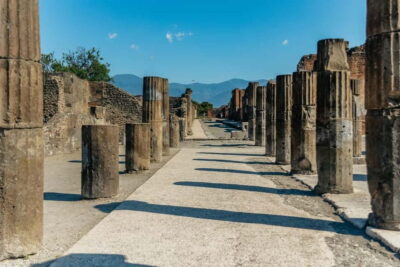
Archaeological Park Tour with Ticket on request
Read our review →