
Reviewed · 2-HOUR EXPERIENCES
2 Hours Private Tour of Pompeii for Journey Through Time
Pompeii makes its strongest impression when you move through it as a town, not as a collection of museum pieces. This private tour takes you from the ancient amphitheater to Via dell’Abbondanza and then into the Stabian Baths, giving you a quick look at entertainment, daily commerce, and Roman public life. I like the efficient route and the chance to ask your own questions without a large group slowing things down. I also like that guides Annarosa and Carla are specifically connected with warm communication and useful local recommendations.
The main drawback is simple: two hours is short for Pompeii. The archaeological site is large, and this visit focuses on three areas rather than trying to cover everything. You also pay the €18 entrance fee per person separately, so the tour price is not the full cost of admission.
In This Review
- Key Points to Know Before Booking
- Why a Private Two-Hour Visit Can Work at Pompeii
- Starting at the Amphitheater
- Via dell’Abbondanza: Pompeii’s Main Street
- The Stabian Baths and Roman Public Life
- What the Guide Adds
- Price, Group Size, and Overall Value
- Timing, Meeting Point, and Practical Details
- Who Will Get the Most From This Tour
- Should You Book the Pompeii Private Tour?
- FAQ
- How long does the Pompeii private tour last?
- How much does the tour cost?
- Is the tour offered in English?
- Where does the tour start and end?
- Is this a private experience?
- What is included in the tour?
Key Points to Know Before Booking
- Three sharply different Pompeii stops: See the amphitheater, the city’s main commercial street, and one of its oldest bathing complexes.
- A private group of up to eight: Your guide’s attention stays with your party rather than a larger crowd.
- Two hours with a clear purpose: This works well when Pompeii is one part of a busy Campania schedule.
- English-language guiding: The experience is offered in English, with Annarosa and Carla named among the guides associated with the tour.
- Site admission costs extra: Budget €18 per person in addition to the group tour price.
- A useful end point: The tour begins at Piazza Immacolata and finishes at the ruins entrance on Via Villa dei Misteri.
Why a Private Two-Hour Visit Can Work at Pompeii
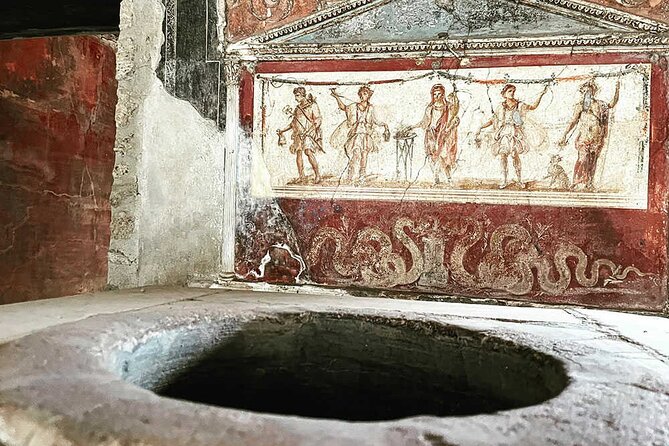
Pompeii is not a compact monument. It is an ancient city with streets, homes, shops, public buildings, shrines, baths, and entertainment spaces spread across a broad archaeological area. Without a plan, you can spend much of your time simply finding your way from one major feature to another.
This tour solves that problem with a tight sequence. You begin at the Anfiteatro Romano, move along Via dell’Abbondanza, and finish at the Stabian Baths. The order gives you a useful story: how Pompeii entertained its people, how they lived and worked, and how they used public facilities.
I especially like the private format for a site like this. A group of up to eight is small enough for a more personal walk, and you can ask for clarification when a building or street needs more context. You are not locked into the pace or questions of a large coach group.
The two-hour length calls for realistic expectations. You will not see every famous house, painting, or public building. Instead, you get a focused introduction to Pompeii’s urban life. If this is your first visit and your schedule is tight, that focus is useful. If you want a full archaeological survey, you will need more time at the site beyond this guided portion.
More Pompeii excavation visits:
- Pompeii: Entry Ticket and Guided Tour with an Archaeologist
★ 4.8 · 19,459 reviews - Pompeii: Entry Ticket with Optional Audio Guide
★ 4.2 · 12,360 reviews - Pompeii: Small Group Tour with an Archaeologist
★ 4.8 · 12,264 reviews
Starting at the Amphitheater
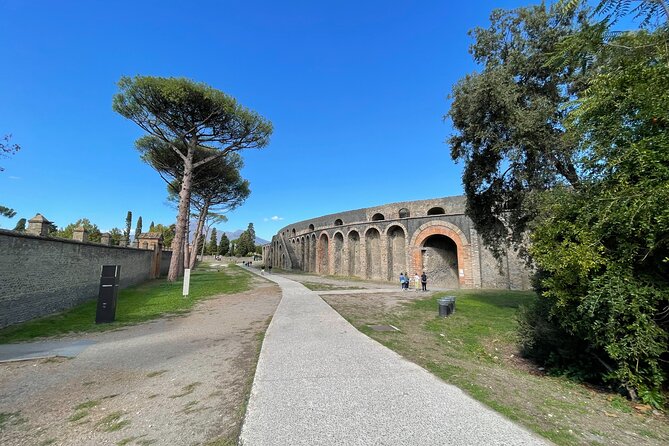
The Anfiteatro Romano is the tour’s first stop, with about 30 minutes set aside for it. It is one of the oldest surviving Roman amphitheaters, so it offers a strong opening to the visit.
Here, your guide explains the world of gladiator contests and the way public figures were promoted. The comparison with modern sports stars is especially helpful. Slogans, nicknames, posters, banners, and public loyalty were not inventions of the modern age. Pompeii’s amphitheater was a place where entertainment, fame, and civic identity came together.
This stop is valuable because it puts ordinary Roman life in a social setting. You are not looking only at old stone. You are considering what brought people together, what they talked about, and how public spectacles shaped local culture.
The 30-minute limit keeps the visit moving, but it also means the amphitheater receives a brisk treatment. If gladiatorial history is your main interest, you may wish the stop were longer. Still, as the first chapter of a short tour, it gives you an immediate sense of Pompeii as a living city rather than a silent ruin.
Admission is not included in the tour price, so you need the archaeological site ticket to enter. The stated entrance fee is €18 per person.
Via dell’Abbondanza: Pompeii’s Main Street
The tour then spends about 45 minutes on Via dell’Abbondanza. This is the heart of the experience for anyone who wants to understand how Pompeii functioned day by day.
Two thousand years ago, homes, apartments, businesses, workspaces, public buildings, and shrines faced this road. People from different social classes used the same urban corridor, though not in the same way or with the same status. The street helps you see Pompeii as a working community with many kinds of residents and activities.
I like this stop because it moves the focus away from famous individuals and toward ordinary routines. A house front might sit near a shop. A workspace could be close to a religious shrine. Public life and private life were physically close, much as they are in many historic Italian towns today.
Your guide can help you read the street as more than a row of walls. Look for the changing scale and purpose of the buildings as you walk. The value of an expert guide here is not simply naming structures. It is explaining how the street connected housing, trade, religion, and public life.
This is also the point where Pompeii’s preservation can feel most immediate. The street plan remains clear, and the arrangement of buildings lets you picture movement through the city. The experience is strongest when you slow down enough to imagine people using the road for errands, work, worship, and social contact.
The drawback is that 45 minutes cannot cover every building along Via dell’Abbondanza. Pompeii has many layers of detail, and you may leave with several questions about particular houses or businesses. That is a fair trade for a short tour, especially when the goal is to understand the city’s overall structure.
The Stabian Baths and Roman Public Life
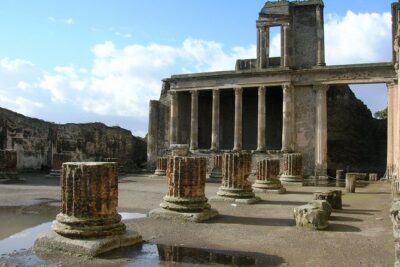
The final stop is the Terme Stabiane, or Stabian Baths, with about 45 minutes devoted to the complex. Dating to the second century BC, these baths are among the oldest known in the Roman world.
The visit follows the basic sequence of the bathing complex. You see the apodyterium, or dressing room, then the frigidarium for cold baths, the tepidarium for medium-temperature bathing, and the caldarium for hot baths.
This progression gives you a practical way to understand Roman bathing. The baths were not just places to wash. They were public spaces organized around temperature, changing, and social activity. Even without adding details that are not part of the tour description, the layout itself shows careful planning and a strong interest in public comfort.
The Stabian Baths also balance the first two stops nicely. The amphitheater represents mass entertainment. Via dell’Abbondanza shows the city’s streets and work. The baths reveal another part of urban life, where public facilities shaped daily routines.
Forty-five minutes is a sensible amount of time here. The sequence of rooms gives the guide a clear structure, and you can follow the path from cold to warm areas without needing a long explanation of unrelated buildings. If you enjoy architecture and engineering, this may be the most satisfying stop.
As with the amphitheater, the tour does not promise every room or every feature of Pompeii. You are getting a readable introduction to the baths, not a specialist study of Roman bathing culture.
More Pompeii Ruins tours worth comparing
- Pompeii 2h Small-Group Tour with Expert Archaeologist
★ 5.0 · 385 reviews - 2 hours Pompeii Tour with Local Historian – Ticket Included
★ 5.0 · 335 reviews - Pompeii: 2 Hour Private Tour with an Archeologist Guide
★ 5.0 · 214 reviews - Pompeii 2-hour Private Tour with an Archaeologist-Ticket included
★ 5.0 · 181 reviews
What the Guide Adds
A private guide matters most when the site is large and the remains require interpretation. Pompeii can show you walls, streets, doorways, and rooms, but it cannot explain itself. Your guide connects those physical remains to the people who used them.
The experience is offered in English. Annarosa and Carla are the named guides associated with the experience, and direct communication before the tour is part of what makes planning easier. If one of them leads your visit, you can also ask for local recommendations beyond Pompeii. That extra help is useful when Pompeii is part of a wider trip in southern Italy.
You should use the private format to your advantage. Ask about the parts of the site that interest you most, such as gladiatorial contests, city streets, public baths, or the eruption of Mount Vesuvius. The tour includes stories about the eruption of AD 79, so you get the historical event alongside the physical remains.
The private setup does not mean the route can expand without limit. The tour still lasts approximately two hours, and the three planned stops account for the full time. Your guide can answer questions, but you should not expect to add several distant areas to the route.
Price, Group Size, and Overall Value
The listed price is $216.27 per group, with up to eight people included. The site entrance fee is separate at €18 per person.
The value changes sharply with group size. If eight people share the tour, the guiding cost works out to about $27 per person before admission. For four people, it is about $54 per person. For two people, it is about $108.14 per person, again before the €18 entrance ticket.
That makes this easier to recommend for a family or group of friends than for a solo visitor. A larger party gets the benefit of private guiding while dividing the fixed cost. A couple may still prefer it for the personal attention, but should compare the price with a shared group tour or a longer self-guided visit.
The fee is buying more than entry. The archaeological site ticket alone does not provide the same focused route or direct explanation. You are paying for a guide who organizes the visit around three important parts of Pompeii and keeps the tour moving.
Still, the two-hour limit matters. If you are already paying for private guiding, some people may prefer a longer experience that reaches more of the site. This option makes the most financial sense when your schedule is tight or when you value a private format more than maximum coverage.
Timing, Meeting Point, and Practical Details
The meeting point is Piazza Immacolata, 2, in Pompei. The tour ends at the Pompeii ruins on Via Villa dei Misteri, 2. Starting and ending at different points can be useful, especially if you plan to continue exploring after the guided walk.
The location is near public transportation, which helps if you are arriving without a car. The experience is described as suitable for most people, but the supplied details do not give a specific route assessment or information about every mobility need. If you have particular access concerns, ask the provider before booking.
You receive confirmation at the time of booking. The tour is private, so only your own group participates. That is a practical advantage for families, friends, or anyone who prefers not to spend two hours matching the pace of strangers.
The cancellation terms are generous if your plans are uncertain. You can cancel for a full refund up to 24 hours before the local start time. Cancellations or changes made less than 24 hours before the start are not refunded or accepted.
Bring your attention, not an overpacked wish list. The route is short and purposeful. Since the site admission is separate, make sure you have accounted for that cost before arriving.
Who Will Get the Most From This Tour
This experience suits you best if you want a clear first look at Pompeii without giving the entire day to the archaeological site. It is also a good match if you prefer asking questions directly rather than listening from the edge of a large group.
Families may appreciate the two-hour format. Pompeii can be tiring, and a focused visit gives younger members a manageable introduction to the city. The amphitheater, main street, and baths also provide three different subjects, which helps keep the visit varied.
First-time visitors can use this as a foundation. After the tour, you will understand the broad shape of Pompeii and can decide if you want to continue on your own. The end point at the ruins gives you a natural opportunity to remain in the area, although the tour itself lasts only about two hours.
History fans should note the limits. The tour covers important public spaces and urban life, but the supplied route does not include every major Pompeii attraction. If your priority is a specific house, fresco, temple, or museum collection, confirm that it is part of the guide’s route before booking.
The tour is less suitable if you want a slow, exhaustive day among the ruins. It is designed for focus and efficiency, not total coverage.
Should You Book the Pompeii Private Tour?
Book it if you want a private English-language introduction to Pompeii, have about two hours, and are comfortable paying the €18 entrance fee separately. The amphitheater, Via dell’Abbondanza, and Stabian Baths give you a well-shaped look at entertainment, work, streets, and public life.
I would especially consider it for a group of four to eight people, where the fixed price becomes easier to share. Annarosa and Carla are associated with helpful communication and local recommendations, which adds practical value when you are planning more than one stop in the area.
Skip it if you want to see a wide range of individual houses and monuments, or if you are visiting alone and want the lowest possible cost. In that case, a longer visit with a self-guided plan may suit you better.
For a short, organized, personal introduction to Pompeii, this tour makes a sensible choice. Just arrive knowing that it is a highlights visit, not the whole ancient city.
FAQ
How long does the Pompeii private tour last?
The tour lasts approximately two hours. The planned stops allow about 30 minutes at the amphitheater, 45 minutes on Via dell’Abbondanza, and 45 minutes at the Stabian Baths.
How much does the tour cost?
The private tour costs $216.27 per group of up to eight people. The archaeological site entrance fee is separate and costs €18 per person.
Is the tour offered in English?
Yes. The experience is offered in English.
Where does the tour start and end?
The tour starts at Piazza Immacolata, 2, 80045 Pompei. It ends at the Pompeii ruins at Via Villa dei Misteri, 2, 80045 Pompei.
Is this a private experience?
Yes. Only your group participates, with a maximum group size of eight people.
What is included in the tour?
A private guide is included. Admission to the archaeological site is not included, and the stated entrance fee is €18 per person.
Newest reviews from Pompeii Ruins
- Private Tour Pompeii and Winery★ 5.0 · 4 reviews
- Visit the Pompeii ruins from Salerno with Pizza Lunch★ 5.0 · 4 reviews
- Pompeii Private Tour for Kids and Their Families★ 4.8 · 4 reviews
- From Sorrento: Pompeii & Vesuvius tour small group★ 4.8 · 4 reviews
- Pompeii Sorrento and Positano Tour★ 5.0 · 4 reviews
- From Naples_ Pompeii Tour_Skip the line ticket + audioguide★ 4.3 · 4 reviews
- Pompeii, skip-the-line ticket with smartphone audio guide on App★ 3.0 · 4 reviews
- Pompeii Private Half-Day Tour from: Naples,Sorrento, Amalfi Coast★ 5.0 · 4 reviews
2-Hour Experiences, compared.
Pompeii 2h Small-Group Tour with Expert Archaeologist
Read our review →
2 hours Pompeii Tour with Local Historian – Ticket Included
Read our review →
2 Hour Private Tour with an Archeologist Guide
Read our review →
Pompeii 2-hour Private Tour with an Archaeologist-Ticket included
Read our review →

Browse the lists this tour appears in