
Reviewed · DAY TRIPS IN POMPEII
The Ultimate Ruins of Pompeii and Herculaneum Private Day Trip
Pompeii and Herculaneum tell two different stories of the same catastrophe. Pompeii gives you grand public spaces, theaters, baths, and a forum spread across a large Roman town. Herculaneum feels more intimate, with ancient shops, houses, mosaics, and sacred places that often reveal daily life at close range. A private guide helps connect those stones to the people who used them.
I like the choice of morning or afternoon start times, and I like that admission to both sites is included. The main catch is transport: you must arrange your own way to the meeting point and buy your own train ticket between Pompeii and Herculaneum. That is worth knowing before you pay $461.98 per person.
- Two ancient towns in one half-day: Compare Pompeii’s broad public spaces with Herculaneum’s more intimate houses and shops.
- Private attention: Your guide can adjust the pace and focus to your interests, including archaeology, geology, Roman life, or local plant life.
- English-speaking guides with strong site knowledge: Dario, Barbara, Raffaele, and Roberto are among the guides associated with especially praised tours.
- Included admission: Entry tickets for Pompeii and Herculaneum are part of the experience, with preferential access described for Pompeii.
- Train connection not included: Allow time and money for your own train tickets between the archaeological sites.
- A fixed, non-refundable purchase: You cannot cancel or amend the booking for a refund, so check your plans carefully.
In This Review
- Two Roman towns, two very different stories
- Meeting at Pompeii’s Via Villa dei Misteri
- Pompeii’s ancient streets and public life
- The 30-minute train to Herculaneum
- Herculaneum’s houses, shops, and mosaics
- What the private format really adds
- Is $461.98 per person a fair price?
- Timing, heat, and the five-hour estimate
- Who should book this experience?
- Should you book Pompeii and Herculaneum together?
- FAQ
- Where does the tour start?
- How long does the experience last?
- Are entry tickets included?
- Is transportation included?
- Is the tour private?
- What language is offered?
- Can I choose a start time?
- Can I cancel or change the booking?
Two Roman towns, two very different stories
Pompeii is the larger and more famous site, but Herculaneum may be the place that surprises you most. Visiting both in one outing gives you a useful comparison instead of treating Pompeii as the whole story of the eruption of Mount Vesuvius.
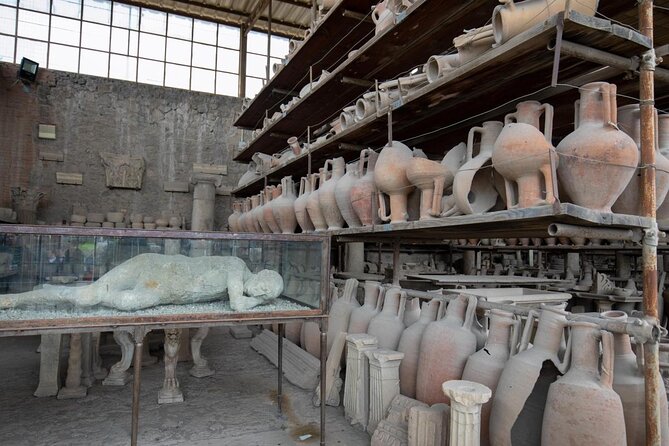
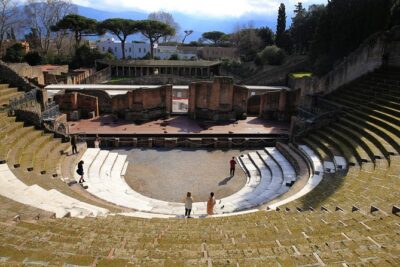
At Pompeii, you walk through a city that was suddenly buried in AD 79. Its streets, forum, public baths, ancient theater, and brothel help you picture the public side of Roman life. The scale can be hard to grasp when you walk alone, since the ruins spread across a large area and many buildings look similar at first glance.
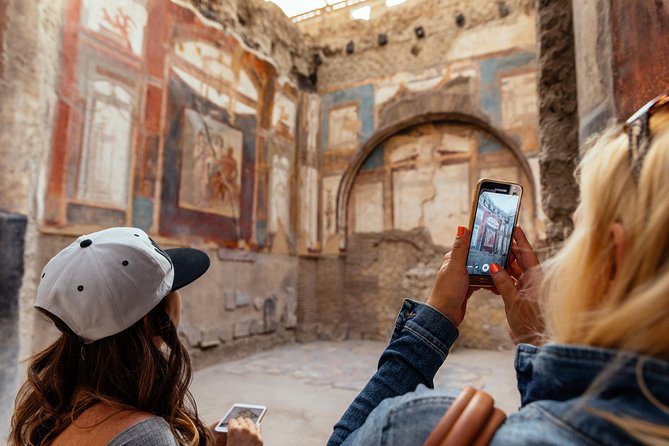
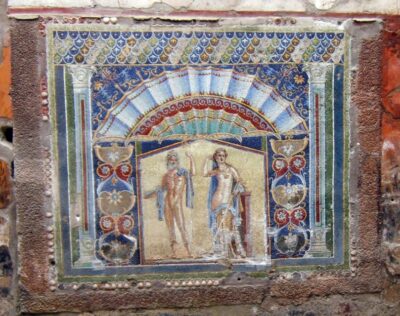
Herculaneum has a different feel. The town was smaller, and its remains include private homes, stores, sacred sites, atriums, and detailed mosaics. Your guide can help you notice how rooms were arranged, how houses opened onto streets, and how decoration reflected the wealth and habits of the people who lived there.
I think the pairing is the real strength of this experience. Pompeii explains the city as a whole. Herculaneum brings you closer to individual homes and businesses.
Meeting at Pompeii’s Via Villa dei Misteri

The tour begins at Via Villa dei Misteri in Pompei. There is no hotel pickup or drop-off, so you need to reach this meeting point on your own. The location is near public transportation, which makes the arrangement workable if you are staying in Pompeii or arriving from Naples.
If you are coming from Rome, build extra care into your plans. Dario has helped people choose trains, explained the meeting point through WhatsApp, and even adjusted the meeting arrangement when a train was booked incorrectly. That kind of communication can be useful, but it is still your responsibility to get to Pompeii on time.
The tour ends back at the meeting point. Since you must also arrange your return from Herculaneum, do not treat the five-hour estimate as the full length of your day. You need to add your travel to Pompeii, the train ride between sites, and your onward journey afterward.
More Day Trips in Pompeii
- Discover the Ancient Ruins of Pompeii: Day Trip from Rome
★ 3.5 · 2,247 reviews - Pompeii and Amalfi Coast Private Day Trip with Pick Up
★ 5.0 · 312 reviews - From Rome: Day Trip to Pompeii and Sorrento with Lunch
★ 4.8 · 269 reviews
Pompeii’s ancient streets and public life
The Pompeii portion lasts about two hours. Your guide leads you through some of the major areas, including an ancient theater, baths, brothel, forum, and other important buildings.
That list matters because Pompeii is not simply a collection of ruined walls. The theater shows how the city gathered for entertainment. The baths reveal how public facilities shaped social life. The forum explains the center of civic and commercial activity. The brothel offers a more earthy reminder that Roman cities included ordinary work, private business, and public pleasures alongside temples and official buildings.
A private visit works well here because the site can feel overwhelming. You can ask why a building mattered, how Roman rooms were used, or what the eruption changed. Raffaele, who has worked as an archaeologist at Pompeii, has been especially praised for explaining ongoing restoration and the practical side of archaeological work. If your interests lean toward excavation methods, geology, or the eruption itself, the guide may be able to shape the visit around those questions.
The advertised preferential access should help reduce time spent waiting. Still, one account describes confusion over tickets and time spent in a queue under the sun. Since the tickets are included, the normal expectation is that your guide handles the entry process, but I would confirm the exact meeting and ticket procedure before the day begins.
Two hours is enough for a strong introduction, not a full survey of Pompeii. You will see major highlights, but you will not cover every street or building. That tradeoff is sensible when Herculaneum is also part of the same outing.
The 30-minute train to Herculaneum
After Pompeii, you take a train for roughly 30 minutes to Herculaneum. The train ticket is not included, and transportation between the sites is not provided as a private transfer.
That arrangement keeps the tour price focused on the guide and admissions, but it also means the experience is not entirely door to door. You need to purchase the train ticket yourself and follow the instructions for the correct service. If you are returning to a hotel in Pompeii, Naples, or another town, you also arrange that journey independently.
This is the least polished part of the day for anyone expecting a fully private excursion. A private tour usually suggests personal service from beginning to end. Here, the guiding is private, but the movement between sites is public and self-managed.
The upside is that the train ride is short and gives you a break between two demanding archaeological visits. Ask your guide for clear instructions about where to board and where you will meet at Herculaneum. Guides have helped people coordinate their trains, but it is wise to keep the details in writing.
Herculaneum’s houses, shops, and mosaics

The Herculaneum visit lasts about two hours. You explore ancient stores, private houses, sacred places, and other remains while hearing how the town differed from Pompeii.
For many people, Herculaneum is easier to read. The town is less crowded, and the remains of houses can offer a stronger sense of domestic life. You might find yourself looking closely at an atrium, a floor mosaic, or a shopfront rather than trying to understand an enormous public complex.
One guide described in the tour material is especially strong at showing the difference between the two sites. After Pompeii’s broad streets and public buildings, Herculaneum’s villas and decorated interiors can feel more personal. The contrast helps you understand that the eruption did not affect every town in exactly the same way.
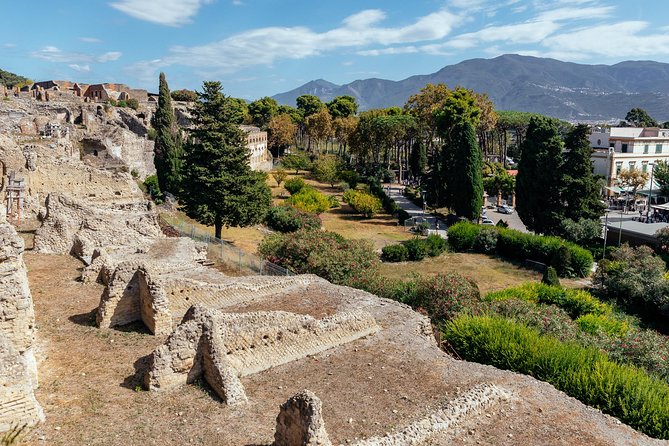
The guide may also point out views across the archaeological remains and explain the events surrounding Mount Vesuvius. Roberto, for example, has handled detailed questions about archaeology, geology, history, and local flora. That makes this a good choice if you enjoy asking precise questions rather than only listening to a prepared speech.
Again, two hours gives you a selected route. Your guide chooses the most useful highlights, and the exact path may vary. That is one reason the private format can be valuable: you can spend more time on houses, mosaics, religion, science, or the eruption, depending on what catches your attention.
More Pompeii excavation visits:
- Pompeii: Entry Ticket and Guided Tour with an Archaeologist
★ 4.8 · 19,459 reviews - Pompeii: Entry Ticket with Optional Audio Guide
★ 4.2 · 12,360 reviews - Pompeii: Small Group Tour with an Archaeologist
★ 4.8 · 12,264 reviews - Pompeii Small Group Tour with an Archaeologist
★ 5.0 · 6,593 reviews
What the private format really adds
A private tour does not make the ruins physically smaller or the sun less strong. Its main benefit is attention.
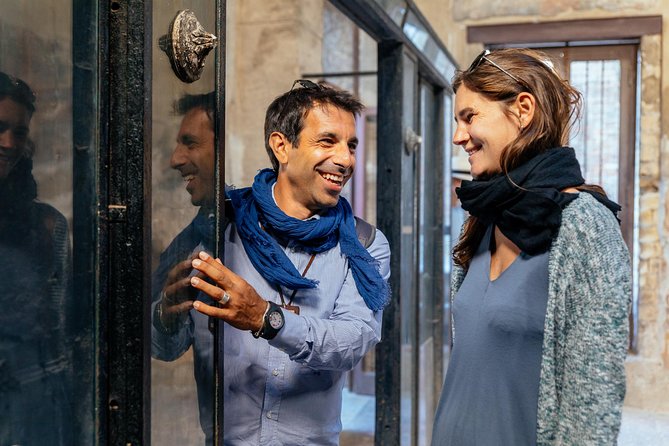
With only your group, you can ask questions without waiting for a large party to catch up. A guide can explain a technical detail in plain language, slow down at a house that interests you, or move more quickly through a section that feels repetitive. That flexibility is useful at Pompeii, where the sheer number of buildings can blur together.
The guides praised most strongly are Dario, Barbara, Raffaele, and Roberto. Their strengths differ slightly. Dario has helped with train planning and linked Roman life to modern comparisons. Barbara is known for explaining lesser-known details and answering a wide range of questions. Raffaele brings archaeological work and restoration into the conversation. Roberto has handled technical questions from visitors with scientific backgrounds.
You are not guaranteed a particular guide unless the booking specifically confirms one. Still, these examples show the level of guiding you should hope to receive: not just dates and names, but explanations of how people lived, built, worked, worshiped, and responded to the volcano.
The private format is best for couples, families, or a small group with shared interests. It is less appealing if you prefer to wander alone, need a very slow pace, or want a completely private vehicle and hotel service included.
Is $461.98 per person a fair price?
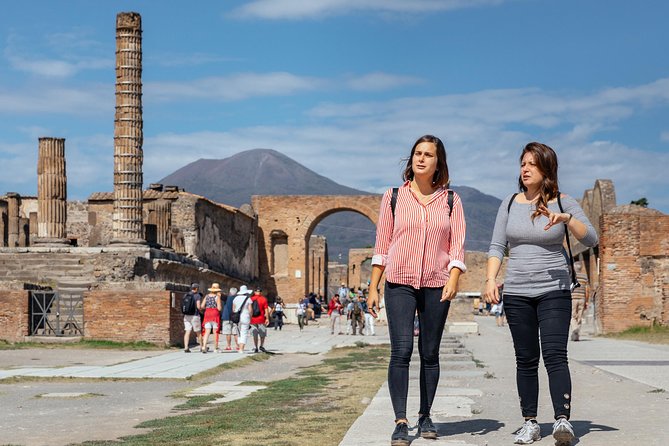
At $461.98 per person, this is a costly half-day. The price makes the most sense for a small group that values a private English-speaking guide and wants both archaeological sites explained in detail.
Admission to Pompeii and Herculaneum is included, which removes two important expenses and simplifies the visit. You are also paying for a guide who can connect the sites instead of leaving you to read signs and piece together the story yourself.
The value drops if you assume the cost includes all transportation. It does not include hotel pickup, hotel drop-off, or the train from Pompeii to Herculaneum. You also need to arrange the train ticket yourself. One of the clearest complaints about the experience came from a person who expected private transport and pre-purchased entry arrangements as part of the package.
Group discounts may improve the price for larger parties, so check how the per-person cost changes when several people book together. For one or two people, compare the total with a shared tour or a private car-and-guide service. This experience is strongest when the guide’s personal attention matters more to you than having every transfer handled.
The tour is also non-refundable and cannot be changed after booking. That is a serious condition for an expensive activity. Confirm your travel dates, meeting point, train plans, and the expected ticket procedure before committing.
Timing, heat, and the five-hour estimate
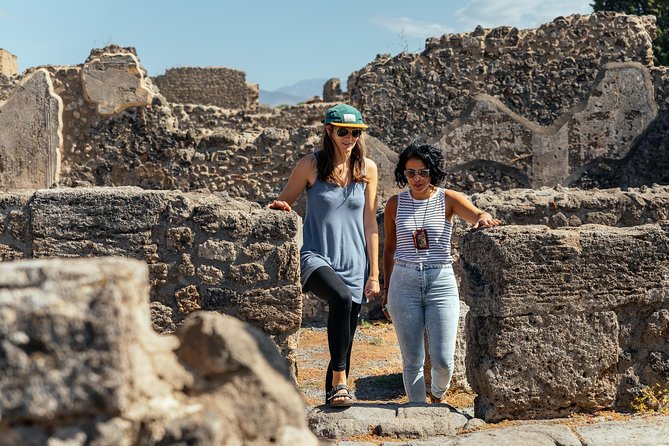
You can choose a morning or afternoon start, which helps fit the tour around trains or other plans. Morning may be easier if you want cooler conditions and more time afterward. Afternoon can work if you are arriving in Pompeii later, but you need to keep the closing hours of both sites in mind. The supplied information does not state exact start or closing times, so confirm those details before booking.
The advertised duration is about five hours. The core sightseeing adds up to roughly four hours, with a 30-minute train between Pompeii and Herculaneum. A short break may also be possible, but the exact timing depends on your guide and route.
You will be outdoors for much of the visit, walking over ancient surfaces. Wear practical shoes, carry water, and plan for sun or rain. One account describes a sudden heavy rainstorm and a guide who had to leave for another tour, so do not assume bad weather will automatically extend or change the schedule.
The private format lets the guide work at your pace to some degree, but the tour still has a fixed end time. If you need regular rests or want to linger for photographs, say so at the start.
Who should book this experience?
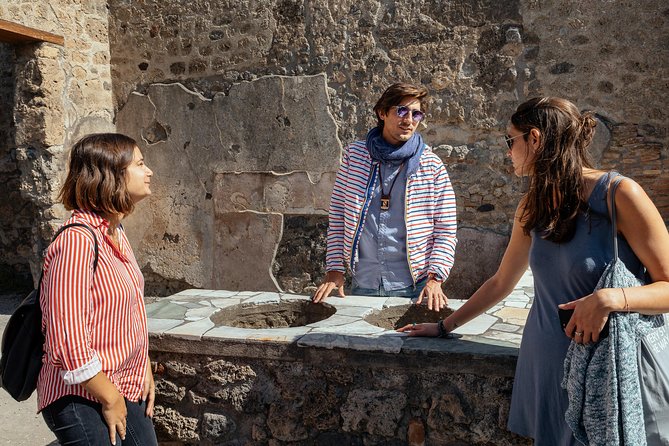
I would choose this tour if you want both Pompeii and Herculaneum in one day and care about understanding what you see. It suits people who ask questions, enjoy Roman history, or want help making sense of architecture, archaeology, and the eruption.
It is also a strong option for a group with different interests. One person can ask about geology, another about Roman homes, and another about public life. A private guide can keep the visit from becoming a one-size-fits-all walk.
I would hesitate if you want all transportation included. The meeting point, train connection, and return journey require your own planning. I would also hesitate if you prefer a long, unhurried exploration of Pompeii alone, since two hours there means a highlights visit.
The 4.9 rating from 103 reviews and 97 percent recommendation suggest very strong overall satisfaction, but the lower ratings point to a real issue: guide quality may be excellent while ticket handling and transport expectations are less clear. Read the inclusions carefully and contact the provider before paying.
Should you book Pompeii and Herculaneum together?
Book it if the guide is your priority. The best parts are the private attention, the comparison between two very different Roman towns, and the chance to ask detailed questions about archaeology, Roman life, and Vesuvius.
Before booking, confirm who will meet you, how the included tickets are handled, where you should go at Pompeii, and how you will reach Herculaneum by train. If you are comfortable arranging those pieces yourself, this can turn two difficult sites into a clear and memorable half-day.
If you expect a private vehicle, hotel pickup, and every ticket handled in advance, choose a more fully packaged tour instead. At this price, the guiding is the main value, not the transport.
FAQ
Where does the tour start?
The meeting point is on Via Villa dei Misteri, 80045 Pompei, Italy. The activity ends back at the meeting point.
How long does the experience last?
The tour lasts approximately five hours. The Pompeii visit is about two hours, the train to Herculaneum takes about 30 minutes, and the Herculaneum visit is about two hours.
Are entry tickets included?
Yes. Tickets for Pompeii and Herculaneum are included in the experience.
Is transportation included?
No. Hotel pickup and drop-off are not included, and the train journey between Pompeii and Herculaneum is not provided as part of the tour. You must arrange the train tickets yourself.
Is the tour private?
Yes. Only your group participates in the private activity.
What language is offered?
The experience is offered in English with a local guide.
Can I choose a start time?
Yes. The experience offers convenient morning or afternoon start times.
Can I cancel or change the booking?
No. The experience is non-refundable and cannot be changed for any reason. The amount paid will not be refunded after cancellation or an amendment request.
More 1-Day Tours in Pompeii Ruins
- Naples: Pompeii & Herculaneum Day Trip – Small Group Tour
★ 4.5 · 72 reviews - Private Pompeii & Ravello Day Trip via Amalfi Coast (Tickets)
★ 5.0 · 71 reviews - From Pompei: Amalfi Coast Day Trip with Limoncello Tasting
★ 4.3 · 28 reviews - Sorrento: Pompeii & Herculaneum Day Trip Entry and Lunch
★ 4.6 · 27 reviews
Newest reviews from Pompeii Ruins
- Private Tour Pompeii and Winery★ 5.0 · 4 reviews
- Visit the Pompeii ruins from Salerno with Pizza Lunch★ 5.0 · 4 reviews
- From Sorrento: Pompeii & Vesuvius tour small group★ 4.8 · 4 reviews
- Pompeii Private Tour for Kids and Their Families★ 4.8 · 4 reviews
- Pompeii Sorrento and Positano Tour★ 5.0 · 4 reviews
- From Naples_ Pompeii Tour_Skip the line ticket + audioguide★ 4.3 · 4 reviews
- Pompeii, skip-the-line ticket with smartphone audio guide on App★ 3.0 · 4 reviews
- Pompeii Private Half-Day Tour from: Naples,Sorrento, Amalfi Coast★ 5.0 · 4 reviews
Day Trips in Pompeii, compared.

Discover the Ancient Ruins of Pompeii: Day Trip from Rome
Read our review →
Pompeii and Amalfi Coast Private Day Trip with Pick Up
Read our review →
From Rome: Day Trip to Pompeii and Sorrento with Lunch
Read our review →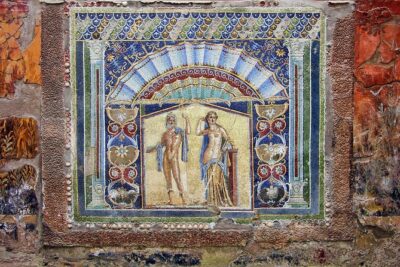
Pompeii & Herculaneum Day Trip – Small Group Tour
Read our review →
Private Pompeii & Ravello Day Trip via Amalfi Coast (Tickets)
Read our review →
Skip-the-Line Best of Pompeii in one Day Tour w Local Guide & new opened houses
Read our review →Browse the lists this tour appears in