
Reviewed · CITY TOURS
Pompeii the Buried city
Pompeii feels most powerful when the grand public spaces give way to ordinary streets, houses, baths, and the plaster casts of people caught by Mount Vesuvius in 79 AD. This private two-hour tour takes you beyond the busiest paths, with an authorized local guide explaining how the ancient city worked rather than simply pointing at old stones.
I like the route’s mix of famous sights and quieter corners. I also like the small-group format, which means your party of up to six can ask questions and keep a sensible pace. The main drawback is that admission is not included, and two hours is enough for a strong introduction, not a full survey of Pompeii.
In This Review
- Key points to know before booking
- Pompeii beyond the postcard ruins
- Meeting your guide at Porta Marina
- The Forum gives you Pompeii’s public center
- Baths, houses, and the texture of daily life
- The Lupanare and Pompeii’s frank side
- Plaster casts in the southern ruins
- The theaters and streets on the northern side
- Is two hours enough for Pompeii?
- Price, admission, and group value
- Weather and cancellation terms
- Who will get the most from this tour?
- Should you book Pompeii the Buried City?
- FAQ
- Where does the Pompeii tour meet?
- How long does the guided visit last?
- Is admission to Pompeii included in the tour price?
- How many people can join the private tour?
- What places are included on the route?
- Who guides the tour?
- Is the tour suitable for someone with limited walking ability?
- What happens if the weather is poor?
Key points to know before booking
- See Pompeii’s essential landmarks: The route includes the Forum, thermal baths, Menander’s House, Lupanare, theaters, streets, and plaster casts.
- Use a private guide: Only your group takes part, with room for questions and a pace suited to your party.
- Follow a quieter route: The southern section offers a less crowded way to encounter the ruins.
- Meet at Porta Marina: The start and finish are at Pompei-Porta Marina, near public transportation.
- Budget for the entrance fee: Adults pay €16 for admission, while under-18s enter free with a valid ID.
- Plan for uneven walking: You should have a moderate level of physical fitness for the two-hour visit.
Pompeii beyond the postcard ruins
Pompeii is not just a collection of temples and broken columns. It is a city you walk through street by street, with homes, public buildings, shops, bathing facilities, theaters, and intimate traces of daily life still laid out under the open sky.
That is the strength of this experience. You are not being rushed from one famous photo stop to another. The guide leads you through a chain of places that show how public life, private life, entertainment, religion, and commerce fit together.
The official route includes the most important public and private buildings, while also reaching the southern part of the archaeological park, where the crowds may thin. That matters at Pompeii. The site is large, and a guide who knows how to connect nearby sights can help you spend your time looking rather than trying to work out where to go next.
You should also keep your expectations in check. The tour lasts about two hours, and Pompeii covers a great deal of ground. You will see a well-chosen selection of the city, but you will not cover every neighborhood or building. If you want an all-day exploration, this is better used as a focused introduction.
More Pompeii excavation visits:
- Pompeii: Entry Ticket and Guided Tour with an Archaeologist
★ 4.8 · 19,459 reviews - Pompeii: Entry Ticket with Optional Audio Guide
★ 4.2 · 12,360 reviews - Pompeii: Small Group Tour with an Archaeologist
★ 4.8 · 12,264 reviews
Meeting your guide at Porta Marina
The meeting point is Pompei-Porta Marina, at the archaeological site in Pompei. The tour returns to the same place, so you do not need to arrange a separate ending point or wonder where the guide will leave you.
The stated operating hours are 9:00 AM to 1:00 PM daily from October 1, 2025, through November 30, 2026. That morning window can work well for a planned visit, especially if you prefer to see Pompeii before the day becomes more tiring.
Your guide is an authorized professional from the Campania region. That authorization is useful here because Pompeii requires more than general sightseeing knowledge. A good guide can explain what you are seeing, choose a practical route, and adjust the emphasis when your group becomes interested in a particular house or public building.
Ilaria is one guide associated with especially strong feedback for this experience. Her tours have been praised for explaining everyday life, art, and architecture, and for handling questions with confidence. You should not assume she will lead every departure, but if she is assigned to your group, expect an energetic and well-informed presentation.
The private format is a real advantage for families and small groups. The price is $229.28 for up to six people, not per person. A group of six pays about $38 per person before admission, while a solo visitor pays the full group price. The value improves sharply as your party gets larger.
The Forum gives you Pompeii’s public center
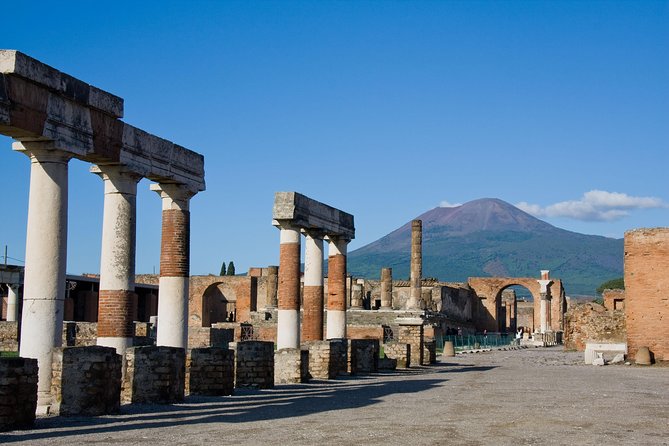
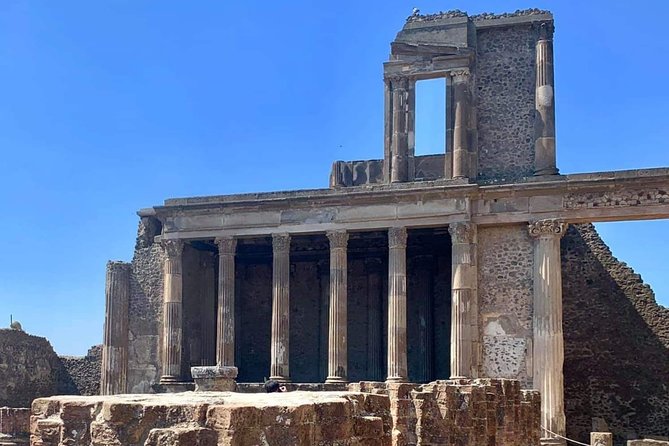
The Forum is the natural place to understand Pompeii as a functioning city. This broad civic area served as a center for public activity, and it gives you a useful visual starting point for the rest of the visit.
Here, the guide can help you read the ruins as part of a city plan rather than as isolated fragments. You begin to see the relationship between public buildings, streets, religious spaces, and the daily movement of residents.
I like having a guide at the Forum because the scale can be difficult to grasp on your own. It is easy to look at columns and paving stones without understanding what role the space played. The guide’s explanations turn a wide open area into a place where civic life once took place.
The Forum is also one of Pompeii’s major sights, so it may feel busier than the southern section later in the route. That contrast is helpful. You get the famous public center, then a chance to walk in areas where the ruins may feel less crowded and more personal.
Baths, houses, and the texture of daily life
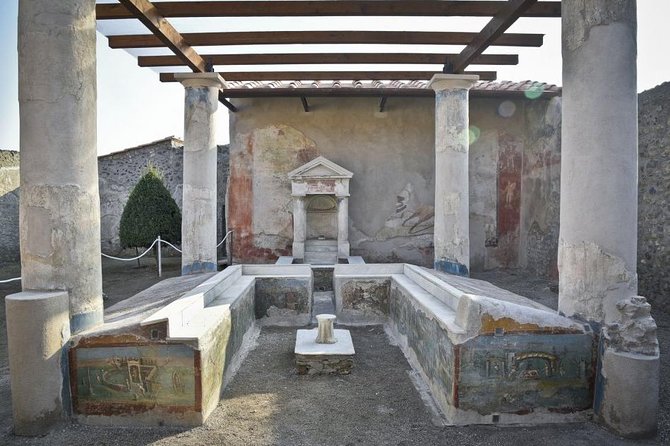
The itinerary includes the thermal baths and Menander’s House, two stops that shift the focus from civic life to the routines and comforts of Pompeii’s residents.
The baths are valuable because they show that public life was not limited to politics and temples. They were places connected with washing, social contact, and the practical systems that made urban living possible. Let the guide explain the building’s purpose and layout, since a bath complex can otherwise look like a confusing collection of rooms.
Menander’s House brings the visit into a private setting. Houses help you imagine how Pompeii’s wealthier residents arranged their lives, received people, and displayed their taste. The name itself is a reminder that private homes at Pompeii are not simply empty shells. Their decoration, rooms, and surviving features can reveal social standing and cultural interests.
These stops are a good reason to choose a guided walk instead of relying only on a map. The guide can point out details you might miss and explain why one room matters more than another. You get a clearer sense of how the city functioned at several levels, from public gathering spaces to domestic interiors.
More Pompeii Ruins tours worth comparing
- Discover Pompeii: French Walking Tour of the Buried City
★ 4.8 · 253 reviews - Discover Pompeii: English Walking Tour of the Buried City
★ 4.2 · 24 reviews - Pompeii Ancient City Walking Tour – Italian & English Guide
★ 4.5 · 10 reviews - Discover Pompeii on this Guided Walking Tour of the Buried City
★ 4.0 · 9 reviews
The Lupanare and Pompeii’s frank side
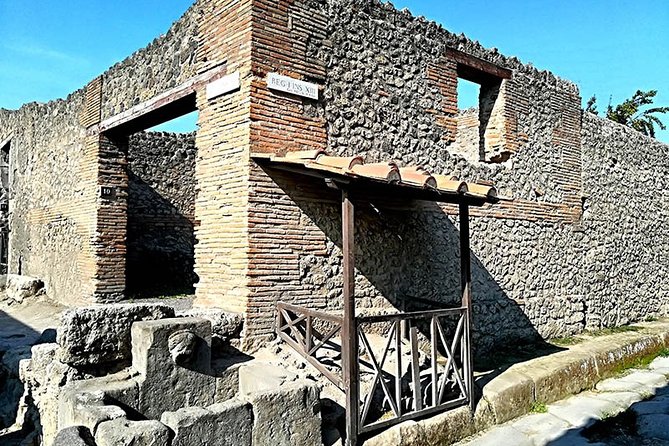
The Lupanare, Pompeii’s famous brothel, is included in the route. Its erotic frescoes are among the site’s most recognizable features, but the stop is more useful when treated as part of the city’s social world rather than as a novelty.
The frescoes are direct and memorable. They also remind you that Pompeii was a lived-in Roman city, with commercial and private activities that were not arranged for modern comfort or modesty.
Families should decide in advance if this stop suits their group. The tour description identifies the erotic material clearly, so there should be no surprise, but parents may want to discuss it before arrival. The guide can provide context, which is preferable to seeing the images without explanation.
I appreciate that the Lupanare appears alongside baths, homes, theaters, and public buildings. That broader route keeps Pompeii from becoming a simple collection of sensational details. You see a city with many kinds of activity, from formal civic business to entertainment and private transactions.
Plaster casts in the southern ruins
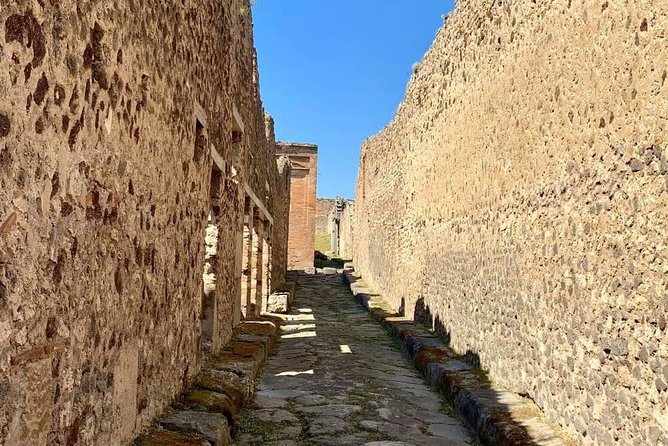
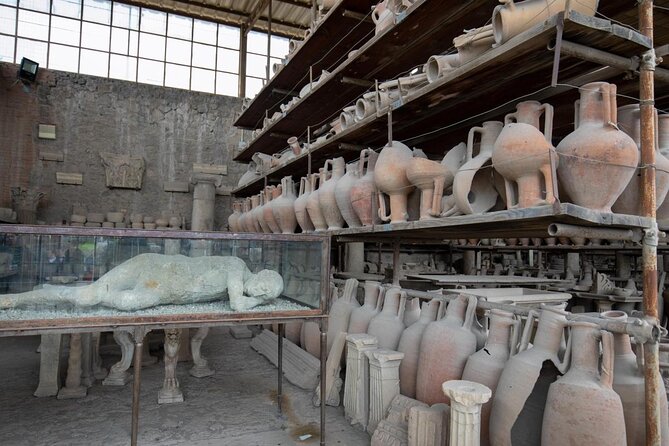
The southern part of Pompeii is one of the most emotionally difficult sections of the visit. Here you may see the famous plaster casts made from cavities left by people who died during the eruption of Mount Vesuvius in 79 AD.
These casts are not ordinary museum pieces. Their shapes preserve a final moment, and the sight can change the tone of the entire tour. The guide’s explanation helps place them in context, but you should still allow yourself time to look quietly.
This part of the route is also described as less crowded than some of Pompeii’s headline sights. That makes a practical difference. You may have more space to listen, take in the setting, and understand that these were once streets occupied by real residents.
The word famous can make the casts sound like another item on a sightseeing checklist. They are not. I would plan your visit with enough emotional energy for this section, particularly if you are traveling with children or anyone who finds disaster sites upsetting.
The theaters and streets on the northern side
After the southern area, the route continues toward Pompeii’s theaters. Theaters show another side of the city, one tied to public entertainment and shared experiences.
The itinerary then takes you across streets along the northern side of the ancient city. This is where the tour can feel less like a sequence of monuments and more like a walk through an urban neighborhood. Streets provide scale. You see how buildings faced one another and how people moved from one part of the city to another.
A guide can help you notice the relationship between the route and the surrounding buildings. Without that explanation, it is easy to focus only on the largest walls and overlook the street pattern that makes Pompeii feel like a city.
The final stretch is intended to give you the sensation of walking through Pompeii with its ancient residents. That is a strong aim for a short visit. You may not learn every detail, but you should leave with a more coherent picture of how the city was organized.
Is two hours enough for Pompeii?
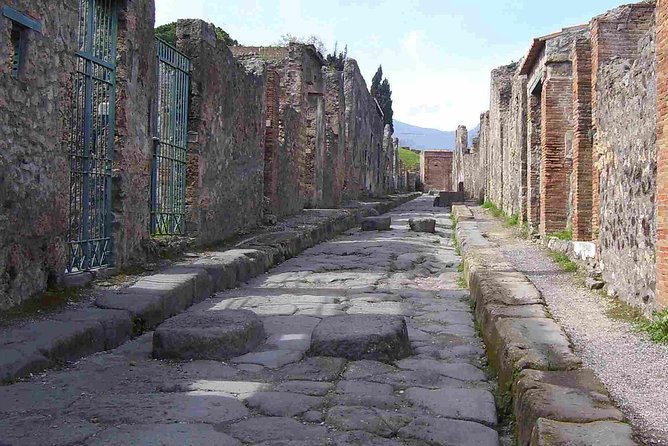
Two hours is enough if you want a guided introduction with the major themes clearly explained. You will see a good range of public buildings, private homes, baths, the Lupanare, theaters, streets, and the plaster casts.
It is not enough to see everything. Pompeii rewards extra time, and the site can easily fill half a day or more for someone interested in architecture, art, or Roman urban life. One account connected with this guide describes a three-hour visit, which suggests that some groups may arrange a longer format, but the experience described here lasts approximately two hours.
The shorter duration suits you if Pompeii is part of a busy day around Naples or if you want a focused orientation before exploring alone. It also helps if someone in your group has limited stamina. One account describes the guiding as suitable for a person who had some difficulty walking, with interesting sites kept relatively close together. Still, the official advice calls for moderate physical fitness, so do not treat this as a fully accessible or effortless walk.
Wear practical shoes and expect an outdoor archaeological site. The supplied information does not promise special accessibility arrangements, so anyone with mobility concerns should confirm details before booking.
Price, admission, and group value
The tour costs $229.28 per group of up to six people. You must also pay the €16 admission fee per person. Under-18s enter free with a valid identity document.
For a full group, the guiding cost is reasonable because it is shared. Six adults would divide the tour price among themselves, then add each person’s entrance fee. A couple pays much more per head, so the value depends on how many people are in your party and how much you want private attention.
The guide is the main product here. You are paying for route planning, context, and the ability to ask questions in a private setting. If you are content to walk with a map and read signs, the added cost may not make sense. If Pompeii feels confusing or you want the site explained through daily life, the price is easier to justify.
Confirmation is provided at booking, and the activity is near public transportation. The mobile ticket format is convenient, but it does not remove the separate admission charge. Check that you have budgeted for both parts.
Weather and cancellation terms
The experience requires good weather. If poor weather causes cancellation, you are offered another date or a full refund.
That condition matters because Pompeii is an outdoor site, and rain can make a long archaeological walk less pleasant. A separate account describes heavy rain, lightning, hail, and flooding disrupting plans for other nearby sights, a useful reminder that conditions around Pompeii and Mount Vesuvius can change a day’s schedule.
You can cancel for a full refund if you do so at least 24 hours before the start time. Cancellations or changes made less than 24 hours ahead are not refunded or accepted. The cut-off follows local time.
Who will get the most from this tour?
I would choose this tour for a small family, a group of friends, or a couple who wants a private explanation without committing to a full day. It suits first-time visitors who want to see the major landmarks while also reaching quieter sections.
It is particularly useful if you care about how people lived, not just how temples looked. The combination of houses, baths, the Lupanare, theaters, streets, and plaster casts gives you several ways into Pompeii.
I would think twice if you want a leisurely, highly detailed archaeological study. Two hours moves at a purposeful pace, and the ticket price is separate. You may prefer a longer visit if you want to linger at every house or explore beyond the route.
The tour can also work for someone who walks slowly, since the guide may focus on nearby highlights. But moderate physical fitness is still expected, and no special access service is listed. Ask before booking if your group needs specific mobility support.
Should you book Pompeii the Buried City?
Book it if you want a private, focused introduction to Pompeii, especially with four to six people sharing the cost. The route covers the city’s essential public and private spaces, then adds the quieter southern ruins, the plaster casts, theaters, and streets.
The strongest reason to choose it is the guide. Ilaria has received especially warm praise for bringing out the details of daily life and answering questions, though guide assignment can vary. The 4.9 rating from eight reviews also points to a consistently well-received experience, while the short duration and separate entrance fee remain the main limits.
Skip it if you want to roam independently for hours or avoid emotionally heavy sights such as the plaster casts. For everyone else, this is a sensible way to give Pompeii shape and meaning without turning your entire day into a march across the ruins.
FAQ
Where does the Pompeii tour meet?
You meet the guide at Pompei-Porta Marina, Scavi, 80045 Pompei, in the Metropolitan City of Naples. The activity also ends back at the meeting point.
How long does the guided visit last?
The tour lasts approximately two hours.
Is admission to Pompeii included in the tour price?
No. Admission costs €16 per person. Visitors under 18 enter free with a valid identity document.
How many people can join the private tour?
The price covers one group of up to six people. Only your group participates in the activity.
What places are included on the route?
The route includes the Forum, thermal baths, Menander’s House, the Lupanare with erotic frescoes, the southern ruins with plaster casts, the theaters, and streets on the northern side of the ancient city.
Who guides the tour?
The experience is led by a professional local tourist guide authorized by the authorities of the Campania region. Ilaria is one guide associated with this tour, but a specific guide is not guaranteed in the supplied information.
Is the tour suitable for someone with limited walking ability?
A moderate level of physical fitness is required. One account indicates that the route worked well for someone who had some difficulty walking, but no special accessibility arrangements are specified.
What happens if the weather is poor?
The experience requires good weather. If it is canceled because of poor weather, you will be offered another date or a full refund.
Newest reviews from Pompeii Ruins
- Private Tour Pompeii and Winery★ 5.0 · 4 reviews
- Visit the Pompeii ruins from Salerno with Pizza Lunch★ 5.0 · 4 reviews
- From Sorrento: Pompeii & Vesuvius tour small group★ 4.8 · 4 reviews
- Pompeii Private Tour for Kids and Their Families★ 4.8 · 4 reviews
- Pompeii Sorrento and Positano Tour★ 5.0 · 4 reviews
- From Naples_ Pompeii Tour_Skip the line ticket + audioguide★ 4.3 · 4 reviews
- Pompeii, skip-the-line ticket with smartphone audio guide on App★ 3.0 · 4 reviews
- Pompeii Private Half-Day Tour from: Naples,Sorrento, Amalfi Coast★ 5.0 · 4 reviews
City Tours, compared.

Capri in a Day All Inclusive Premium Boat Tour + City Visit
Read our review →
Discover Pompeii: French Walking Tour of the Buried City
Read our review →
All-Inclusive Capri Boat Tour with City Visit from Positano
Read our review →


Capri Premium Boat Tour and City Visit Free Bar and Aperitif
Read our review →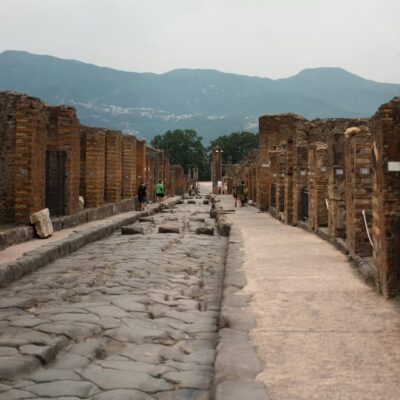
Discover Pompeii: English Walking Tour of the Buried City
Read our review →
Browse the lists this tour appears in