
Reviewed · HERCULANEUM TOURS
Herculaneum – Small Group Tour (admission included)
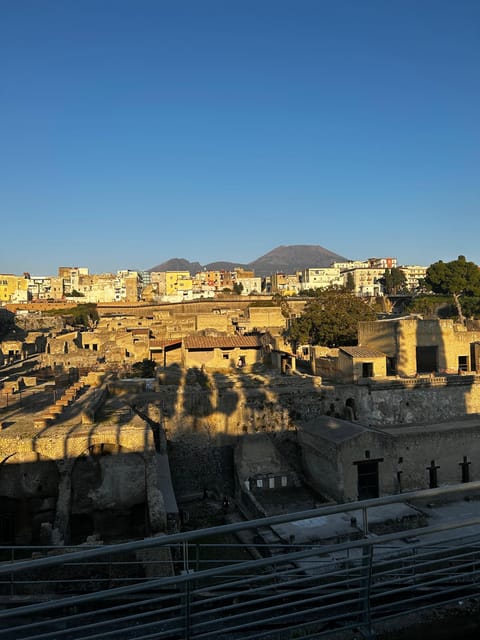
Herculaneum gives you a more intimate look at the Roman world than Pompeii. The city is smaller, but its wealthy homes, painted walls, decorations, and unusually preserved objects make the ancient streets feel remarkably close at hand.
I like two things in particular: the two-hour focus keeps the visit manageable, and the licensed local guide adds meaning to buildings you could otherwise walk past. The stop at the boat museum, or nearby Antiquarium, also helps explain the human cost of the eruption.
The main consideration is time. Two hours is enough for a strong introduction, not a full study of every corner. If you want long periods for photography or a detailed look at every house, you may want more time at the site after the guided walk.
In This Review
- Key points to know before booking
- Why Herculaneum feels different from Pompeii
- Meeting outside the ticket office
- The opening lesson on Vesuvius and the town
- The boat museum and the human side of the eruption
- Walking through wealthy Roman homes
- What the two-hour format does well
- How the guides shape the visit
- Is $75 per person good value?
- Who should choose this Herculaneum tour?
- Practical details that matter
- Should you book it?
- FAQ
- Where does the Herculaneum tour meet?
- How long does the tour last?
- Is admission to Herculaneum included?
- Which languages are available?
- Is this a small-group tour?
- Does the tour include a museum visit?
- Can I cancel or pay later?
Key points to know before booking
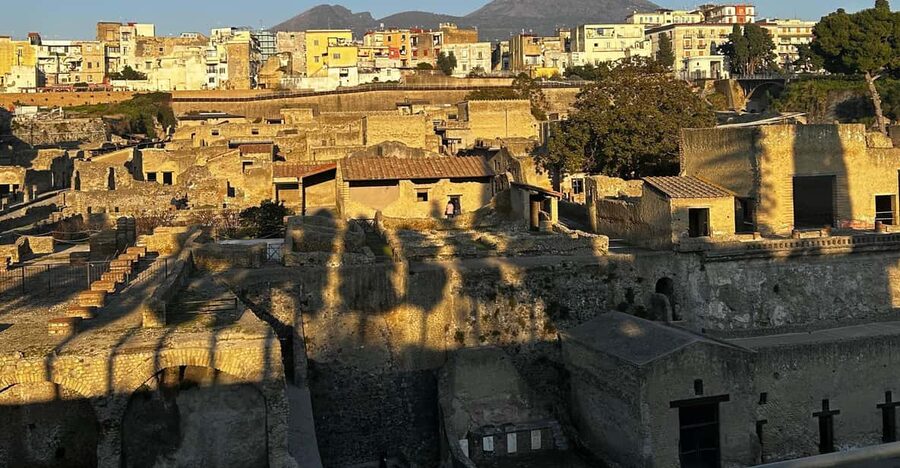
- Herculaneum was buried under about 60 feet of volcanic material, which helped preserve details that are easy to miss at Pompeii.
- The tour begins outside the Herculaneum ticket office on Corso Resina, 187.
- Skip-the-line admission is included, so you are not buying a guided talk and then sorting out entry on your own.
- Marzia and Gabriella are among the named guides, with strong praise for clear explanations and thoughtful answers.
- The route covers Roman homes, daily life, the eruption, and the boat museum, rather than focusing only on dramatic ruins.
- The price is $75 per person for two hours, a fair deal if you value interpretation and a small group over exploring alone.
Why Herculaneum feels different from Pompeii
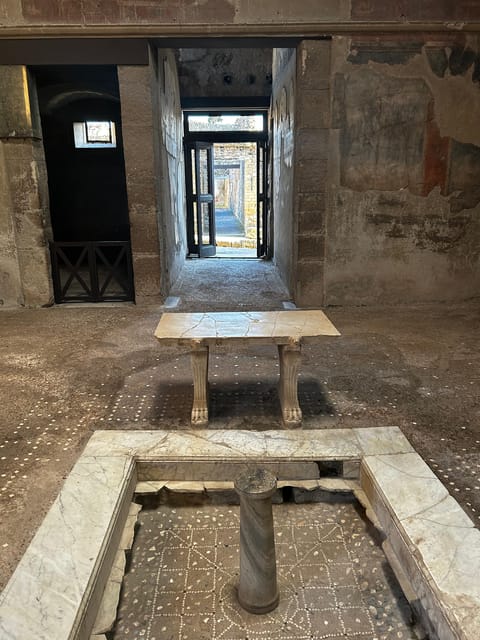
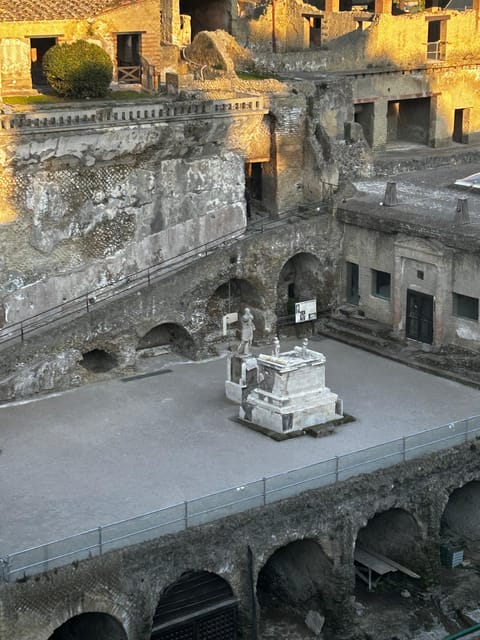
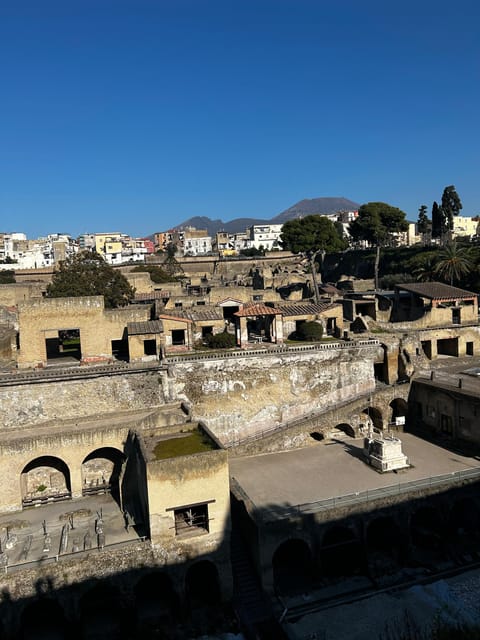
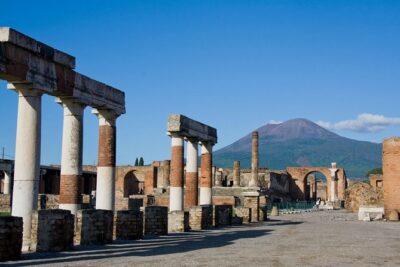
Pompeii is the larger and more famous site, but Herculaneum tells a tighter story. This was a smaller coastal town with a more residential character, and many of its homes belonged to wealthy Romans. You see that in the elegant decorations, original designs, paintings, and private spaces.
The eruption of Mount Vesuvius in A.D. 79 destroyed both cities, but the material that covered them behaved differently. Herculaneum was buried by scalding pyroclastic flows and ash. The remains disappeared beneath a mass of cinder roughly 60 feet deep, sealing parts of the town away from the air for almost 2,000 years.
That matters when you walk through the site. Herculaneum is not simply a smaller Pompeii. Its preservation offers a different kind of visit, one centered on household details and the texture of ordinary Roman life. You might notice a wall decoration, a building style, or an object that makes the past feel less abstract.
I find this especially useful if you have already seen Pompeii. Instead of repeating the same experience on a smaller scale, Herculaneum gives you another angle on Roman society. You spend less time covering vast distances and more time looking closely at homes and the people who lived in them.
More Herculaneum excavation visits:
- Ercolano: Herculaneum Entry Ticket with Optional Audio Guide
★ 4.1 · 581 reviews - Herculaneum: Skip The Line Entrance ticket + Audioguide
★ 4.3 · 266 reviews - Naples: Pompeii and Herculaneum Tour with Tickets and Lunch
★ 4.4 · 136 reviews
Meeting outside the ticket office
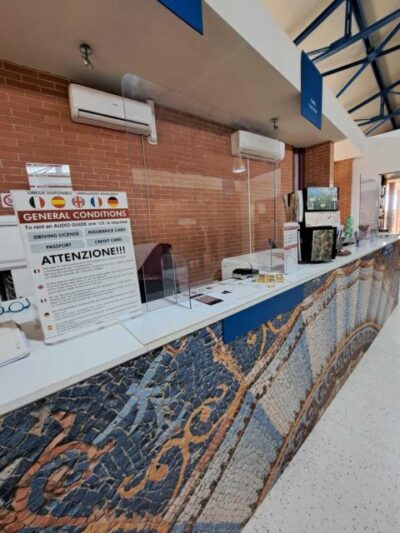
The meeting point is just outside the Herculaneum ticket office at Corso Resina, 187. This is a helpful arrangement because you do not need to search through the archaeological area for the guide. You should still allow enough time to identify the correct meeting spot before the start time.
The tour includes a skip-the-line admission ticket. That saves you from handling the entrance purchase separately, and it makes a two-hour visit more practical. With a short tour, losing time before the walk begins would cut into the actual explanation of the site.
The experience is offered in English, Italian, and German. Small-group availability is another useful feature. A compact group gives you a better chance to hear the guide and ask questions, especially inside narrow streets or near detailed wall decorations.
The group size is not specified, so you should not assume that every departure will have only a handful of people. Still, the small-group format is designed to feel more personal than a large coach-style visit.
The opening lesson on Vesuvius and the town
The first part of the walk sets up the eruption and explains why Herculaneum was different from Pompeii. This context is not filler. Without it, the preserved walls and objects can look like a collection of disconnected ruins.
You learn how a town on the Gulf of Naples was overwhelmed in A.D. 79. The guide also places Herculaneum in its social setting: a smaller, wealthier residential center rather than a huge urban area. That helps you read the houses as homes, not just archaeological shells.
A good guide has to balance disaster with daily life. The eruption is dramatic, but the strongest part of Herculaneum is often the quiet evidence left behind: the layout of a private house, the quality of its decoration, and the signs of a comfortable lifestyle.
The named guides Marzia and Gabriella have been singled out for explaining the site clearly and answering questions in detail. Gabriella is also noted for adapting explanations for children, using a mix of facts and stories to keep a family group engaged. That makes her a particularly good choice for parents, although guide assignments can vary.
The boat museum and the human side of the eruption
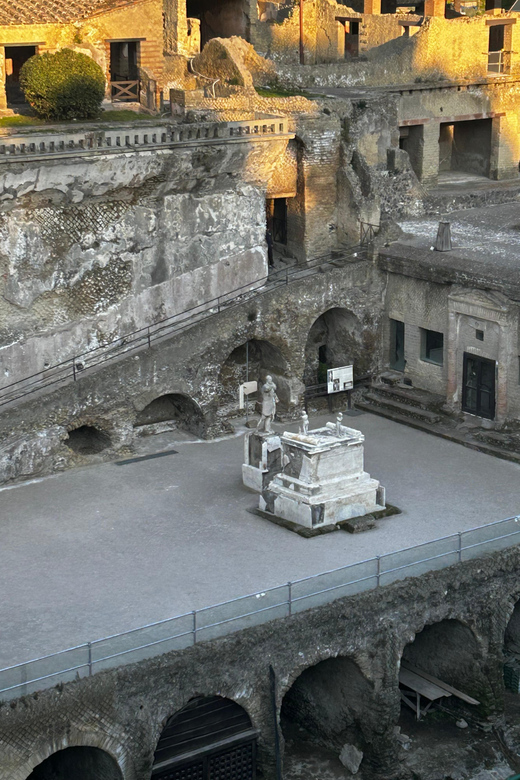
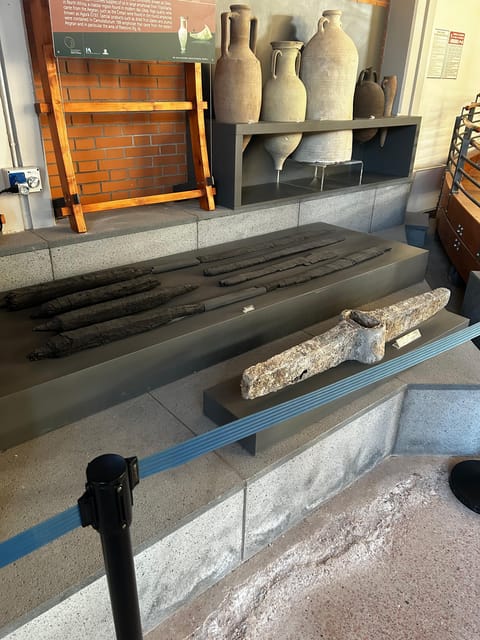
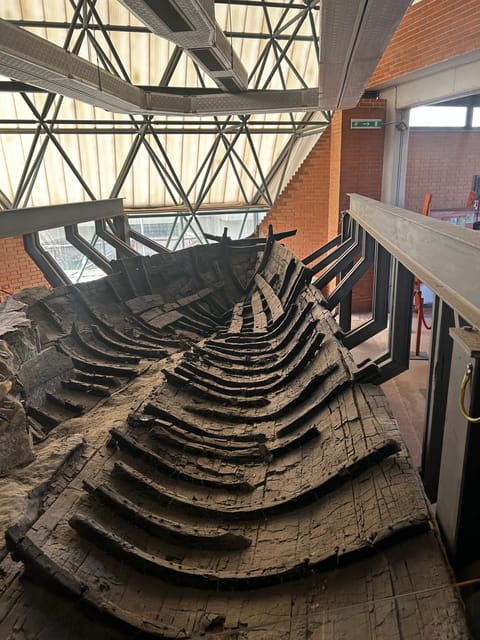
The boat museum adds a useful layer to the visit. Herculaneum was located near the coast, and the boat display helps connect the town to its waterfront setting. It also moves the story away from walls and mosaics and toward the people caught in the eruption.
The nearby Antiquarium contains objects from the ancient town. A guide may use these exhibits to point out small details that are harder to understand in the open-air ruins. One guide, Marzia, took time to show the collection at the end of a tour and drew attention to the similarity between an ancient earring on display and a modern earring worn by a member of the group.
That kind of comparison is useful because it makes ancient objects easier to understand. Jewelry, household items, and personal belongings are not just museum pieces. They show taste, status, craft, and everyday habits.
The museum stop is also a reason to choose a guided visit instead of simply walking the streets with a map. You get help connecting an object in a case with the buildings and people described during the tour. Just keep in mind that the precise balance between the ruins and museum exhibits may depend on the guide and the pace of the group.
A completely different way to spend a day in Ercolano:
- Vesuvio Skip The Line Ticket With Digital Audioguide
★ 3.2 · 91 reviews - Herculaneum Archaeological Park smart Audio Tour
★ 3.8 · 70 reviews - Herculaneum: Private Walking Tour with Archeologist Guide
★ 5.0 · 59 reviews - From Naples_ Vesuvius transfer+ticket and digital audioguide
★ 3.7 · 58 reviews
Walking through wealthy Roman homes
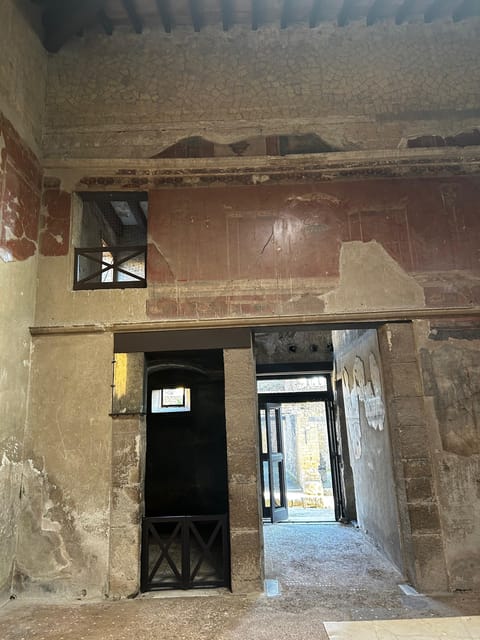
The heart of the experience is the guided walk through the archaeological site. Herculaneum’s private houses are the main draw, especially if you care about architecture and decoration more than sheer scale.
You can expect attention to original styles and elegant details. The city’s affluence survives in the private residences, where paintings and decorative work reveal more than a bare outline of Roman buildings. A guide can explain how the spaces fit into Roman domestic life and why the preservation here is so unusual.
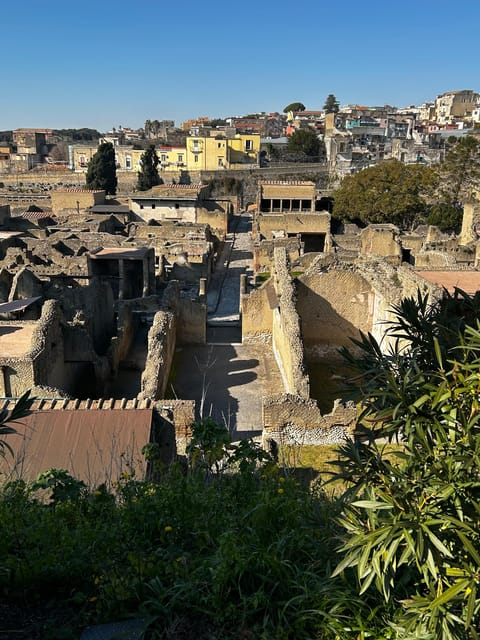
The smaller size works in your favor. At Pompeii, it is easy to spend much of your energy crossing from one major area to another. Herculaneum lets you move through a more compact ancient center, with less sense of a long march between sights.
That does not mean every moment is spectacular. Some sections may require you to listen closely while looking at foundations, walls, or partial rooms. The value comes from having those remains explained. A building that seems plain at first can make more sense once you understand its purpose and place in the town.
I would pay particular attention to the transitions between public and private life. The tour is designed to show a typical Roman center, but the preserved wealthy homes add a social angle. You are not only seeing where people lived. You are also seeing how status was displayed through space and decoration.
What the two-hour format does well
Two hours is a sensible length for a first visit. It gives you a clear route, an introduction to the eruption, a look at the preserved homes, and time for the museum material without turning the day into an archaeological marathon.
I like this format for a first-time visit or for a day that also includes other sights around Naples and Campania. You get a strong framework, then you can decide if you want to stay longer on your own.
The tradeoff is depth. A guide has to keep moving, and a group cannot pause at every painting or building. If you enjoy reading every sign, making careful sketches, or taking many photographs, the tour may feel brisk.
The experience is best for you if you want the site explained as a connected story. It is less suited to you if your main goal is total independence or an unhurried technical study of the ruins.
Questions are part of the strength of the format. Several guides have been praised for taking time to answer group questions, including detailed questions about the eruption, residents, and Roman life. A small group should make it easier to speak up, though you still need to respect the pace of the walk.
How the guides shape the visit
The guide is the main reason to book this experience rather than simply buying admission. The ticket gets you into Herculaneum, but the guide helps you see why the site matters.
Marzia is described as passionate about Herculaneum and careful with questions. Roberta is also singled out for giving information in the right balance, meaning the tour aims to inform without burying you under a lecture. Gabriella has shown a talent for adjusting explanations for children and mixing facts with anecdotes.
The provider is Pompeiify di Parlato Gabriella, and the visit uses guides licensed by the Regione Campania. That regional license gives you a trained local interpreter rather than an unverified escort.
Of course, guide quality can vary from one departure to another, and you may not receive the same person named in the feedback. Still, the repeated pattern is encouraging: clear explanations, strong subject knowledge, patience with questions, and a genuine interest in the ancient town.
I would book this especially for a family, a couple wanting context without a full-day commitment, or anyone who found Pompeii confusing on a previous visit. The family feedback is useful here. Gabriella kept three children involved for the full two hours by following their curiosity instead of giving one fixed speech.
Is $75 per person good value?
At $75 per person, this is not the cheapest way to enter Herculaneum. You are paying for more than admission, though. The price includes the licensed guide, the skip-the-line ticket, and a structured two-hour visit in a small-group setting.
The value depends on how you like to sightsee. If you already know Roman archaeology and enjoy researching sites on your own, a guided tour may not add enough for you. You may prefer to pay for entry and set your own pace.
For most first-time visitors, the price is easier to justify because Herculaneum rewards close looking. The guide explains why preservation differs from Pompeii, identifies the significance of homes and decorations, and links the ruins to objects in the museum. Those connections are hard to get from a quick walk with only a printed map.
It is also useful that you can reserve now and pay later, and cancel up to 24 hours before the activity for a full refund. Those terms help if your Campania schedule is still moving around. Check the available start times before booking, since the exact departure schedule is not fixed in the details provided.
Who should choose this Herculaneum tour?
I would recommend it to you if you want:
- A short, guided introduction to Herculaneum
- Help understanding the eruption and unusual preservation
- A closer look at wealthy Roman homes and decoration
- A museum or boat exhibit included in the story
- A small-group setting with room for questions
- A family-friendly explanation, especially if Gabriella is assigned
It is also a good companion to Pompeii. You can compare the larger city with Herculaneum’s more compact, residential feel and see how one eruption produced different forms of preservation.
I would hesitate if you want to spend an entire day inside the ruins, work at a very slow pace, or avoid all fixed routes. Two hours gives you a guided foundation, but it does not promise an exhaustive examination of the archaeological site.
Practical details that matter
The tour starts and ends at Corso Resina, 187, outside the Herculaneum ticket office. Admission is included, and the ticket line is skipped as part of the booking.
The duration is two hours. English, Italian, and German are available. The experience is offered as a small group when available, but no exact maximum group size is provided.
You can cancel up to 24 hours in advance for a full refund. The reserve-now, pay-later option lets you hold a place without paying at the time of booking. These details are useful when you are coordinating Herculaneum with other Campania plans.
Should you book it?
Book this tour if you want Herculaneum to make sense, not just look old. The combination of a compact site, preserved private homes, eruption context, and museum objects gives you a focused two-hour introduction with real interpretive value.
The strongest reason to choose it is the guide. Marzia, Roberta, Gabriella, and other guides connected with the experience have been praised for clear explanations, patient answers, and the ability to adjust the visit for families. The only real limitation is the fixed two-hour pace.
For a first visit, $75 is reasonable if you want admission and a licensed guide handled together. If you already know the site well or want complete freedom, enter independently instead. For most people comparing Pompeii with Herculaneum, this tour is the better way to understand why the smaller city deserves its own afternoon.
FAQ
Where does the Herculaneum tour meet?
The meeting point is just outside the Herculaneum ticket office at Corso Resina, 187.
How long does the tour last?
The guided experience lasts two hours.
Is admission to Herculaneum included?
Yes. The price includes a skip-the-line admission ticket.
Which languages are available?
The tour is available in English, Italian, and German.
Is this a small-group tour?
Small-group availability is offered, but the exact maximum group size is not specified.
Does the tour include a museum visit?
The experience includes an explanation of Herculaneum’s preservation and a visit to the boat museum. A nearby Antiquarium may also be used to show objects from the ancient town.
Can I cancel or pay later?
You can cancel up to 24 hours in advance for a full refund. The reserve-now, pay-later option allows you to book without paying immediately.
Newest reviews from Ercolano
- Herculaneum with an Archaelogical Guide & Ticket★ 4.8 · 11 reviews
- Vesuvius and Pompeii Transfer + Entrance for the Vesuvio★ 4.2 · 11 reviews
- Herculaneum: Private Tour with Driver from Naples★ 4.6 · 15 reviews
- Herculaneum Guided Walking Tour with Entry Ticket★ 3.7 · 21 reviews
- Herculaneum: 2hour Shared Guided Tour + entry tickets★ 4.3 · 38 reviews
- From Naples_ Vesuvius transfer+ticket and digital audioguide★ 3.7 · 58 reviews
- Herculaneum: Private Walking Tour with Archeologist Guide★ 5.0 · 59 reviews
- Herculaneum Archaeological Park smart Audio Tour★ 3.8 · 70 reviews
Herculaneum Tours, compared.

Pompeii and Herculaneum Small Group Tour with an Archaeologist
Read our review →

Herculaneum Entry Ticket with Optional Audio Guide
Read our review →
Guided Day Tour of Pompeii and Herculaneum with Light Lunch
Read our review →
Private Day Tour to Vesuvius, Herculaneum & Pompeii with Pick Up
Read our review →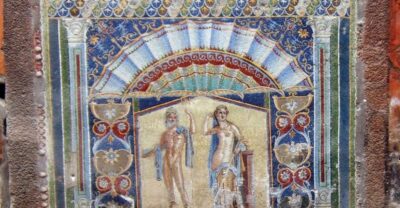
Browse the lists this tour appears in