Reviewed · HALF-DAY
Private Half-Day Tour of The Pompeii Ruins Highlights and Mann
The clever part of this tour is the pairing of Pompeii’s streets and buildings with the Naples museum’s frescoes and objects. At the ruins, guides such as Lello, Italo, and Giovanna focus on the people behind the stones. In Naples, you see the art removed from those buried houses.
I like the private format, which lets your guide adjust the pace for your group, including families with teenagers. I also like the easy-to-follow route through the Stabian Baths, theater district, brothel, and Forum, with skip-the-line admission included.
The catch is practical: transportation between Pompeii and Naples is not included, and the advertised timing needs careful checking. The listed stops add up to about four hours, but the museum description refers to roughly two hours while the stop itself is listed as one hour.
In This Review
- Key points to know before booking
- Why a private guide changes Pompeii
- Starting at Pompeii Archaeological Park
- The Stabian Baths: public life in Pompeii
- Teatro Grande and Pompeii’s performance district
- The Lupanar, with the choice to skip it
- The Forum and the monuments around it
- From buried frescoes to the Naples museum
- The transfer problem is yours to solve
- Who will get the most from this tour
- What to know about cancellation
- FAQ
- Where does the tour start?
- Where does the tour end?
- Is transportation included?
- Are entrance tickets included?
- Is the Lupanar required?
- Can I cancel for a full refund?
- Should you book this Pompeii and Naples tour?
Key points to know before booking
- A private guide makes Pompeii easier to understand: The ruins are broad and scattered, so personal explanations matter far more than simply walking from building to building.
- The tour covers Pompeii and Naples: You see the ancient town first, then view many of its paintings and objects at the National Archaeological Museum.
- Lello is known for lively storytelling: Past guests describe his humor, archaeological training, and strong connection to Pompeii. Italo and Giovanna are also named as engaging guides.
- The Lupanar is optional: You can choose to see the famous small brothel or skip it if it is not right for your group.
- You must arrange the transfer yourself: The tour ends in Naples, but bus, train, taxi, and private-car costs are not part of the $310.24 per-person price.
- The format suits families and small groups: Only your party takes part, so a guide can include children and teenagers rather than following a fixed large-group script.
Why a private guide changes Pompeii
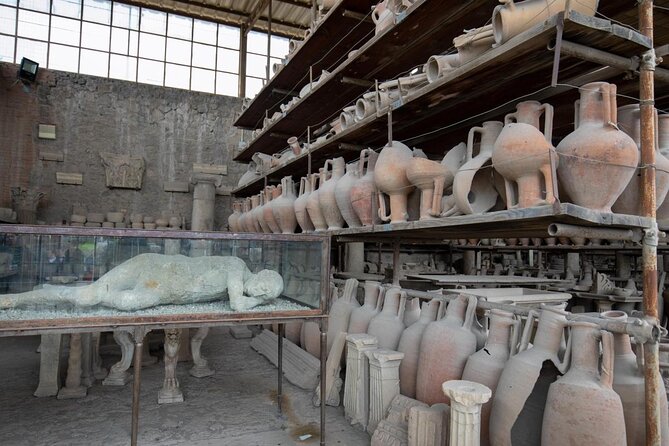
Pompeii can look simple at first: streets, walls, columns, and roofless rooms spread across a large archaeological park. The trouble is that many details are easy to miss. A private guide can explain what each space did, how the town worked, and why a plain-looking building matters.
That personal attention is especially useful if you are visiting with children or teenagers. One family arranged a private visit for a 12-year-old who had long wanted to see Pompeii. Lello kept her involved rather than speaking only to the adults, a small point that can make a big difference during a technical archaeological tour.
You should expect a guide who mixes facts with stories and humor. Lello is described as a professional archaeologist with a strong interest in Roman life. Italo is praised for building historical details in a clear order, while Giovanna is noted for positive energy and for keeping two teenagers involved.
The best part of a private tour is not simply having more space around you. It is the freedom to ask why something was built, how a room may have been used, or what you should look for next. Your guide can spend more time on subjects that interest your group and less time on parts that do not.
The tour is offered in English and includes a private native guide. Since only your group participates, you avoid the stop-and-start rhythm of a large party. That is valuable in Pompeii, where a few extra minutes in one house or public building can help the site make sense.
More Pompeii excavation visits:
- Pompeii: Entry Ticket and Guided Tour with an Archaeologist
★ 4.8 · 19,459 reviews - Pompeii: Entry Ticket with Optional Audio Guide
★ 4.2 · 12,360 reviews - Pompeii: Small Group Tour with an Archaeologist
★ 4.8 · 12,264 reviews
Starting at Pompeii Archaeological Park
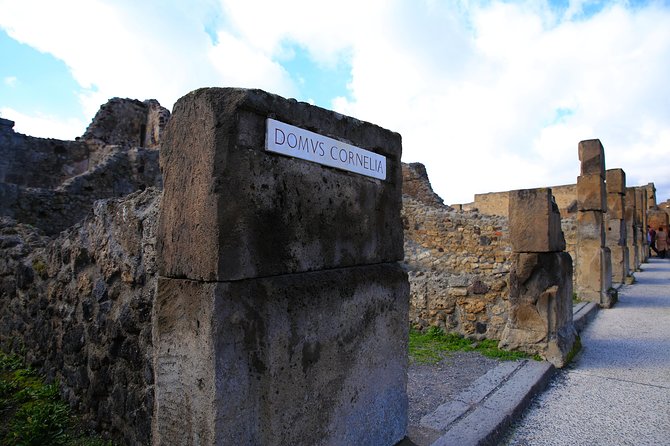
The meeting point is Coffee Shop Vittoria on Via Mare in Pompei, with a 9:00 a.m. start. Admission to the archaeological park is included, as are skip-the-line entrance tickets.
The first Pompeii portion is described as a highlights visit lasting about one hour, followed by more focused stops. In practice, the value comes from how the guide links these areas together. You are not just checking off isolated ruins. You are moving from public bathing to theater, private or commercial life, and finally the political center.
A morning start is useful because it gives you the rest of the day for Naples, but you should arrive ready for an active outdoor visit. The information provided does not promise hotel pickup, so you need to reach the meeting point yourself.
Pompeii is not a single monument with a neat entrance and exit. It is an ancient town, and the remains are spread across streets and blocks. That is why comfortable walking shoes, water, and protection from the sun are sensible choices, even though the tour listing does not specify a dress code or equipment list.
The Stabian Baths: public life in Pompeii
The Stabian Baths receive about 30 minutes. This is a useful stop because Roman bathing was not only about washing. It was part of daily social life, and the bath complex helps you see how public buildings served several purposes at once.
A guide can point out the organization of the baths and explain how the different areas fit together. Without that help, a visitor may see a series of rooms and struggle to understand their order or purpose.
Thirty minutes is enough for an overview, but it is not a long archaeological study. If baths are your main interest, tell your guide early. The private format gives you a better chance of getting extra explanation, though the overall half-day schedule still requires a brisk pace.
Teatro Grande and Pompeii’s performance district
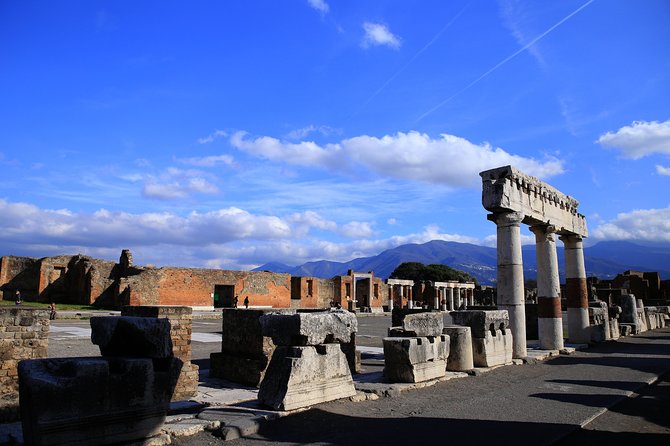
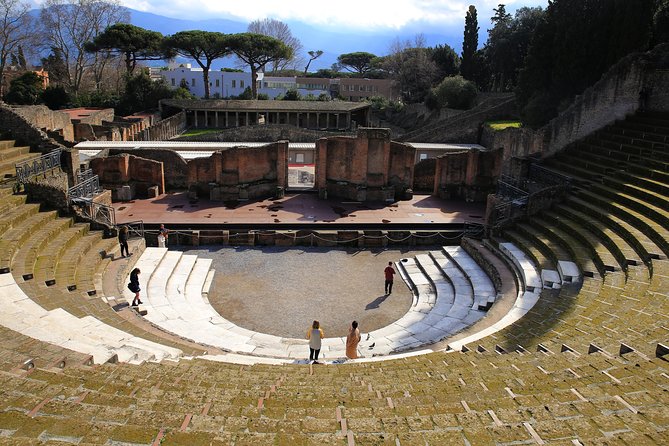
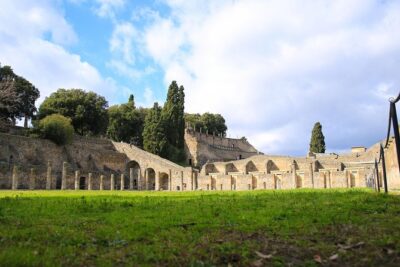
The Teatro Grande is another 30-minute stop. The theater area gives the tour a change of mood. Instead of looking only at homes and business spaces, you consider entertainment and public gatherings.
This is also where the guide’s storytelling can add real value. A theater is easier to picture when you understand who used it and how it fitted into the town’s public life. Italo’s reported style, building details in a natural sequence, should work well here.
The stop is short, so do not expect a full theater seminar. Think of it as a well-chosen introduction to one part of Pompeii’s civic life. A private guide can help you notice the shape and setting of the area before moving on.
More Pompeii Ruins tours worth comparing
- Pompeii Ruins Half-Day Tour from Sorrento with Guide
★ 4.0 · 714 reviews - From Sorrento: Pompeii Half-Day Skip-the-Line Tour
★ 4.6 · 541 reviews - Skip-the-Line Half-Day Private Tour Ancient Pompeii Highlights with Native Guide
★ 5.0 · 146 reviews - Half-Day Exclusive Private Tour of Pompeii and Herculaneum
★ 5.0 · 49 reviews
The Lupanar, with the choice to skip it
The Lupanar is scheduled for about 30 minutes, but you may skip it. This flexibility is important for families or anyone who would rather focus on other parts of Pompeii.
The site is famous for its small rooms and erotic wall paintings, and it can be an awkward stop for some groups. If you are visiting with young children, decide in advance whether you want to include it. You do not need to treat every famous Pompeii stop as compulsory.
If you do visit, a guide can provide context rather than leaving you to make assumptions from the paintings alone. The private setting also makes it easier to ask questions discreetly. Still, the option to leave it out is one of the more practical touches in this route.
The Forum and the monuments around it
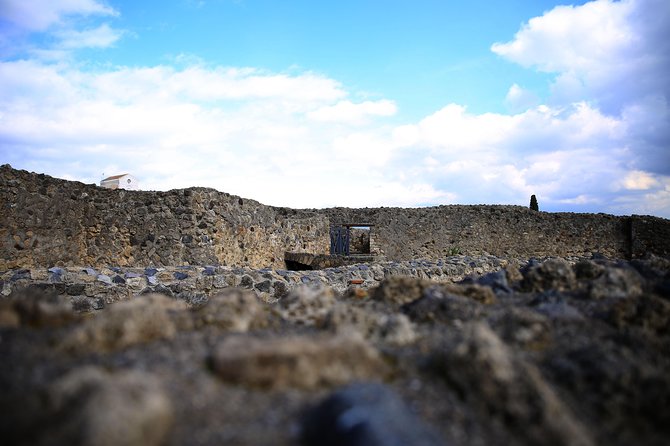
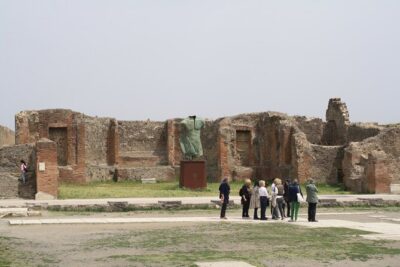
The Forum receives another 30 minutes. This is the natural place to pull the whole Pompeii visit together because it was the town’s central public space.
Here, you can connect religion, government, commerce, and civic display. The Forum is not merely a large open area. Its surrounding monuments show how Pompeii presented power and organized public life.
A half-hour gives you a focused look, not a slow examination of every nearby building. Your guide’s job is to identify the major monuments and explain their place in the town. If the group has already spent extra time at the baths or theater, the Forum may need to move at a quicker pace.
This is another reason to use the private format well. Tell your guide what your group has already seen elsewhere in Italy and what you most want to understand. You will get more from the Forum if the explanation connects with your interests.
From buried frescoes to the Naples museum
The second major part of the experience is the National Archaeological Museum of Naples, located at Piazza Museo 19. The tour ends there, and museum admission is included.
The museum matters because it holds many of the frescoes, mosaics, sculptures, and other objects found in Pompeii and nearby Roman sites. At the ruins, you see walls and rooms in their original setting. At the museum, you can study the artwork at closer range.
The supplied schedule says about one hour at the museum, while the tour description also refers to spending about two hours there for a close look at Pompeian frescoes. That difference is significant. Confirm the exact museum duration when booking, especially if the paintings are your main reason for choosing this experience.
The museum portion can feel more demanding than the outdoor ruins. Pompeii gives you streets and architecture. Naples gives you objects and images that require time to examine. A guide can explain how the frescoes relate to the homes where they were found, which helps prevent the museum from becoming a parade of disconnected works.
The tour ends in Naples rather than returning to Pompeii. That makes the route useful if you are continuing your day in the city, but it also means you need a clear plan after the final explanation. Hotel drop-off is not included.
The transfer problem is yours to solve
The price is listed at $310.24 per person. Because this is a private experience, the value depends heavily on your group size and your interest in guided archaeology. For a couple, it is a serious expense. For a family or small group, the cost may make more sense because you are buying a dedicated guide rather than several separate places in a large tour.
The price includes admission to Pompeii and the Naples museum, plus skip-the-line entry and a private guide. It does not include transport from Pompeii to Naples, hotel pickup or drop-off, bus fares, train fares, taxi costs, or lunch.
That missing transfer is not a minor footnote. The tour starts in Pompei and ends at the museum in Naples, so you need to budget both the time and cost of getting between the two places. The provider does not supply that transportation as part of this booking.
One past party used a private car and driver for a larger journey involving Rome, Pompeii, and Sorrento, but that was an additional arrangement, not part of this experience. Do not assume a driver is waiting for you unless you have separately confirmed and paid for one.
The ending point can be convenient if you are staying in Naples or want to continue sightseeing there. It is less convenient if your hotel is back in Pompeii, Sorrento, or elsewhere along the coast. Before booking, map the route from the museum to your next stop.
Who will get the most from this tour
I would choose this experience for a family, a couple with a strong interest in Roman archaeology, or a small group that wants to ask questions freely. It also suits anyone who has visited Pompeii before but wants a better explanation of what they saw.
The named guides bring different strengths. Lello is associated with archaeology, humor, and a personal enthusiasm for Roman design. Italo is praised for clear structure and storytelling. Giovanna is described as warm and engaging with teenagers. You cannot necessarily request a particular guide from the supplied information, so ask the provider if that matters to you.
The tour is also a good fit if you want both the site and the art. Many people visit Pompeii without making time for the museum, then see the frescoes only in photographs. This route links the two, although you must verify how much time is actually allocated to Naples.
I would hesitate if you want a slow, full-day archaeological study. The listed schedule is tight, and the park contains far more than these highlights. I would also hesitate if you need included transport or a hotel-to-hotel service. Those costs and arrangements are your responsibility.
Confirmation is provided at booking, and the activity is near public transportation. Most people can participate, according to the supplied information, but no further accessibility details are given. Ask directly if your group has specific mobility needs.
What to know about cancellation
You can cancel for a full refund up to 24 hours before the 9:00 a.m. start time. Changes or cancellations made less than 24 hours before the experience are not accepted for a refund, and the cut-off uses local time.
That policy gives you some flexibility, but Pompeii plans often involve trains, hotels, and other paid arrangements. Check your wider schedule before committing, particularly because transportation to the meeting point and from Pompeii to Naples is not included.
FAQ
Where does the tour start?
The meeting point is Coffee Shop Vittoria on Via Mare, 80045 Pompei, Italy. The stated start time is 9:00 a.m.
Where does the tour end?
The tour ends at the Museo Archeologico Nazionale di Napoli, Piazza Museo 19, Naples.
Is transportation included?
No. Hotel pickup and drop-off, transportation from Pompeii to the museum, and bus, train, or taxi fees are not included.
Are entrance tickets included?
Yes. Skip-the-line admission tickets for Pompeii and the National Archaeological Museum of Naples are included.
Is the Lupanar required?
No. The Lupanar is included as an optional stop, so you can choose to skip it.
Can I cancel for a full refund?
Yes, if you cancel at least 24 hours before the experience start time. Cancellations or changes made less than 24 hours before the start are not refunded or accepted.
Should you book this Pompeii and Naples tour?
Book it if you want a private guide who can turn Pompeii’s broken walls into a readable town, and if seeing the original frescoes in Naples matters to you. The strongest points are the private attention, the lively guides, and the useful pairing of archaeological site with museum collection.
Before paying $310.24 per person, confirm two things: the exact museum time and your own transfer from Pompeii to Naples. If your group values personal explanation and can handle the extra transport planning, this is a strong, focused introduction to Pompeii. If you want included travel, a slower visit, or the lowest possible cost, choose a different arrangement.
Newest reviews from Pompeii Ruins
- Private Tour Pompeii and Winery★ 5.0 · 4 reviews
- Visit the Pompeii ruins from Salerno with Pizza Lunch★ 5.0 · 4 reviews
- Pompeii Private Tour for Kids and Their Families★ 4.8 · 4 reviews
- From Sorrento: Pompeii & Vesuvius tour small group★ 4.8 · 4 reviews
- Pompeii Sorrento and Positano Tour★ 5.0 · 4 reviews
- From Naples_ Pompeii Tour_Skip the line ticket + audioguide★ 4.3 · 4 reviews
- Pompeii Private Half-Day Tour from: Naples,Sorrento, Amalfi Coast★ 5.0 · 4 reviews
- Pompeii, skip-the-line ticket with smartphone audio guide on App★ 3.0 · 4 reviews
Half-Day, compared.
Pompeii Ruins Half-Day Tour from Sorrento with Guide
Read our review →

Skip-the-Line Half-Day Private Tour Ancient Pompeii Highlights with Native Guide
Read our review →
Half-Day Small Group Trip to Capri & Blue Grotto from Sorrento
Read our review →